DVSA Show Me Tell Me Questions: A Calm Checklist for Your Driving Test
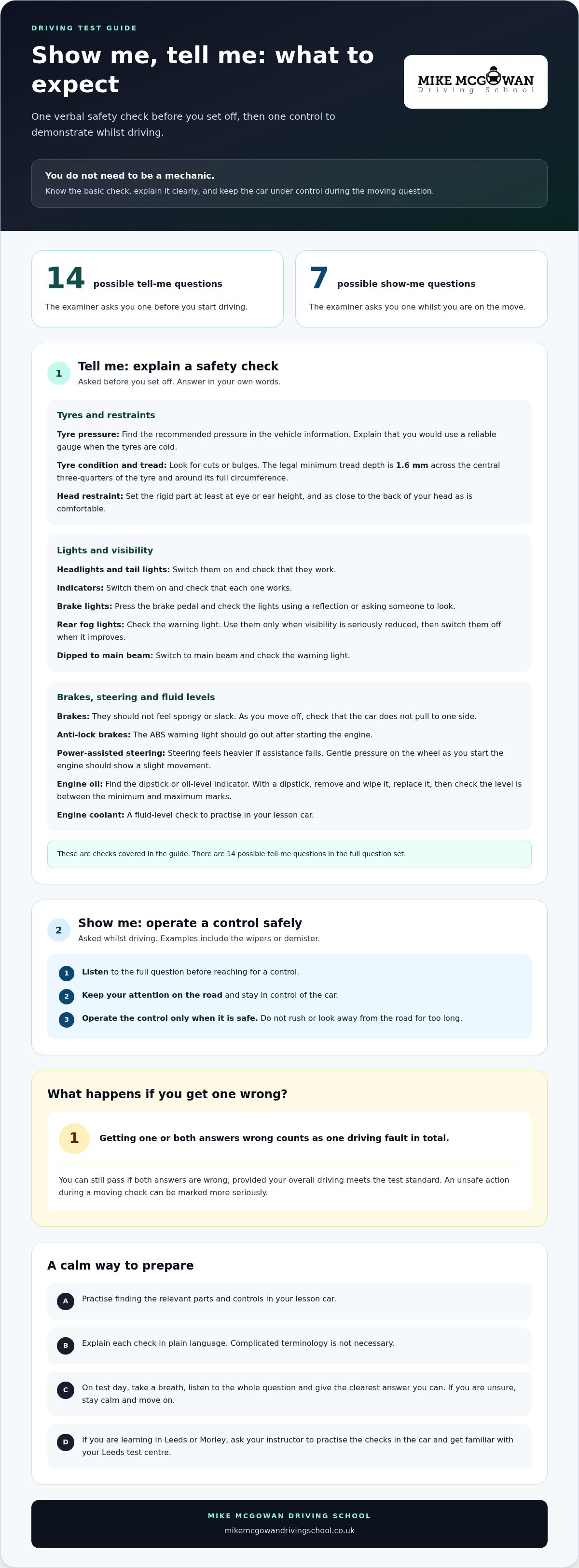
What if the vehicle safety questions aren’t a test of your mechanical knowledge? The show me tell questions check that you know a few basic safety checks. There are 14 possible “tell me” questions and seven possible “show me” questions. Your examiner asks one while you’re stationary, then one while you’re driving.
It’s understandable to worry about forgetting a technical answer, especially if you’re already nervous about the test. Getting an answer wrong counts as one driving fault, not an automatic fail. For the moving question, the priority is to carry out the check safely and stay in control of the car.
This guide lists the questions and answers, with straightforward explanations of what to do and where to find the relevant parts. You’ll also learn what to expect on test day and how to avoid letting a small mistake unsettle you. If you’re learning in Leeds or Morley, Mike McGowan’s calm, practical explanations can help make these checks feel familiar before you meet the examiner.
Key Takeaways
- Use the show me tell questions checklist to revise basic safety checks, including tyres, lights and fluid levels.
- Know the difference between the verbal check before driving and the control you’ll operate during the drive.
- Practise finding the relevant controls and parts in your lesson car, so your answers feel familiar rather than technical.
- Keep your attention on the road during a moving check and only operate a control when it’s safe.
- Get familiar with your Leeds test centre and ask your instructor to practise the checks in the car.
What Are the Show Me Tell Me Questions?
The show me tell questions are short vehicle safety checks in your practical driving test. They check that you know how to carry out basic checks, such as looking after tyres, lights and fluid levels. You don’t need to be a mechanic. You need to understand what to check and explain or demonstrate it clearly.
The examiner asks one “tell me” question before you start driving and one “show me” question whilst you’re on the move. There are 14 possible tell me questions and seven possible show me questions. These questions are a small part of the wider UK driving test procedure.
The DVSA’s video shows how the tell me questions are asked:
The Difference Between Show and Tell
A “tell me” question asks you to explain how you’d carry out a safety check. For example, the examiner could ask how you’d check that the brakes are working before setting off. Answer in your own words. Some questions involve opening the bonnet to point out a part.
A “show me” question comes later, whilst you’re driving. The examiner asks you to operate a control, such as the windscreen wipers or demister. Keep your attention on the road, stay in control and only operate it when it’s safe. The questions happen at different stages, so you don’t have to explain and demonstrate at the same time.
Scoring and Test Day Impact
Getting one or both answers wrong counts as one driving fault in total. You can still pass if you get both questions wrong, provided your overall driving meets the test standard. However, an unsafe action during a moving question can be marked more seriously. Don’t rush to find a control or take your eyes off the road for too long.
The first question can feel like a test before the test has properly begun. Treat it as a steady start, not a verdict on how the drive will go. Take a breath, listen to the full question and give the clearest answer you can. If you’re unsure, stay calm and move on. Practising the checks in the car with a patient instructor can make them feel more familiar before test day.
The 14 Tell Me Questions: Before You Start Driving
The examiner asks one “tell me” question before you set off. There are 14 possible questions, but you’ll only be asked one on test day. Group them by the type of check to make revision easier. The official DVSA ‘show me, tell me’ questions provide the full list and wording.
Here’s a checklist of all 14. Practise explaining each check in plain language. Complicated terminology isn’t necessary.
Inside the car and around the vehicle
- Brakes: Explain that they shouldn’t feel spongy or slack. As you move off, check that the car doesn’t pull to one side.
- Tyre pressures: Find the recommended pressures in the vehicle information. Explain that you’d check them with a reliable pressure gauge when the tyres are cold.
- Head restraint: Adjust the rigid part to at least eye or ear height, and as close to the back of your head as is comfortable.
- Tyre condition and tread: Check for cuts or bulges. The legal minimum tread depth for a car tyre is 1.6mm across the central three-quarters of its breadth and around its entire circumference.
- Headlights and tail lights: Switch them on and check that they work.
- Anti-lock brakes: Explain that the ABS warning light should go out after starting the engine.
- Indicators: Switch them on and check that each one works.
- Brake lights: Press the brake pedal and check the lights, using a reflection or asking someone to look.
- Power-assisted steering: Explain that the steering feels heavier if assistance fails. Apply gentle pressure to the steering wheel as you start the engine. A slight movement shows the assistance is working.
- Rear fog lights: Switch them on and check the warning light. Explain that you use them only when visibility is seriously reduced and switch them off when it improves.
- Dipped to main beam: Use the control to switch to main beam. The main beam warning light shows that it’s on.
Under the bonnet
- Engine oil: Identify the dipstick or oil-level indicator. For a dipstick, remove and wipe it, put it back, then check that the level is between the minimum and maximum marks.
- Engine coolant: Identify the coolant reservoir and explain that the level should be between its minimum and maximum marks. Check it when the engine is cold.
- Windscreen washer fluid: Identify the washer reservoir and explain that you’d check its level and top it up with screenwash as needed.
That’s 14 questions in total: 11 checks inside or around the car, and three under the bonnet. Mike McGowan can help you practise them in the car during test preparation in Leeds and Morley.
The 7 Show Me Questions: Whilst You Are on the Move
The examiner asks one “show me” question during the drive, when it’s safe to do so. You’ll need to operate a control whilst keeping the car steady and your attention on the road. The examiner won’t expect you to rush. If you’re unsure where a control is, take a moment to find it when it’s safe rather than looking away for too long.
The seven possible tasks cover familiar controls. The official DVSA Show Me, Tell Me questions list the current wording. Know where the controls are before the test, then operate them calmly.
Operating Secondary Controls Safely
- Front windscreen wash and wipe: Use the washer and wiper control to clean the front screen. Keep looking ahead as you operate it.
- Rear windscreen wash and wipe: Find the rear washer and wiper setting, then use it to clean the back screen.
- Dipped headlights: Switch on the dipped headlights using the light control. Avoid taking your eyes off the road to search for it.
- Horn: Give it a brief press only when it’s safe and appropriate. Keep your hands ready to steer and maintain your course.
These controls are usually close to the steering wheel or on a stalk, but their position differs between cars. Get familiar with the car you’ll use for the test. You don’t need to memorise a complicated sequence. Practise finding each control while staying aware of what’s happening around you.
Demisting and Window Controls
- Rear windscreen demister: Switch on the rear demister using its control, and check the indicator if there is one.
- Front windscreen demister: Select the setting that directs air to the front windscreen. Keep your course steady as you adjust it.
- Side window: Open and close the window using its control, whilst continuing to watch the road.
There’s no need to complete the task as quickly as possible. Listen to the full instruction, choose a safe moment and make one smooth adjustment. If traffic or the road needs your attention, prioritise safe driving and follow the examiner’s direction.
Mike McGowan helps learners practise these controls during lessons in Leeds, so they feel less unfamiliar on test day. You can also ask about test preparation that includes practising vehicle safety questions.
Calm Strategies for Nervous Learners
The show me tell questions can sound harder than they are, especially if words such as “reservoir” or “tread depth” feel unfamiliar. Uncertainty often causes nerves: you don’t know which question is coming or what the examiner expects. Practising the checks in the car turns unfamiliar terms into things you can see and explain in everyday language.
If opening the bonnet feels intimidating, ask your instructor to show you where the main parts are during a lesson. Get familiar with the engine bay, including the oil dipstick, coolant reservoir, brake fluid reservoir and washer fluid cap. You’re learning to identify the parts and describe a basic check, not to repair the car.
Managing Test Day Nerves
A wrong answer to one or both safety questions counts as one driving fault, not an automatic fail. Keep that in perspective. Before answering the “tell me” question, pause for a breath and listen to the whole question. You can take a moment to gather your thoughts.
For the “show me” question, driving safely comes first. Keep your attention on the road and control of the car. If you need a moment to find a control, don’t rush or stare down at the dashboard. Wait until it’s safe to operate it.
Practical Memory Aids
For tyre checks, remember Pressure, Condition, Tread. This prompt can help you recall three useful areas without learning a long technical answer:
- Pressure: Know where to find the recommended tyre pressures and explain how you’d check them.
- Condition: Look for damage such as cuts or bulges.
- Tread: Remember the legal minimum is 1.6mm across the central three-quarters of the tyre and around its full circumference.
Ask your instructor to run through the questions with you in the car. Practise answering aloud as well as locating the controls. Mike McGowan provides calm, one-to-one tuition for nervous learners in Leeds and Morley, including test preparation. A mock run-through gives you a chance to practise the questions in test order and get comfortable with the bonnet checks.
Preparing for Success at Leeds Test Centres
Local practice can make test day feel more familiar, but the show me tell questions are the same wherever you take your car test. Leeds learners use several centres, including the main Leeds centre at Hillcrest House on Harehills Lane and the Horsforth centre. The examiner will give you instructions on the day, including where to stop for any vehicle checks.
Bonnet checks happen while the car is stationary. You don’t need to memorise a particular car park layout. Focus on knowing how to open the bonnet safely, locate the relevant parts in your lesson car and explain the check in simple terms. Follow the examiner’s instructions if you’re asked to move or position the car.
Horsforth and Harehills Specifics
Test conditions and routes vary, so there isn’t one fixed starting routine to memorise for Horsforth or Harehills. At the start, listen carefully to the examiner and take each instruction one step at a time. If the area around the Leeds centre feels busy, give yourself a moment to settle before answering. The tell me question is asked whilst you’re stationary, before the drive begins.
Practising locally helps you get used to the roads and the feel of the test car, rather than trying to predict the exact route. Mike McGowan has local knowledge of Leeds test centres and uses local routes in test preparation. You can find out more about Leeds driving lessons.
Next Steps for Your Licence
A one-to-one lesson gives you room to ask questions, practise finding the controls and repeat any checks that aren’t clear yet. Mike provides calm tuition in Leeds and Morley and specialises in nervous learners. You can ask about test preparation that includes a run-through of the vehicle safety questions, alongside other areas you want to feel more settled with.
Before your test, try a simple practice routine: answer a tell me question aloud, point to the relevant part if needed, then practise a show me control while keeping your attention on the road. If you’re unsure about a term or part under the bonnet, ask your instructor to explain it in the car. Familiarity comes from seeing and practising the checks, not from putting extra pressure on yourself.
Take These Checks into Your Test with Confidence
The show me tell questions are a short check of your vehicle safety knowledge, not a test of whether you’re a mechanic. You now know when each question is asked, what the examiner is looking for and how to keep the moving check safe. A wrong answer counts as one driving fault, not an automatic fail.
Practise the checks in your lesson car until you can explain them in plain language and find the controls without rushing. If you’re taking your test in Leeds, getting familiar with the car and local roads can help the start of the test feel less unknown.
Mike McGowan is a DVSA-approved instructor who specialises in nervous learners. His calm, patient coaching and one-to-one test preparation can help you practise at a steady pace in Leeds and Morley.
You don’t need perfect nerves to do well. Take the questions one at a time, then give your attention to the drive ahead.
Frequently Asked Questions
Can I fail my driving test on the show me tell me questions?
No, getting one or both answers wrong does not automatically fail your test. The DVSA counts incorrect answers as one driving fault in total. You can still pass if your overall driving meets the required standard. For a “show me” task, don’t let finding a control distract you from driving safely. An unsafe action whilst operating it can be marked more seriously, so keep control of the car first.
What happens if I cannot find the control for a show me question?
Don’t search frantically or take your eyes off the road for too long. Keep the car under control and look for a safe moment to locate the control. If you’re unsure, stay calm and listen to the examiner’s instruction. Practising in your lesson car beforehand helps you learn where the wipers, demisters, lights and window controls are, so you’re less likely to be caught out on test day.
Do I need to open the bonnet for every tell me question?
No, only some tell me questions ask you to open the bonnet and identify a part. Others ask you to explain a check without pointing anything out, such as how you’d check the brakes before setting off. Practise locating the oil dipstick, coolant reservoir, brake fluid reservoir and washer reservoir, but don’t assume every question involves them. The examiner will tell you what they want you to explain or show.
How many questions will the examiner ask me in total?
You’ll be asked two questions in total: one “tell me” question before you start driving and one “show me” question during the drive, when it’s safe. The examiner chooses from 14 possible tell me questions and seven possible show me questions. You don’t need to answer all 21 on test day. Revising the full list helps you feel prepared whichever questions you’re given.
What if I do not know the answer to the tell me question?
Take a breath and give the clearest answer you can. If you’re unsure, don’t let one question unsettle you before the drive has started. An incorrect answer counts as one driving fault, not an automatic fail. Practise putting the checks into your own words rather than trying to memorise a complicated script. In lessons around Leeds, you can ask your instructor to explain any unfamiliar car parts.
Are the show me tell me questions the same for automatic and manual cars?
Yes, the vehicle safety questions are part of the car practical test for both automatic and manual learners. The examiner asks one tell me question before driving and one show me question during the drive. The controls can be positioned differently from one car to another, so get familiar with the car you’ll use for your test. Practise finding its wipers, lights, demisters and other relevant controls safely.
When during the test will the show me question be asked?
The examiner asks the show me question whilst you’re driving, at a point when it’s safe to carry out the task. You won’t be asked to operate a control before setting off as part of this question. Keep your attention on the road and maintain control as you use the requested control. If you need a moment, don’t rush. Safety matters more than finding it quickly.
Is the tread depth question the same for all vehicles?
The 1.6mm minimum applies to car tyres: the tread must cover the central three-quarters of the tyre’s breadth and its full outer circumference. This answer is for the car driving test. Don’t assume the same figure applies to every type of vehicle, as requirements can differ by vehicle category. For your test revision, learn the car answer and check the official DVSA question list if you need the exact wording.
Disclaimer
This article is intended as general guidance for learner drivers and does not replace official DVSA advice or a lesson with a qualified instructor. Rules, test requirements, and local test centre procedures can change, so always check GOV.UK or speak to your instructor for the most current information. Mike McGowan Driving School accepts no responsibility for outcomes based solely on the content of this article.
