Contact Us
07344 035280
Follow Us:
Driving Tips & Support
Manual Car Lessons: Busting the Myths About Learning with Gears
What if the very thing making you nervous about driving is actually what will give you the most confidence on the road? Many learners across Leeds and Morley feel a genuine sense of dread at the thought of coordinating a clutch and gear stick, especially when imagining a stall in the middle of busy city centre traffic. You aren't alone if you've spent time worrying about fumbling with gears while other drivers wait behind you. You want to feel in control, yet the pressure to pass quickly can make the entire process feel overwhelming.
Choosing manual car lessons doesn't mean signing up for a stressful or high-pressure experience. You'll soon discover that mastering a manual gearbox is much simpler than the common myths suggest, provided you have a patient mentor who prioritises your peace of mind. This guide explains why stalling is a perfectly normal part of learning and how steady, one-to-one coaching helps you navigate everything from steep hills to complex West Yorkshire roundabouts with quiet capability. We will show you how to turn that initial anxiety into a sense of steady progress and genuine independence.
Key Takeaways
- Understand why stalling is a normal part of the learning process rather than a sign of failure. It is simply the engine asking for a little more help.
- Discover how manual car lessons provide better vehicle control, which is especially useful when navigating the steep hills and busy roundabouts in Morley and Leeds.
- Learn practical techniques to find gears by touch and sound, allowing you to keep your eyes on the road and your focus on safety.
- Identify the benefits of one-to-one tuition, where a patient instructor creates a calm environment tailored to your specific pace and confidence levels.
- See why local knowledge of Leeds test centres like Horsforth or Harehills can make your practical test feel much more familiar and manageable.
Why Manual Car Lessons Aren’t as Scary as You’ve Heard
Many people think manual car lessons require a deep understanding of mechanics or a natural gift for multitasking. This is a common misconception. In reality, moving a car through its gears is a skill of timing and rhythm rather than complex mathematics. You don't need to be "mechanically minded" to understand when the engine needs a change. You just need to listen to the car. Within a few hours of practice, your hand will move to the gear stick without you even thinking about it.
To better understand this concept, watch this helpful video:
The Reality of the Third Pedal
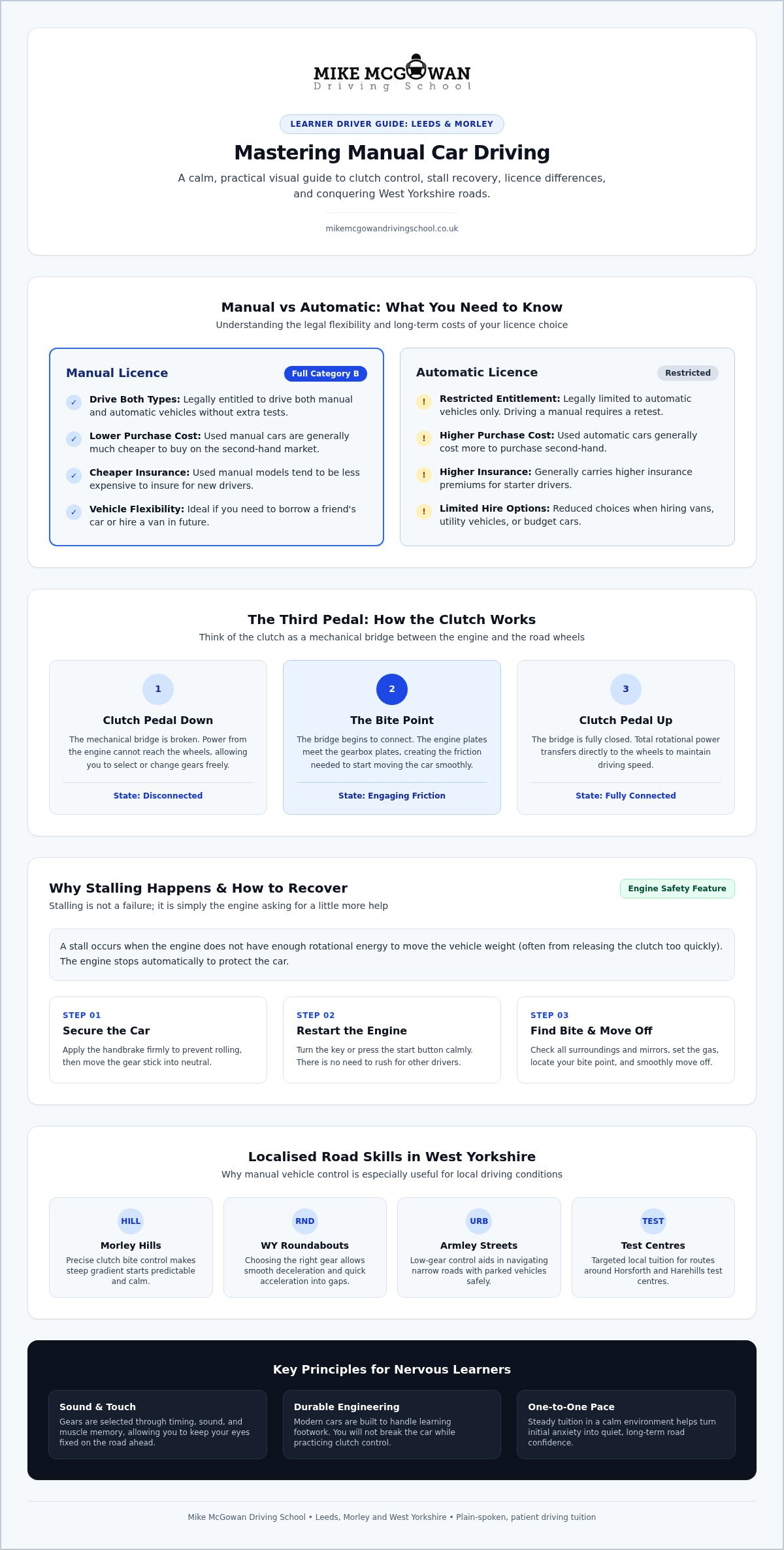
The clutch is often the biggest source of anxiety for new learners. It helps to think of it simply as a bridge between the engine and the wheels. When you press it down, you are temporarily breaking that bridge so you can change gears. Understanding how manual transmissions work doesn't require an engineering degree; it is just about learning the "bite point" where the engine and wheels begin to connect.
We break this physical movement down into tiny, manageable steps so you never feel rushed. You won't break the car by moving the gear stick, even if it feels a bit clunky at first. Modern cars are built to be durable. Your instructor is there to guide your footwork until the coordination becomes a natural habit, much like walking or riding a bike. Most learners find that the "mystery" of the clutch disappears after just one or two quiet sessions on a flat road.
Manual vs Automatic: The Long-Term Benefits
While automatic cars are becoming more common, a manual licence remains the gold standard for flexibility in the UK. Passing your test in a manual car grants you a full Category B licence. This entitles you to drive both manual and automatic vehicles, giving you total freedom over what you drive in the future. If you pass in an automatic, you are legally restricted to those vehicles only, which can be limiting if you ever need to borrow a car or hire a van.
Choosing manual car lessons often makes sense for your bank balance too. For young drivers in Leeds and Morley, budget is a major factor. Used manual cars are generally much cheaper to buy than their automatic counterparts. They also tend to be less expensive to insure, which is a significant saving when you are just starting out. You get more car for your money and more options on the second-hand market.
If you are just beginning your journey, our Beginner Driving Lessons Leeds guide explains how we create a pressure-free environment to help you reach this goal. We focus on building your confidence steadily, ensuring you feel in control of the car before we move on to busier roads like the Leeds Ring Road or the narrow streets of Armley.
Stalling Your Manual Car: Why It Is Actually a Part of Learning
Every single driver on the road has stalled a car. It doesn't matter if they have been driving for forty years or forty minutes. Stalling is not a sign that you are a "bad" driver. It is simply a part of the mechanical learning process. When you take manual car lessons, your instructor expects you to stall. We don't see it as a failure. We see it as the engine giving us feedback and telling us what it needs.
A stall happens when the engine doesn't have enough rotational energy to move the weight of the vehicle. It is basically the engine saying it needs a bit more help from you. If you release the clutch too quickly, the engine "bogs down" and stops. It is a safety feature designed to protect the car, not a breakdown. A calm instructor will simply wait for you to reset, whereas a shouting instructor only adds to the tension. We believe in keeping the atmosphere quiet so you can think clearly and recover without feeling rushed.
If the engine cuts out, don't worry about the cars behind you. Follow this simple three-step recovery plan:
- Secure the car with the handbrake and select neutral.
- Restart the engine.
- Check your surroundings, find your bite point, and move off when it is safe.
The "Bite Point" Mystery Solved
The bite point is that moment where the engine and the wheels start to "shake hands." You will feel a slight vibration through the car or see the front of the bonnet dip slightly. This is the car telling you it is ready to move. Rushing the clutch is the most common cause of stalling. We teach you to hold the pedal at that vibration point for a second until the car gains momentum. Understanding the pros and cons of manual versus automatic cars often comes down to how much you value this direct physical connection with the vehicle.
Dealing with Nerves in Traffic
The biggest fear for many is stalling at a busy junction in Leeds city centre. You might worry about a queue of traffic behind you or the pressure of the lights changing. If you stall, the other drivers can wait a few seconds. Your safety and your calm recovery are the only priorities. If you have struggled with anxiety in the car before, finding a Driving Instructor for Nervous Learners can make a massive difference to your progress. You can speak with us about your concerns before your first lesson to ensure you feel supported from day one.
Manual vs Automatic: Choosing the Right Path for Your Confidence
Deciding between manual and automatic is a personal choice based on how you want to feel behind the wheel. Manual car lessons have a steeper learning curve during the first few weeks because you are learning to balance the clutch and gears. However, once that coordination becomes muscle memory, the learning curve levels out. You'll find that your focus shifts entirely to the road ahead, just like it would in an automatic vehicle. Many people find that the initial effort is worth the long-term sense of achievement.
Many drivers in West Yorkshire prefer manual cars for the level of control they provide. If you are driving down a steep hill in Morley or tackling a snowy morning in Headingley, being able to select a specific gear helps you manage your speed and grip more effectively. If you ever feel that manual is simply not for you, switching to automatic is always an option. We want you to feel comfortable, not trapped. Remember that an automatic licence does not allow you to drive a manual car, whereas a manual licence gives you the freedom to drive both.
Is Manual Harder for Nervous Drivers?
It is true that gears add an extra layer of thought when you first start. For a nervous learner, this can feel like one thing too many to manage. Patient coaching removes the panic by slowing everything down. We don't move on to busy junctions until you can change gears without looking at your hand. Interestingly, some of our learners find that having something to do with their hands and feet actually helps them stay focused. It provides a physical rhythm that can be quite grounding during a lesson.
Cost and Time Comparisons
On average, mastering a manual car might take a few more hours of professional tuition compared to an automatic. DVSA data shows the average learner needs around 45 hours of lessons to be test-ready. While manual takes a bit more time to get right at the start, manual instructors are often more readily available across Leeds and West Yorkshire. Manual lessons also tend to be slightly more affordable per hour than automatic ones. You can find more specific local details on our Manual Driving Lessons Leeds page.
Practical Steps to Mastering Gear Changes Without the Nerves
Mastering the gear stick is often less about strength and more about gentle guidance. Many learners during manual car lessons feel they need to grip the stick tightly, but this actually makes it harder to find the right slot. We teach the "Palm Away" technique, where you use the flat of your palm to nudge the stick. This allows the internal springs to do the work for you, naturally guiding the stick back to the central neutral position so you never get lost between gears.
You will also learn to listen to the engine's voice. When the engine sound changes from a quiet hum to a more audible drone, it is telling you it needs a higher gear. Before you even touch the clutch, we practice "setting the gas." This means giving the accelerator a tiny, steady press to prepare the engine for a smooth transition. It is a small habit that makes a massive difference to how the car behaves.
Your choice of footwear makes a huge difference in how you feel the pedals. We recommend wearing your favourite flat-soled shoes rather than thick boots or heavy trainers. A thinner sole allows you to feel the subtle vibrations of the bite point through your foot. This physical connection builds your confidence much faster because you aren't guessing where the pedal is.
Moving from First to Second Gear
The transition from first to second gear is often the first real change you will master. It can feel jerky if you rush the clutch or pull the stick too hard. We teach a tiny, half-second pause in the middle of the movement to let the car settle. This simple technique prevents the car from lurching forward and keeps the ride smooth, helping you feel in total control of the vehicle's momentum.
Downshifting for Junctions
Approaching a busy roundabout in Leeds, such as those on the A6120 ring road, requires a calm strategy. We use the "brakes to slow, gears to go" philosophy. You use your footbrake to bring the speed down to a manageable level first, then select the gear you need to navigate the junction. This approach stops you from feeling rushed as you approach the line.
By separating braking from shifting, you have more time to look for gaps in traffic whilst keeping the car stable. It removes the panic of trying to do everything at once. Mastering this sequence is a core part of our manual car lessons, ensuring you can handle complex West Yorkshire junctions with a sense of quiet capability.
Finding a Patient Manual Driving Instructor in Leeds
Choosing the right person to sit beside you is the most important decision in your driving journey. Manual car lessons aren't just about the mechanics of the vehicle; they're about the relationship between you and your instructor. In a large national franchise, you are often just another booking in a busy diary. With a local, independent mentor, you get a consistent standard of care and a teacher who is truly invested in your emotional well-being.
Local knowledge is a vital tool for reducing your nerves. Knowing the specific quirks of the Horsforth test centre or the busy multi-lane roundabouts near Thornbury can be the difference between feeling prepared and feeling panicked. We guide you through the exact routes used by examiners in West Yorkshire so the surroundings feel familiar on the big day. When the roads feel familiar, your anxiety naturally begins to fade.
One-to-one tuition is a non-negotiable part of our approach. Some larger schools have the next pupil sit in the back of the car during the final ten minutes of your session to save time on changeovers. We believe this adds unnecessary pressure and invades your private learning space. We ensure the car remains a calm, private environment where you can ask questions and make mistakes without an audience.
Look for an instructor who listens more than they talk. During your first session, you should feel respected and heard rather than lectured. If an instructor is impatient or raises their voice when you stall, they aren't the right partner for a nervous learner. A good mentor remains unfazed by mistakes, offering steady encouragement to help you try again.
Learning in Morley, Headingley, and Beyond
Driving in Morley involves mastering steep hill starts and narrow streets lined with parked cars. Headingley brings the challenge of heavy pedestrian traffic and complex bus lanes. We adapt every session to the roads you actually live on, ensuring your manual car lessons are practical for your daily life. Whether you are navigating the ring road in Horsforth or the vibrant suburban streets of Headingley, we build your confidence where it matters most.
Your First Step Toward a Manual Licence
Taking the first step is often the hardest part of the process. We invite you to book a trial lesson to see how our calm, pressure-free environment works for you. All you need for your first session is your provisional licence and a pair of comfortable, flat shoes. We will handle the rest at a pace that feels right for you. You don't have to commit to a long block of lessons until you are sure that we are the right fit for your journey toward independence.
Take the Next Step Toward Your Independence
Mastering a manual gearbox is about finding a rhythm that works for you. You now know that stalling is simply a conversation with the engine and not a reason to panic. By choosing manual car lessons, you are gaining a lifetime of flexibility and better vehicle control for the steep hills and wintry roads of West Yorkshire. It is a transformation from feeling overwhelmed to feeling quietly capable behind the wheel.
As a DVSA-approved instructor specialising in nervous learner support, I provide patient, one-to-one coaching tailored specifically to your pace. We focus on building your trust in the car and yourself without any shouting or pressure. You deserve a learning environment where you feel respected and safe during every mile of your journey.
You have the potential to be a great driver. I look forward to helping you find your confidence and helping you secure that full licence with ease. Your future on the road is much closer than you think.
Frequently Asked Questions
How many manual car lessons will I need before I can take my test?
The average learner requires roughly 45 hours of professional tuition combined with 22 hours of private practice to be test-ready. Every person is different; some may need more or fewer sessions depending on their confidence levels. We focus on your individual progress rather than a fixed number. This ensures you only book your test at centres like Horsforth or Harehills when you feel genuinely ready and safe.
Is it harder to pass a driving test in a manual car than an automatic?
National pass rates for manual tests sit between 48% and 50%, which is actually higher than the 42% to 44% seen for automatic tests. While gears add an extra layer of coordination, examiners look for safe observation and road positioning regardless of the gearbox. Mastering manual car lessons gives you a solid foundation in vehicle control that many learners find helps their overall awareness on complex Leeds roads.
What happens if I stall my car during the practical driving test?
Stalling is classified as a minor driver fault if you remain calm and recover safely. You should secure the vehicle with the handbrake, restart the engine, and perform all necessary observations before moving off again. It only becomes a serious fault if it causes immediate danger or happens in high-risk traffic without observation. Your examiner wants to see that you can handle small mistakes with composure and safety.
Can I switch from manual to automatic lessons if I find gears too difficult?
You can certainly switch to automatic lessons if you feel that gears are creating unnecessary stress. We offer both manual and automatic tuition in Leeds to ensure you find the path that best suits your learning style. Some people find that removing the clutch allows them to focus more on their surroundings. It is important that you feel comfortable and happy in the car, so we support whichever choice helps you progress.
Is a manual driving licence better than an automatic one in the UK?
A manual licence offers more flexibility because it entitles you to drive both manual and automatic vehicles. If you pass in an automatic, your licence is restricted to those cars only; you would need to retake your test to drive a manual. This flexibility is often useful for hiring vans, borrowing a friend's car, or buying a first vehicle, as manual cars are often less expensive to buy and insure.
Do I need to pass my theory test before starting manual car lessons?
You don't need to pass your theory test before you start your manual car lessons, but you must have a valid provisional licence. Starting your practical lessons whilst studying for your theory can actually help you understand road signs and hazard perception more clearly. You will, however, need to pass the theory test before you can book your practical driving test at any of the West Yorkshire test centres.
Why do I keep stalling when I try to move off from a stationary position?
Stalling usually happens because the clutch is released too quickly or there isn't enough "gas" to help the engine move the car's weight. It is often a sign that you are rushing to move off, perhaps because you feel pressure from traffic behind you. We practice finding the "bite point" in quiet areas of Morley or Headingley until the coordination becomes a natural habit, allowing you to move off smoothly every time.
How much do manual driving lessons in Leeds typically cost?
The cost of lessons in West Yorkshire varies depending on the school and whether you choose to pay hourly or book a block of sessions. Manual lessons are generally more affordable than automatic ones due to the lower purchase and maintenance costs of the vehicles. You can speak with us directly to get an honest, plain-spoken quote for your tuition. We don't believe in using fake urgency or hidden fees to pressure you into booking.
Disclaimer
This article is intended as general guidance for learner drivers and does not replace official DVSA advice or a lesson with a qualified instructor. Rules, test requirements, and local test centre procedures can change, so always check GOV.UK or speak to your instructor for the most current information. Mike McGowan Driving School accepts no responsibility for outcomes based solely on the content of this article.

Frequently Asked Questions
Q:
Do I need any experience before my first lesson?
No experience is needed at all. Whether it's your very first time in a car or you're starting over after a break, lessons are tailored to your level. You’ll be supported from the very first turn of the wheel.
Q:
What kind of car will I learn in?
You’ll learn in a modern Toyota Yaris Hybrid with automatic transmission. This car is smooth, quiet, and ideal for learners who want to focus on road awareness without worrying about gears.
Q:
I’m nervous about driving. Can you help?
Absolutely. Many learners feel nervous at first. Mike specialises in creating a relaxed, judgment-free environment where you can build confidence at your own pace.
Q:
How do I book a lesson?
You can call or message Mike directly to arrange your first session. There’s no app or complicated portal — just a simple, friendly conversation to get you started.
Get in touch with Mike
Questions about lessons? Not sure where to start? Ready to book a time that works for you?
You are welcome to reach out anytime. Whether you're a first-time learner, coming back after a break, or feeling unsure about the process, Mike is here to help.
Every enquiry is handled with care and zero pressure. You will speak directly with Mike, not a call centre or automated system.
Send a message or call today. Friendly support and honest answers are just one step away.
07344 035280
Lewisham Ct, Morley
- Monday - Friday, 8:00 am - 5:00 pm
Get In Touch
Follow Us
Follow Us
Mike McGowan Driving School
Calm, one-to-one driving lessons across Leeds in manual and automatic vehicles. Learn with a DVSA‑approved instructor who specialises in automatic lessons and helps nervous learners build real confidence, at a pace that works for you.
Incorporated 2011 • Based in West Yorkshire (Leeds / Morley)
Call Mike: 07344 035 280
Hours: Monday–Friday, 8:00am–5:00pm
Pick-up area: Leeds and surrounding areas (West Yorkshire)
Services
More
Contact Us
07344 035 280
Lewisham Ct, Morley
- Monday - Friday, 8:00 am - 5:00 pm
© Copyright 2026. Mike McGowan Driving School.. All rights reserved.
Need Meta Ads that drive real bookings and sales? Work with FoundUB4