Contact Us
07344 035280
Follow Us:

Driving Tips & Support
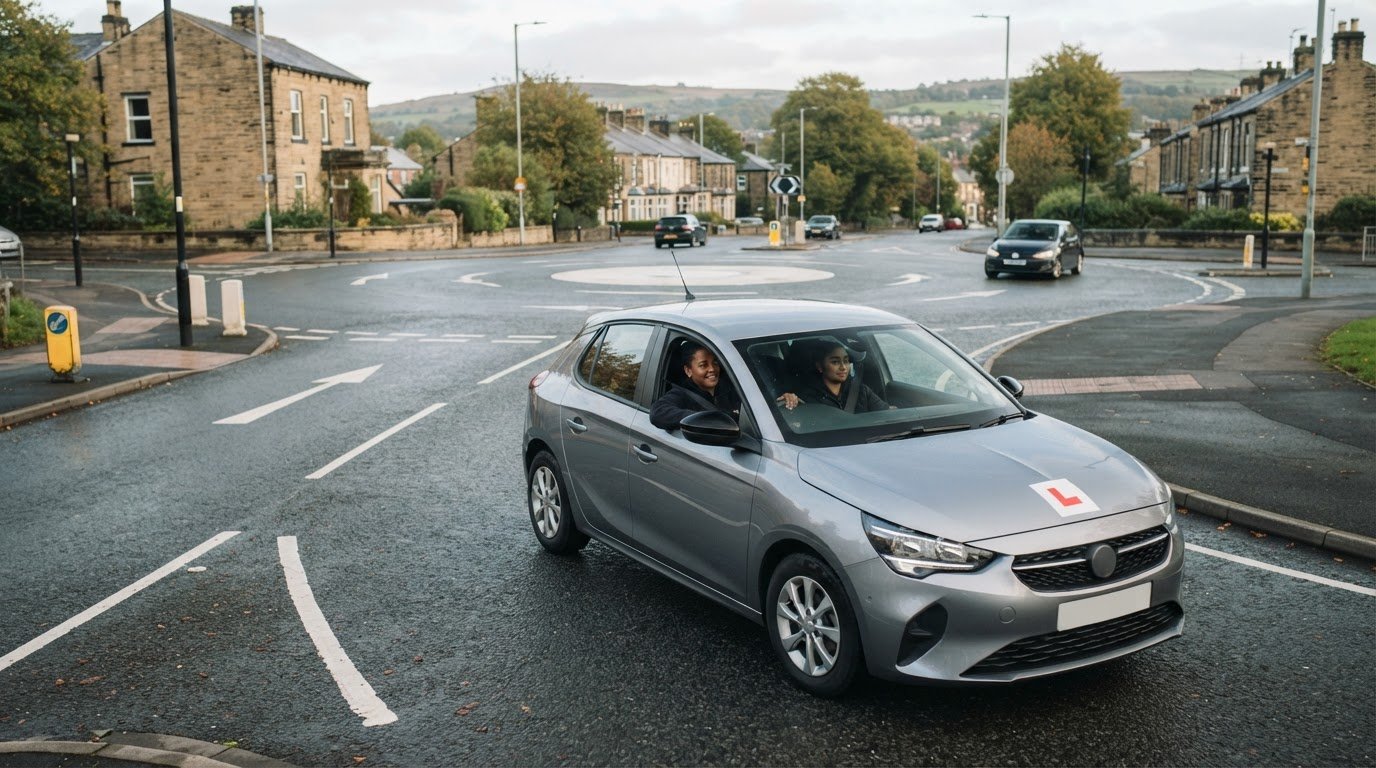
Roundabouts: A Calm, Step-by-Step Guide for Leeds Learners
What if a roundabout isn’t about making every decision at once, but following the same calm routine each time? It’s understandable to feel unsure about which lane to choose, when a gap is safe or whether you’ll signal in time. You don’t need to get everything right straight away. Clear steps give you something steady to focus on.
This guide explains what to do as you approach, choose a lane, give way and exit. You’ll learn how signs and road markings help you position correctly, how to watch for traffic from the right, and when to signal left for your exit. Roundabout layouts vary, so use the information on the road rather than relying on a memorised route.
We’ll work through a simple routine you can practise around Leeds and nearby areas. With patient, supported practice, you can build confidence at a pace that suits you, whether you’re learning in a manual or automatic car. If a roundabout feels busy or unfamiliar, breaking it into clear steps can make it easier to manage.
Key Takeaways
- Use a steady approach routine to organise your decisions before you reach the junction.
- Let signs and road markings guide your lane choice instead of relying on fixed assumptions.
- Learn to judge a safe gap and enter without rushing or stopping unnecessarily.
- Practise mini-roundabouts and unfamiliar junctions by talking through each decision with an instructor.
- Build confidence with a simple check of the signs, lane, speed, observations and exit.
Roundabouts in Leeds: what to notice before you move
Slow down, read the signs and road markings, choose a safe gap, then follow the exit you planned. A roundabout is a junction where traffic travels around a central area before leaving by an exit. If you’re unsure what to expect, start by reading the layout in front of you rather than trying to decide everything at once.
Layouts differ, so signs and road markings matter more than assumptions based on another junction. It’s normal to worry about choosing a lane or judging a gap. A steady approach gives you time to look and make one decision at a time.
This video offers a visual look at two Leeds junctions. Use it to notice how their layouts differ, while remembering that signs and markings can change and need checking on every journey.
What should you look for on the approach?
Look well ahead for direction signs, lane arrows, road markings and the exits. Ease off early enough to take in that information without rushing. Check your mirrors before adjusting speed or position, and keep looking around for vehicles, cyclists and pedestrians. Take particular care with anyone travelling alongside you.
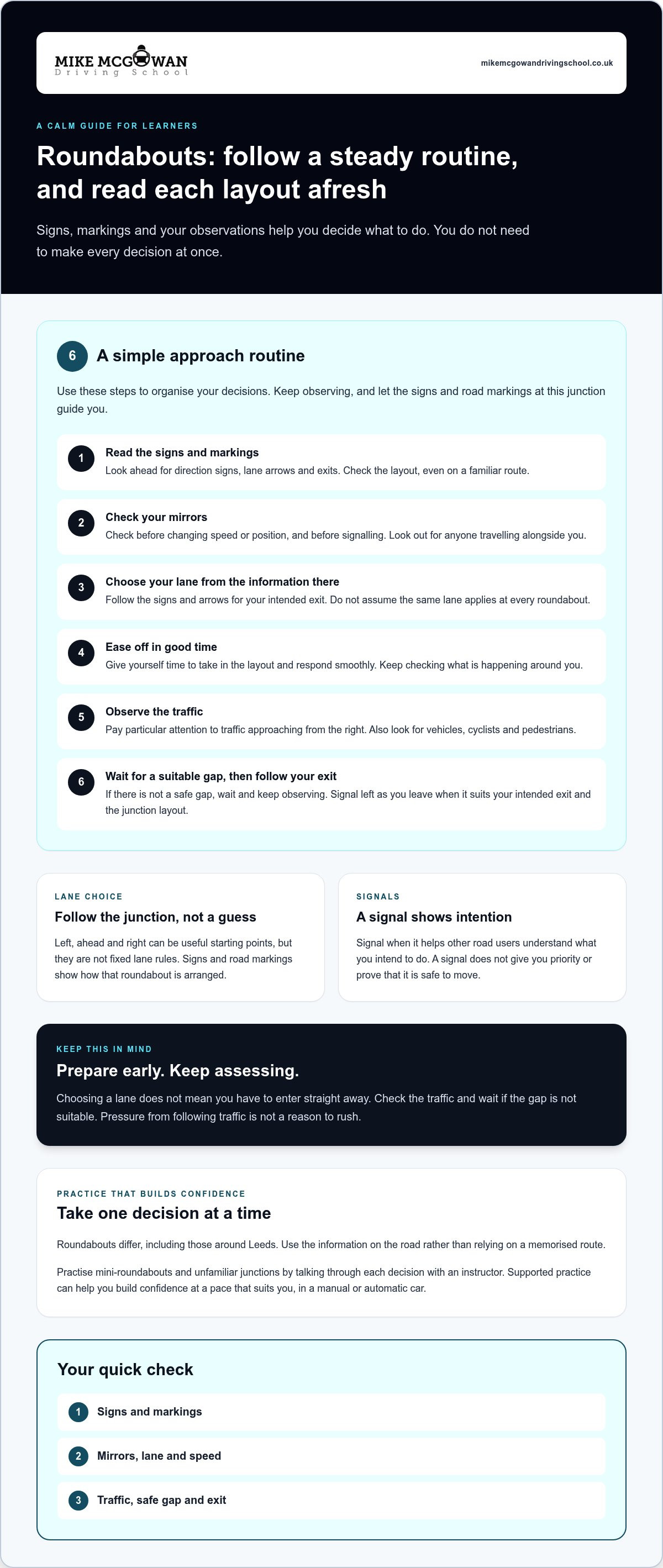
A simple routine: read the signs, choose your lane, adjust your speed, observe the traffic, wait for a safe gap and follow your exit. Traffic approaching from the right is an important part of your observation, unless signs or markings show otherwise. Don’t let pressure from following traffic rush your decision.
Why does every roundabout need a fresh read?
Lane layouts, arrows and exit signs vary. Even on a familiar route, check the markings to see how the junction is arranged. Treat left, ahead and right as starting points, not fixed lane rules. Follow the information at the junction and be ready to adjust your plan safely.
For background on how these junctions are designed and described, see this overview of the history of roundabouts. For local lesson context, visit Leeds learner driving information. During supported practice, an instructor can help you spot the signs and make decisions at a manageable pace.
How to approach a roundabout: a calm sequence for learners
Use this routine to organise your approach, not as a rigid script. Read the signs and road markings, then use your mirrors, position and speed to give yourself time to observe. The layout and your intended exit determine the actions and signals you need.
Signs show directions, lane arrows indicate where lanes lead, and your observations help you assess traffic and choose a safe moment to enter. Keep checking what’s happening around you as you approach.
A simple approach routine
- Mirrors: Check before changing speed or position, and before signalling.
- Signal if needed: Make your intention clear when it helps other road users.
- Lane: Follow signs and arrows for your intended exit. Don’t assume the same lane applies at every junction.
- Speed: Ease off in good time so you can read the layout and respond smoothly.
- Observation: Look for traffic approaching from the right, as well as other vehicles, cyclists and pedestrians.
- Safe entry: Join only when there’s a suitable gap. If there isn’t, wait and keep observing.
Preparing early doesn’t mean committing early. Decide which lane the signs point you towards, then keep assessing traffic before entering. A signal tells others what you intend to do. It doesn’t give you priority or confirm that it’s safe to move.
When should you check mirrors and signal?
Check your mirrors before changing speed or position, and before signalling. Choose a signal that matches your intended exit and the junction layout. If you’re unsure about a particular arrangement, check the official Highway Code rules for roundabouts. They explain how to approach, position and signal, including when to signal as you leave.
How should you adjust your speed and position?
Approach at a speed that gives you time to read signs, notice lane arrows and respond to changing traffic. Position yourself according to the information at that junction, not a rule you remember from another one. If you’d like more practice making these decisions, arrange a driving lesson and work through them with an instructor at a manageable pace.
Roundabout lanes and exits: how to choose without guessing
Choose your lane by reading the signs and road markings alongside the exit you intend to take. The key principle is: your lane choice depends on both the junction layout and your intended exit. Common lane patterns can help you get your bearings, but they’re only a starting point. The signs and arrows at the junction guide your decision.
| Intended direction | What to check | What to observe |
|---|---|---|
| Left or first exit | Direction signs and arrows showing the lane for that exit | Traffic beside you and the gap before entering |
| Ahead or an intermediate exit | Which lane markings point towards your exit | Traffic from the right and vehicles in your chosen lane |
| Right or a later exit | Signs and arrows showing the correct approach lane | Traffic around you, especially before changing position |
Which lane should you use for your exit?
At some junctions, the left-hand lane is used for a left turn or going ahead, while a right-hand lane is used for a right turn. That pattern doesn’t apply to every layout. Follow the signs and painted arrows, even if they differ from what you’ve seen elsewhere.
Where there are several lanes or spiral markings, follow the lane markings through the junction. Don’t change lanes suddenly to reach an exit. If the layout feels confusing, ask your instructor to talk it through before practising it independently.
How do you signal and leave the roundabout?
Signal according to your intended exit and the signs and markings. For a left turn, signal left on approach. For an exit further around, follow the Highway Code guidance and signal left after passing the exit before the one you want. The official Highway Code rules for roundabouts explain lane choice and signals.
Before moving towards an exit, check your mirrors and make sure your position is suitable. Give way to traffic approaching from the right, but don’t treat that as your only safety check. Look at the traffic around you and enter only when there’s a safe gap. If you miss your exit, don’t cut across a lane or turn sharply. Stay on your current path and take another safe route when the layout allows.
How to practise mini-roundabouts and unfamiliar Leeds junctions
Mini-roundabouts call for the same observation-first approach as larger junctions. Their central markings and limited space can make them feel different, but don’t assume every layout or traffic flow is the same. Read the signs and road markings, look for a safe opportunity to proceed and keep watching what other road users are doing.
What changes at a mini-roundabout?
The central marking is smaller, and the space around it can feel tighter. Where you can, drive around the central marking rather than over it. Focus on the actual layout, check for traffic approaching from the right and enter only when it’s safe. If the markings or view are unclear, slow down enough to observe without rushing.
How can you build up practice gradually?
Work through unfamiliar junctions in manageable steps with an instructor. You can:
- Observe the layout together before driving through it.
- Talk through the signs, markings, intended exit and traffic as you approach.
- Repeat the route to practise making the same decisions with growing confidence.
Your instructor can adapt the practice to your experience. If you’re preparing for a test, ask them to help you practise local routes and talk through what to expect, without relying on a memorised route.
What if you feel rushed or take the wrong exit?
A missed signal or exit doesn’t mean you should make a sudden correction. Keep your position and direction safe, and take another route when you can do so safely. Cutting across traffic at the last moment can create more risk than continuing and finding a suitable way back.
After the junction, talk through what happened with your instructor. You can identify what you noticed, what felt rushed and what you’d do next time. If anxiety is affecting your confidence more broadly, mention this to your instructor so you can agree a manageable next step.
A lesson can give you space to talk through unfamiliar layouts and practise them again with support.
Build roundabout confidence with steady, supported practice
Confidence grows through practice, not by expecting to get every decision perfect on your first attempt. Use a short self-check before and during each junction:
- Signs: What do the direction signs and road markings tell you?
- Lane: Does your position match your intended exit?
- Speed: Are you approaching at a pace that gives you time to observe?
- Observation: Which vehicles, cyclists or pedestrians do you need to account for?
- Entry and exit: Is it safe to join, and can you leave without a sudden change of position?
You don’t need to run through these as a rushed checklist. With practice, they become connected decisions. If one part feels difficult, focus on it first and build from there.
How can an instructor help you practise?
A calm instructor can talk through a new layout with you before you drive it. Together, you can read the signs, consider which lane fits your intended exit and plan what to observe. During the drive, take each decision in turn rather than feeling you have to solve the whole junction at once.
Practice can be paced around your experience and confidence. You might begin with a layout that feels manageable, then work towards a less familiar one when you’re ready. Mike McGowan Driving School offers one-to-one manual and automatic lessons in Leeds. For more ideas on building confidence, read this guide to support for nervous drivers in Leeds.
What should you take from your next lesson?
Choose one thing to focus on, such as reading the arrows early or checking traffic before entering. After each attempt, ask your instructor for feedback on your observation, positioning and timing. A missed signal or untidy approach can be reviewed calmly and used to plan what to practise next.
Steady, safe decisions matter more than rushing through the junction. Ask to practise a particular layout again or talk through what made it feel difficult. If you’d like supported practice, you can book a driving lesson.
Before your next lesson, choose one junction you’d like to discuss with your instructor and one decision you want to practise there.
Take your next roundabout one step at a time
Keep the routine simple: read the signs and markings, choose your lane for the exit, adjust your speed, observe and enter when it’s safe. If you miss an exit or signal, don’t make a sudden correction. Continue safely and talk through what happened afterwards.
Practice can make these decisions feel more familiar. Mike McGowan Driving School provides one-to-one manual and automatic lessons in Leeds with a DVSA-approved instructor. Nervous learners can receive calm, personalised support, with practice shaped around their experience.
Before your next lesson, choose one junction or one part of the routine to discuss. You don’t have to master everything at once. Each steady, safe decision is progress.
Frequently Asked Questions
How do you approach a roundabout as a learner driver?
Read the signs and road markings, check your mirrors, choose the lane for your exit and slow down in good time. Keep observing traffic, especially from the right, and enter only when there’s a safe gap. The exact signals and lane position depend on the layout. Give yourself time to look rather than letting following traffic rush your decision.
Which lane should you use at a roundabout?
Use the lane shown by the signs and road markings for your intended exit. A left lane is often used for a left turn or going ahead, and a right lane for a right turn, but these are general patterns, not fixed rules. At multi-lane junctions, follow the arrows and lane markings through the layout. If it’s unfamiliar, ask your instructor to explain it before practising alone.
Do you have to give way to traffic from the right at a roundabout?
Give way to traffic approaching from the right unless signs or road markings indicate otherwise. Keep checking that the gap is safe, including for vehicles already circulating and road users travelling alongside you. Seeing no vehicle immediately to your right doesn’t automatically mean it’s safe to move. Take your time to observe, and don’t let another driver’s signal replace your own checks.
When should you signal to leave a roundabout?
Where it’s practical, signal left after passing the exit before the one you intend to take. This tells other road users that you’re leaving. Check your mirrors and make sure your position is suitable as you approach the exit. The layout and your intended direction also affect signals on approach, so follow the signs and current Highway Code guidance rather than copying another driver.
What should you do if you miss your exit at a roundabout?
Continue safely rather than cutting across a lane or turning sharply to reach the missed exit. Keep your current path, maintain observation and take another suitable route when you can. Missing an exit can feel unsettling, especially if traffic is close behind, but a sudden correction is not the answer. Once you’re safely away from the junction, talk through what happened with your instructor and plan what to do next time.
Are mini-roundabouts different from normal roundabouts?
Mini-roundabouts are smaller, so the central marking and available space can make them feel different. Use the same careful observation, read the signs and road markings, and proceed only when it’s safe. The Highway Code says to pass around the central markings, except where a large vehicle is physically unable to do so. Mini-roundabouts vary, so don’t assume they all have the same shape or traffic flow.
How can I stop feeling nervous at roundabouts?
Build confidence gradually by practising with an instructor and focusing on one decision at a time, such as reading the signs or judging when it’s safe to enter. In Leeds, one-to-one manual and automatic lessons with calm, personalised support can help you work at a pace suited to your experience. Ask your instructor to talk through a junction before you drive it, then discuss what went well afterwards. Steady practice can make the routine feel more familiar.
Disclaimer
This article is intended as general guidance for learner drivers and does not replace official DVSA advice or a lesson with a qualified instructor. Rules, test requirements, and local test centre procedures can change, so always check GOV.UK or speak to your instructor for the most current information. Mike McGowan Driving School accepts no responsibility for outcomes based solely on the content of this article.

Frequently Asked Questions
Q:
Do I need any experience before my first lesson?
No experience is needed at all. Whether it's your very first time in a car or you're starting over after a break, lessons are tailored to your level. You’ll be supported from the very first turn of the wheel.
Q:
What kind of car will I learn in?
You’ll learn in a modern Toyota Yaris Hybrid with automatic transmission. This car is smooth, quiet, and ideal for learners who want to focus on road awareness without worrying about gears.
Q:
I’m nervous about driving. Can you help?
Absolutely. Many learners feel nervous at first. Mike specialises in creating a relaxed, judgment-free environment where you can build confidence at your own pace.
Q:
How do I book a lesson?
You can call or message Mike directly to arrange your first session. There’s no app or complicated portal — just a simple, friendly conversation to get you started.
Get in touch with Mike
Questions about lessons? Not sure where to start? Ready to book a time that works for you?
You are welcome to reach out anytime. Whether you're a first-time learner, coming back after a break, or feeling unsure about the process, Mike is here to help.
Every enquiry is handled with care and zero pressure. You will speak directly with Mike, not a call centre or automated system.
Send a message or call today. Friendly support and honest answers are just one step away.
07344 035280
Lewisham Ct, Morley
- Monday - Friday, 8:00 am - 5:00 pm
Get In Touch

Follow Us
Follow Us
Mike McGowan Driving School
Calm, one-to-one driving lessons across Leeds in manual and automatic vehicles. Learn with a DVSA‑approved instructor who specialises in automatic lessons and helps nervous learners build real confidence, at a pace that works for you.
Incorporated 2011 • Based in West Yorkshire (Leeds / Morley)
Call Mike: 07344 035 280
Hours: Monday–Friday, 8:00am–5:00pm
Pick-up area: Leeds and surrounding areas (West Yorkshire)
Services
More
Contact Us
07344 035 280
Lewisham Ct, Morley
- Monday - Friday, 8:00 am - 5:00 pm
© Copyright 2026. Mike McGowan Driving School.. All rights reserved.
Need Meta Ads that drive real bookings and sales? Work with FoundUB4