Pre test driving assessment in Leeds: mock test and readiness
A pre-test driving assessment in Leeds can mean a mock test or a practical assessment of your driving needs. At the William Merritt Centre, a practical driving assessment takes 40-45 minutes and cannot go ahead without a valid driving licence. That’s the key requirement for taking the assessment; it doesn’t, by itself, tell you whether to travel there by car.
It’s understandable to want a clear answer before booking, especially if you’re nervous about driving with someone new or unsure what an assessment involves. A mock test lets you practise in test-style conditions, while a practical assessment considers how you drive and what support or adaptations may help.
This guide explains the difference, how to arrange an assessment, where it takes place and what the report covers. You’ll also learn what to bring and how test-preparation lessons can help you work on areas that feel uncertain.
Key Takeaways
- Work out whether you need a mock test to practise for your driving test or a practical assessment focused on your driving needs.
- A practical assessment at the William Merritt Centre takes 40-45 minutes, and you need a valid driving licence for it to go ahead.
- You can refer yourself to the William Merritt Centre by calling reception. The booking section explains what details and documents to prepare.
- The Leeds assessment centre is in Rodley, with outreach services at satellite centres elsewhere in Yorkshire.
- Find out how the assessment report can help you understand the outcome and plan your next steps.
Mock driving test and readiness assessment
A mock test gives you practice in test-style conditions. A practical assessment at William Merritt Centre considers your driving in a different context.
Assessment and mock test differences
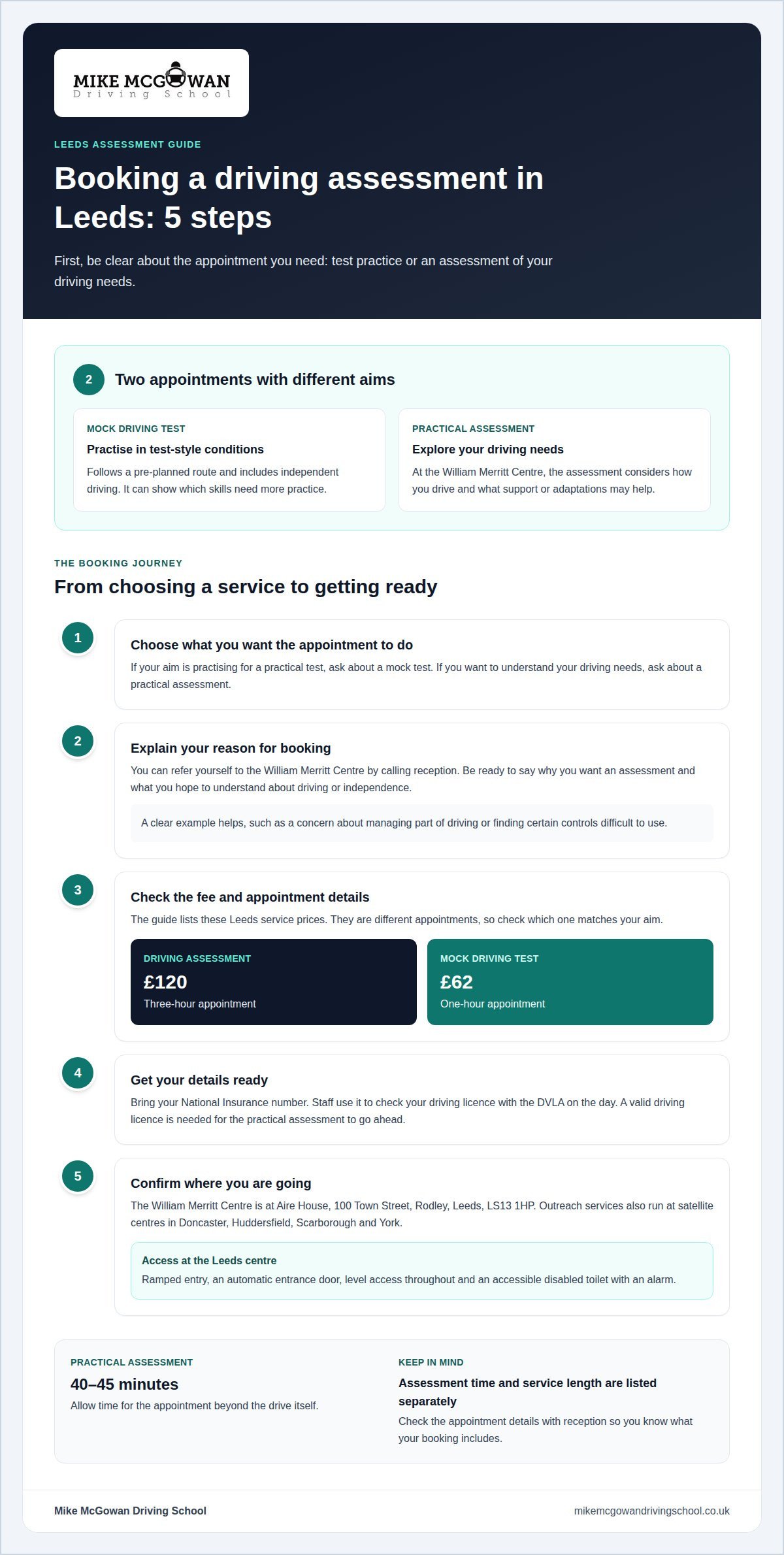
A mock test follows a pre-planned route and includes independent driving. It lets you experience the structure of a practical test and identify skills that need more practice. A pre-test assessment is not simply another test attempt. It focuses on your driving needs and how you manage in the car. First, clarify your aim: test practice or a practical assessment.
Assessment duration
A practical driving assessment at William Merritt Centre should take 40-45 minutes. A practical driving test lasts around 35-40 minutes, so the assessment is a similar length. Allow time for the appointment beyond the drive itself. The assessment takes place at a centre, and you need a valid driving licence for it to go ahead.
Readiness isn’t measured by one perfect drive. The DVSA average for a learner to be ready for a practical test is around 45 hours of professional lessons and 22 hours of private practice. These are averages, not a target every learner must meet. Your control, observation, decisions and ability to drive independently give a clearer picture of what to work on.
Use a mock test to practise the parts of driving that feel less settled. For example, if Leeds roundabouts leave you unsure, ask for feedback on your approach speed, lane choice and observations. If reversing concerns you, focus on a manoeuvre and the observations involved. A specific practice goal makes feedback easier to apply.
Nerves can affect decisions, even when you know the routine. A mock test gives you a chance to experience a quieter, structured drive before test day. The practical test lasts around 35-40 minutes, and an emergency stop is carried out on 1 in 3 tests. Practising a calm response to instructions helps you stay focused on each step rather than guessing what comes next.
After a difficult test or a gap in lessons, readiness can feel hard to judge. Write down the situations that unsettle you, such as meeting traffic on a narrow road or choosing a lane. Then practise them in a lesson or mock test and use the feedback to decide what needs more work. Leeds learners can find local driving lesson information for the area.
Application and booking process
To refer yourself to William Merritt Centre, call and speak to reception. This gives you a direct starting point for arranging a driver assessment in Leeds. Before calling, be ready to explain why you want an assessment and what you hope to understand about driving or independence.
Arranging a practical assessment is different from booking a mock test. The practical assessment considers your driving needs, while a mock test gives you practice in test-style conditions. Explain which one you’re looking for when speaking to reception. A learner preparing for a practical test, for example, has a different aim from someone seeking an assessment of their driving needs.
Bring your National Insurance number to the William Merritt Centre. Staff use it to check your driving licence with the DVLA on the day. Keep it with your appointment details so it’s easy to find. You’ll also need a valid driving licence for the assessment to go ahead.
A three-hour driving assessment in Leeds costs £120. A one-hour mock driving test costs £62. These are different services, so compare what each appointment is intended to do rather than choosing on duration alone. The practical assessment focuses on driving needs; the mock test focuses on test preparation.
Before booking, note the main reason for your referral. You might mention a change in your circumstances, a concern about managing part of driving, or a goal of gaining more independence. A simple, specific example, such as finding certain controls difficult to use, can help explain what you need from the appointment.
If a parent or family member is helping, agree who will make the call and who will attend. The driver should be ready to describe their own experience, even if someone else helps with arrangements. For example, a parent can keep appointment details together while the driver explains what feels straightforward and what feels difficult.
Use your call with reception to establish the next steps for the William Merritt Centre assessment. Keep the appointment details and National Insurance number together, and bring the required information on the day. This preparation helps keep the process clear and lets the appointment focus on the driver’s needs.
If you’re also arranging driving practice around your assessment, you can book a driving appointment.
Assessment locations
For a mock assessment, look to Leeds driving schools that provide test preparation. A practical assessment focused on your driving needs takes place at William Merritt Centre in Rodley. These are different appointments, so choose the location that matches your purpose.
The William Merritt Disabled Living Centre is at Aire House, 100 Town Street, Rodley, Leeds, LS13 1HP. The centre also runs outreach services at satellite centres in Doncaster, Huddersfield, Scarborough and York. If Rodley is difficult to reach, ask about the Yorkshire outreach locations when arranging the appointment.
Access at the Leeds centre includes ramped entry, an automatic entrance door and level access throughout. There is also an accessible disabled toilet with an alarm. These details can help you consider whether the building suits your access needs. If you use mobility equipment, think about the entrance and facilities as well as the journey.
Mock driving tests are linked to test-centre areas rather than the William Merritt Centre assessment site. Mock-test meeting locations can vary, so check the details for your appointment. Harehills Driving Test Centre is at Hillcrest House, 386 Harehills Lane, Leeds, LS9 6NF. The postcodes differ, so use the address provided for your specific appointment.
Leeds also has Horsforth Driving Test Centre at Woodside House, 261 Low Lane, Horsforth, Leeds, LS18 5NY. It is within 400 metres of the Leeds Ring Road, the A6120. This helps you identify the area, but the exact mock-test meeting point depends on the appointment arranged. Allow time to locate the right entrance or meeting place.
Before travelling, match the appointment type to its location. For a practical driving assessment, use the William Merritt Centre address or the outreach location arranged for you. For a mock test, follow the meeting details for the chosen test-centre area. Reception can help with directions for William Merritt Centre appointments, and clear location details can reduce uncertainty on the day.
Leeds driving schools that offer test preparation are the route for learners who want a mock assessment. William Merritt Centre is a separate option for a practical assessment of driving needs. Keeping the purposes distinct helps you book the right appointment and arrive at the correct centre.
Leeds driving schools that provide test preparation offer mock assessments.
Assessment outcome and report
A report is most useful when it turns an assessment into clear next steps. At William Merritt Centre, use the outcome to understand what the drive showed and what needs attention. Compare the findings with your own experience, such as difficulty with steering, judging space or staying comfortable in traffic.
A practical assessment report serves a different purpose from a mock test result. A mock test focuses on driving in test-style conditions, while a practical assessment considers your driving needs. Look for a clear explanation of the outcome, any concerns raised during the drive and what happens next. If anything is unclear, ask the assessor to explain it in everyday language.
For a practical review, consider what the report says about managing the car and the journey. Note, for example, whether a particular control, seating position or traffic situation affected your drive. Separate what felt difficult on the day from what regularly affects your driving. This gives you a clearer basis for discussing mobility and independence.
If your instructor recommends more lessons before the test, ask which skills need attention and why. Turn that advice into specific practice goals, such as improving observations at junctions or making manoeuvres more consistent. Review your progress with the instructor before deciding whether you feel ready to book or take another mock test.
A recommendation for more practice isn’t a judgement on your ability. It identifies areas where further experience could help you drive more reliably. If you recently failed a test, use the feedback to choose a few priorities rather than treating the result as proof that you cannot succeed.
When reading the assessment outcome, mark each point as a strength, a concern or a question. If the report mentions difficulty with a control, for instance, ask how it affected the drive and what alternatives were considered. This keeps the conversation specific and helps clarify whether the next step is practice, further discussion or a change to your driving arrangements.
If you’re working towards a practical test, take the report to a conversation with your instructor. Discuss the findings and agree what to practise in your next lessons. If the report is about a practical driving assessment rather than test readiness, keep its recommendations separate from mock-test feedback. The outcomes address different needs, and treating them separately helps you plan calmly.
Keep a copy of the report with your driving notes. Add the date of your discussion and the practice points you’ve agreed. Reviewing these notes after a lesson can show which concerns have become easier and which still need focused attention.
Car driving assessments
You can drive to the William Merritt Centre assessment if you hold a valid driving licence. The assessment includes a practical drive, and the centre requires your licence for it to go ahead. If driving there feels difficult, plan another way to get to the appointment and discuss your concerns during the assessment.
This is different from a mock test, which focuses on practising for a driving test. A practical assessment considers your driving needs and how you manage in a car. Before the appointment, think about what you want the assessor to understand, such as a control that feels awkward or a situation that affects your confidence.
The assessment should take 40-45 minutes. Applicants are asked to read a number plate from at least 20.5 metres away. These steps help establish whether the drive can proceed and give the assessor a chance to observe your driving. Bring your licence and arrive ready to explain any concerns in your own words.
Some people have questions about automatic cars or medical circumstances. The assessment is not a medical diagnosis. Explain how your circumstances affect driving, such as a movement that feels uncomfortable or a control that is difficult to use. A clear example keeps the discussion focused on your experience behind the wheel.
Consider the journey to the centre as well as the assessment itself. Rodley roads or unfamiliar turns may feel different from routes you know well. If you plan to drive there, consider whether you’re comfortable making the journey before the appointment. You can also arrange another way to travel and discuss any driving concerns during the assessment.
During the drive, listen to the assessor’s instructions and take each part at a manageable pace. If you don’t understand an instruction, ask for it to be repeated. You don’t need to hide a difficulty. If a manoeuvre feels unfamiliar, for example, explain which part is causing trouble instead of guessing what the assessor expects.
A three-hour driving assessment in Leeds costs £120.00. That is the listed duration and price for a driving assessment, not a mock test. Before attending, write down the questions you want answered, such as how a particular driving difficulty affects your confidence or independence.
After the appointment, note any example that helped clarify your concerns. Use these observations to guide your next conversation about driving. A short record can help you explain what felt manageable and what you’d like to understand better.
Mike McGowan Driving School: Beginner Driving Lessons
Mike McGowan Driving School can help you turn assessment feedback into focused driving practice in Leeds. If you’re new to driving, Beginner Driving Lessons build skills step by step. Automatic and Manual Driving Lessons let you learn in the type of car that suits you.
If an instructor recommends more practice, use the feedback to choose a clear goal for your next lesson. That could mean building confidence at junctions, improving manoeuvres or practising independent decisions on Leeds roads. Refresher Lessons can also help if you’ve had a break or want to strengthen particular skills before your test.
An assessment isn’t a judgement. It can help you decide what to practise next. Contact Mike McGowan Driving School to discuss lessons that fit your experience and goals.
Turn your feedback into a clear next step
A pre-test driving assessment in Leeds is most useful when its feedback shapes what you practise next. Choose one area to focus on and give yourself time to build a steady routine. A difficult drive isn’t a verdict on your ability.
If you’re preparing for a test, Mike McGowan Driving School can help you build confidence with Beginner Driving Lessons or Test Preparation. Automatic and Manual Driving Lessons give you the choice of learning in the car type that suits you. The right starting point depends on your experience and what you want to improve.
Bring your questions and the feedback that matters to you. A calm conversation can help turn uncertainty into a practical plan for your next drive.
Take progress one drive at a time. Confidence grows through practice that makes sense for you.
Frequently Asked Questions
What should I bring to my assessment?
Bring your valid driving licence and National Insurance number to a William Merritt Centre practical assessment. Keep them with your appointment details so they’re easy to find on the day. If you’re attending a mock test instead, bring notes about the skills you want to practise, such as junction decisions or manoeuvres. This gives you a clear starting point for the drive and feedback.
What is a pre-test driving assessment in Leeds?
In Leeds, you may be considering a mock test or a practical assessment of your driving needs. A mock test gives you practice in test-style conditions. William Merritt Centre’s practical assessment considers how you manage driving. Choose according to your aim: rehearsing test routines or exploring concerns about driving itself. Being clear about the purpose helps you arrange the appointment that suits your needs.
What does a Leeds pre-test driving assessment include?
A mock test follows a pre-planned route and includes independent driving. It lets you practise making decisions without continuous directions. A practical assessment at William Merritt Centre involves a drive focused on your driving needs. For example, you can describe a control or traffic situation that feels difficult. The appointments have different purposes, so explain which kind of assessment you’re attending.
How do I book a pre-test driving assessment in Leeds?
To arrange a practical driver assessment, call William Merritt Centre reception and refer yourself. Be ready to explain why you want the assessment. For mock-test preparation, arrange practice with a driving instructor. To book lessons with Mike McGowan Driving School, contact Mike directly by phone or message. Keep your appointment details handy, and bring your National Insurance number and valid licence to the practical assessment.
Do I need to bring my own car or use the instructor’s car?
A William Merritt Centre assessment is a practical drive. Mike McGowan Driving School’s automatic lessons use a Toyota Yaris Hybrid with automatic transmission. These are separate appointments, so the school’s lesson-car information applies to its lessons, not automatically to the William Merritt assessment. For an automatic lesson at the school, you’ll learn in the Toyota Yaris Hybrid.
What Leeds test routes, centres, and local driving conditions might be covered?
Mock-test practice uses a pre-planned route and includes independent driving. Leeds test-centre areas include Harehills and Horsforth, though the route depends on the appointment. Practising varied situations, such as junction decisions, lane choices and manoeuvres, helps you prepare for changing road conditions. Focus on making safe decisions rather than memorising a route, so you can respond calmly to the road ahead.
Disclaimer
This article is intended as general guidance for learner drivers and does not replace official DVSA advice or a lesson with a qualified instructor. Rules, test requirements, and local test centre procedures can change, so always check GOV.UK or speak to your instructor for the most current information. Mike McGowan Driving School accepts no responsibility for outcomes based solely on the content of this article.