One-to-One Manual Driving Lessons in Leeds for Beginners
Confidence grows through steady practice, not by being thrown straight into the busiest roads. There’s no legally prescribed minimum number of lessons before you take a driving test in Great Britain. With one-to-one manual driving lessons in Leeds, you can work through the skills at a pace that gives you time to practise and ask questions.
If the clutch, gears or thought of busy traffic feel like a lot to manage, that’s understandable. One-to-one manual driving lessons in Leeds can start with the basics and build towards busier roads as your control and confidence develop. You don’t need any driving experience to begin.
This article explains what beginner manual lessons can involve, from getting comfortable with the controls to practising junctions, roundabouts and manoeuvres. You’ll also see how mirror use, road positioning and hazard awareness fit into your progress, and why the number of lessons needed varies. The aim is to help you picture a calm, gradual route towards feeling more at ease on Leeds roads.
Key Takeaways
- There’s no legally prescribed minimum number of driving lessons before you take a test in Great Britain. Your progress depends on how you build and practise each skill.
- Beginner lessons can start with the car’s controls and quieter roads, then progress to busier traffic as you become more comfortable.
- Manual lessons help you practise coordinating the clutch, gears and accelerator, alongside observation and road awareness.
- Consider whether learning in a manual or automatic car best suits the vehicles you plan to drive and the licence you want.
- Use each lesson to focus on a clear skill, such as junctions, roundabouts or manoeuvres, and discuss what you’d like to practise next.
Driving skills covered from beginner to test-ready
One-to-one manual driving lessons in Leeds can take you from learning the controls to practising the decisions needed on a driving test. There’s no legally prescribed minimum number of lessons before taking a test in Great Britain, and learners can take a driving test from age 17.
Early lessons can cover clutch control, moving off, stopping, steering and selecting gears. As these skills become more familiar, practice can extend to junctions, roundabouts, road positioning, mirrors, signs and hazard awareness.
For a look at clutch control in practice, watch this manual driving lesson:
There are two driving test centres in Leeds. The Leeds (Harehills) Driving Test Centre is at Hillcrest House, 386 Harehills Lane, Leeds, LS9 6NF. Pass rates can vary between test centres and do not predict an individual learner’s result. These figures describe centre results, not what any individual learner will achieve.
For Morley learners, the Leeds and Horsforth centres are nearby options to consider. Choose a centre that suits your location and practice, then select an available practical test slot through the official booking process. Arrange lessons around the skills and roads you need to prepare for that test.
Book your theory test with enough time to prepare, then plan practical test booking around your learning progress. Avoid choosing a practical test date just to create pressure. Your instructor can help identify skills to practise, such as observing safely at roundabouts or reversing under control.
Block-booking discounts vary between driving schools. Before paying in advance, compare the total cost and terms with individual lessons so you understand what the booking covers.
Lesson length and session format depend on the instructor’s options. Agree on a lesson length that leaves time to practise, receive feedback and recap, rather than assuming every school offers the same duration.
Typical lessons can include a recap, a clear goal, focused practice and a short debrief. For example, a session might work on clutch control first, then use that skill at a quiet junction. As your control improves, practice can progress towards busier roads and more complex roundabouts. You can find details of driving lessons in Leeds alongside the skills covered in this section.
Manual and automatic driving lessons
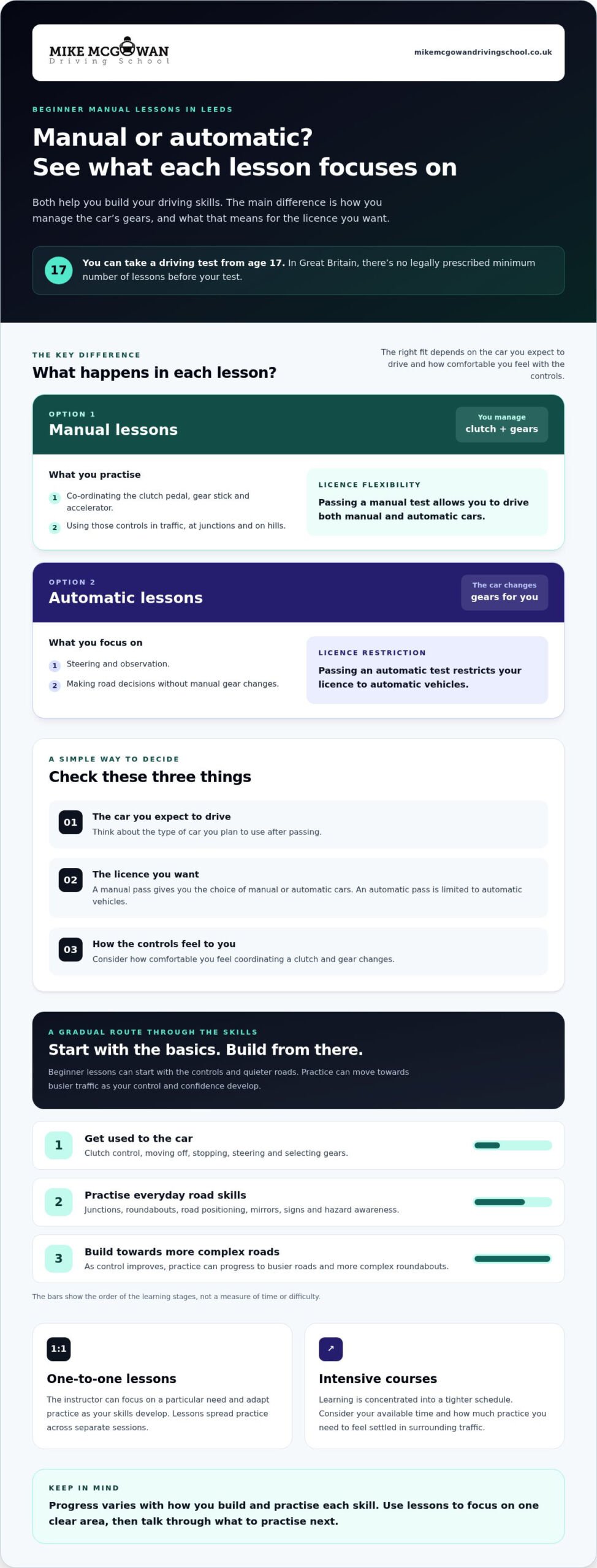
In Leeds, the main choice is whether you want to learn with a clutch and gears or in an automatic car. Consider the type of car you expect to drive, your future needs and how comfortable you feel coordinating the controls.
Choosing manual or automatic tuition
A manual lesson involves using the clutch pedal and gear stick while controlling the accelerator. You practise coordinating these actions, then apply them in traffic, at junctions and on hills. An automatic changes gears for you, so lessons focus more on steering, observation and road decisions without manual gear changes.
Think about the vehicles you expect to drive after passing. In Great Britain, passing a manual test allows you to drive both manual and automatic cars. Passing an automatic test restricts your licence to automatic vehicles. Weigh the flexibility you want against the controls you feel ready to learn.
One-to-one lessons and intensive courses
One-to-one tuition gives you the instructor’s attention throughout the lesson. Your instructor can focus on a particular need, such as clutch control in slow traffic, and adapt practice as your skills develop. An intensive course groups learning into a shorter period, which suits a different pace and schedule.
How do one-to-one manual lessons compare with intensive courses in Leeds? One-to-one lessons spread practice across separate sessions, while intensive learning concentrates lessons into a tighter schedule. Choose a pace that gives you time to absorb feedback and practise between sessions.
Automatic intensive driving lessons use a concentrated schedule, but the car changes gears for the learner. They differ from regular one-to-one lessons. Before choosing a format, consider your available time, experience and how much practice you need to feel settled in surrounding traffic.
What is the average price of a one-to-one manual driving lesson in Leeds? There is no single average that applies to every instructor and booking arrangement. Compare the stated lesson length and total cost before committing, especially if you’re considering booking several lessons together.
Which Leeds driving schools offer one-to-one manual driving lessons? Look for a Leeds instructor who teaches manual learners individually, then consider the lesson structure and teaching approach. A postcode search can help narrow down options near home, college or work, but lesson format matters as much as location.
To choose between manual and automatic tuition, consider the cars you expect to use and whether you want a manual licence. Then think about how comfortable you feel managing clutch and gear changes. Manual tuition offers broader vehicle choice; automatic lessons suit learners who prefer not to coordinate gears.
If you’d like to talk through a suitable lesson format, you can arrange an appointment and explain what you want from your learning.
Driving lessons for beginners and experienced learners
Your first lesson and a return to driving call for different starting points. If you’re new, tell your instructor what you already know about the car. If you’ve driven before, explain what you want to feel more confident doing, such as handling a particular junction or driving independently again.
Progress depends on lesson frequency, anxiety and how quickly you learn and remember new skills. A short recap at the start helps you and your instructor decide what needs attention, rather than spending the session repeating something you’ve already mastered.
Tuition shaped around your starting point
For a beginner, your instructor can introduce tasks in a manageable order and check your understanding as you go. If you’ve had lessons before, describe what felt difficult and what you could do comfortably. For example, you could practise a familiar route first, then build towards a less familiar road.
Automatic driving lessons suit learners who want to focus on road decisions without changing gears. The right choice depends on the type of car you plan to drive and the skills you want to develop.
Instructor assessment and useful feedback
Your instructor can assess your driving through observation and discussion during a lesson. Ask which skill needs attention next and request a clear example. “Check the mirrors before changing speed” gives you a practical action to focus on during your next drive.
What affects progress?
Learning to drive means remembering skills and applying them in different situations. Lesson frequency, anxiety and how quickly you absorb new skills all affect progress. If a task still feels difficult, tell your instructor what part is causing trouble, such as timing a decision or remembering a sequence.
Failing a previous test doesn’t mean you need to start from scratch. Use the feedback to choose a focused practice goal, then review whether it feels clearer after the lesson. This gives you a more specific next step than simply trying to “drive better”.
Changing instructors during your learning
If you want to switch instructors, explain what you’ve already covered and what you’d like help with next. For example, share the skills you feel comfortable with and the situations that still make you anxious. Your new instructor can use this information to understand your experience and plan where to begin.
Before changing instructors, keep a brief record of recent lesson goals and feedback. This gives you a clear starting point and helps you feel that your previous learning hasn’t been lost.
Simple resources between lessons
A notes app or notebook can help you record a lesson goal, a useful piece of feedback and a question for next time. For example: “Practise choosing a safe gap; ask about mirror checks before slowing.” Keep the note short enough to review before your next lesson.
Online videos and driving apps can support revision, but they can’t observe your decisions on Leeds routes. Use them to revisit an idea, then ask your instructor how it applies to your driving.
What can I expect from my driving lessons?
A lesson can begin with a brief check-in about how you’re feeling and what you’d like to work on. Agreeing on a focus helps you know what to pay attention to during the drive. For example, you could practise making decisions early at a junction, then talk through what felt clear afterwards.
As your skills develop, lessons can include different road layouts around Leeds and surrounding areas. A narrow residential street with parked cars calls for careful judgement of space, while a multi-lane roundabout needs early planning. Your instructor can choose a suitable route for the skill you’re practising and adapt it as your confidence grows.
One-to-one teaching means the lesson focuses on you and your instructor, rather than being shared with another learner. You have time to ask for an explanation or pause to discuss a decision. If you’re worried about making a mistake in front of someone else, this format may feel more comfortable.
Rain and darker evenings can change what you notice from the driver’s seat. In wet weather, take extra care to read the road surface and markings; in low light, give yourself time to identify signs and other road users. Your instructor can talk through these conditions as you practise, linking the learning to what you can see.
Local driving also involves changes in traffic flow and visibility. A parked van, for instance, can hide your view at a junction, so consider what you can see before deciding when to move. Discussing the decision afterwards links observation with safe action, rather than treating each manoeuvre as a set routine.
Routes don’t need to follow a test route to be useful. Practising unfamiliar roads helps you respond to signs, markings and changing layouts instead of relying on memory. You can also revisit a place that felt difficult and compare how you approach it after practising the relevant skill.
Before a manual lesson, wear comfortable shoes that let you feel the pedals. Bring any glasses or contact lenses you use for driving, and come ready to listen and ask questions. You don’t need to learn the controls in advance; tell your instructor if anything is unclear before setting off.
After the drive, identify one decision you handled well and one you want to understand better. A specific note, such as “I spotted the sign early but chose my lane late”, gives your next session a useful focus. Small, clear observations help you recognise progress without expecting every part of driving to feel easy at once.
Gradual confidence-building on Leeds roads
Confidence grows when each new challenge builds on a skill you’ve already practised. A useful lesson plan starts with what feels manageable, then adds one unfamiliar demand, such as busier traffic or a new junction layout. Focus on making a decision calmly instead of trying to handle several new situations at once.
Think of your progress as a series of steps. First, practise on a familiar road while working on smooth control and observation. Next, use those skills at a junction or roundabout. Then try a busier road, focusing on mirrors, position and following distance. Your instructor can help decide which step is useful next.
Leeds roads offer varied situations to learn from, including parked cars on residential streets, changing traffic flow and roundabouts. Before trying a new section, agree on what to focus on. For example, plan your approach to a roundabout, choose the correct lane, then review how well you checked your surroundings.
Feeling nervous about one manoeuvre doesn’t mean you can’t make progress elsewhere. Break it into manageable actions. For reversing, agree on the starting position, move slowly, check around the car and pause if you need to reassess. Practising one part at a time can make the task easier to understand.
If you’ve failed a driving test, use the feedback to set a practical goal rather than treating the whole test as a problem. A note about observation, for example, can become a lesson focus: check mirrors before changing speed, then practise that habit on different Leeds roads. This gives each drive a clear purpose.
Booking lessons at a pace that suits your routine can help you retain what you’ve learnt. An intensive course packs learning into a shorter period, while lessons spaced over time leave room to reflect between sessions. The right choice depends on your available time, how you respond to practice and whether you’re comfortable retaining several new skills close together.
After each lesson, note one thing that felt more controlled and one question to bring next time. “I chose my lane earlier at the roundabout” is more useful than a general note that the drive went well. This gives you and your instructor a specific starting point for the next session.
For a practical next step, choose one Leeds road situation you’d like to handle more confidently, then discuss it when arranging lessons. A clear focus helps you track progress through real decisions and actions, not just how relaxed you felt before setting off.
Mike McGowan Driving School: Beginner Driving Lessons
Mike McGowan Driving School offers one-to-one beginner manual lessons in Leeds, with calm, personalised coaching. If you’re new to driving, lessons can build from the basics at a pace suited to your learning. Manual, automatic and refresher lessons are also available for different needs.
If you’re unsure where to begin or returning after time away from driving, choose the lesson type that fits your experience and the car you want to learn in. Local routes can help you practise the road situations you’ll encounter around Leeds.
For a steady start with manual driving, contact Mike McGowan Driving School to discuss lessons.
Take your next step at a pace that feels manageable
Before your next lesson, choose one thing you’d like to feel more comfortable doing. It could be moving off smoothly, approaching a roundabout or dealing with a busy junction. A clear starting point gives you something practical to work towards, without needing to tackle every driving worry at once.
You don’t need to feel completely confident before you begin. Confidence can build through practice, one decision and one road situation at a time. If you’ve had a difficult lesson or test experience, tell your instructor what you’d like to approach differently next.
Take the next step when you’re ready. Every skill you practise is another opportunity to feel more at ease behind the wheel.
Frequently Asked Questions
How many lessons do I need to pass?
There isn’t one lesson count that suits every learner. Your experience, practice between lessons and how well you use feedback all affect progress. To assess readiness, review specific skills with your instructor, such as making safe decisions at junctions and completing manoeuvres without prompts. A short note of what you can manage independently and what needs more practice is a clearer guide than counting lessons alone.
Which Leeds areas and postcodes do manual driving instructors cover?
Mike McGowan Driving School covers Leeds and surrounding areas in West Yorkshire. Coverage is described by area rather than by postcode. A postcode can still help identify your neighbourhood and the roads you’d like to practise nearby. Consider where you usually start your day, such as home or college, and which local routes could help you build confidence for everyday driving.
How many manual driving lessons do learners typically need before the practical test?
The average figure attributed to the DVSA is around 45 hours of professional lessons, alongside 22 hours of private practice. Treat this as a broad reference, not a target you must match exactly. Manual learners also need time to develop clutch and gear control while building observation and decision-making skills. Your readiness depends on driving safely and consistently, not reaching a particular lesson total.
What is the average price of a one-to-one manual driving lesson in Leeds?
A one-hour manual driving lesson in Leeds costs £39.00. The total cost varies with lesson length and booking arrangement.
Disclaimer
This article is intended as general guidance for learner drivers and does not replace official DVSA advice or a lesson with a qualified instructor. Rules, test requirements, and local test centre procedures can change, so always check GOV.UK or speak to your instructor for the most current information. Mike McGowan Driving School accepts no responsibility for outcomes based solely on the content of this article.