Hill start driving lessons in Leeds with clear pricing
A hill start is a skill you can build steadily, not something you need to master in one go. There’s no single number of hill-start lessons that suits every learner: your progress depends on how comfortable you feel with clutch control, moving off and managing the car on a slope. Hill start driving lessons in Leeds can help you practise these skills at a pace that feels manageable.
It’s reasonable to want clear costs before you start, especially when you’re balancing lessons with a budget. You’ll also want to know how lesson times fit your week and whether booking a block suits your plans.
This guide explains how hill starts fit into learning to drive, which Leeds road skills build on them, and how to grow confidence from simpler situations to busier roads. It also explains how to compare lesson pricing and booking terms, so you can make an informed choice without feeling rushed.
Key Takeaways
- Compare lesson prices and availability before planning your budget, and read any block-booking terms carefully.
- Hill starts are one part of learning to drive. Clutch control and moving off smoothly help you approach them with more confidence.
- Build up to roundabouts, traffic lights and busier Leeds roads as your vehicle control improves.
- Your progress depends on factors such as lesson frequency, practice and how comfortable you feel in traffic.
- Choose an instructor whose teaching pace helps you feel supported, especially if you’re nervous or returning after a test failure.
Driving lesson prices and availability
Compare Leeds driving instructors by lesson price, length, vehicle type and how they teach hill starts. Ask how lessons are scheduled and whether practice can progress from quiet roads to slopes, roundabouts and busier traffic. These details help you compare the full learning experience, not just the cost of one lesson.
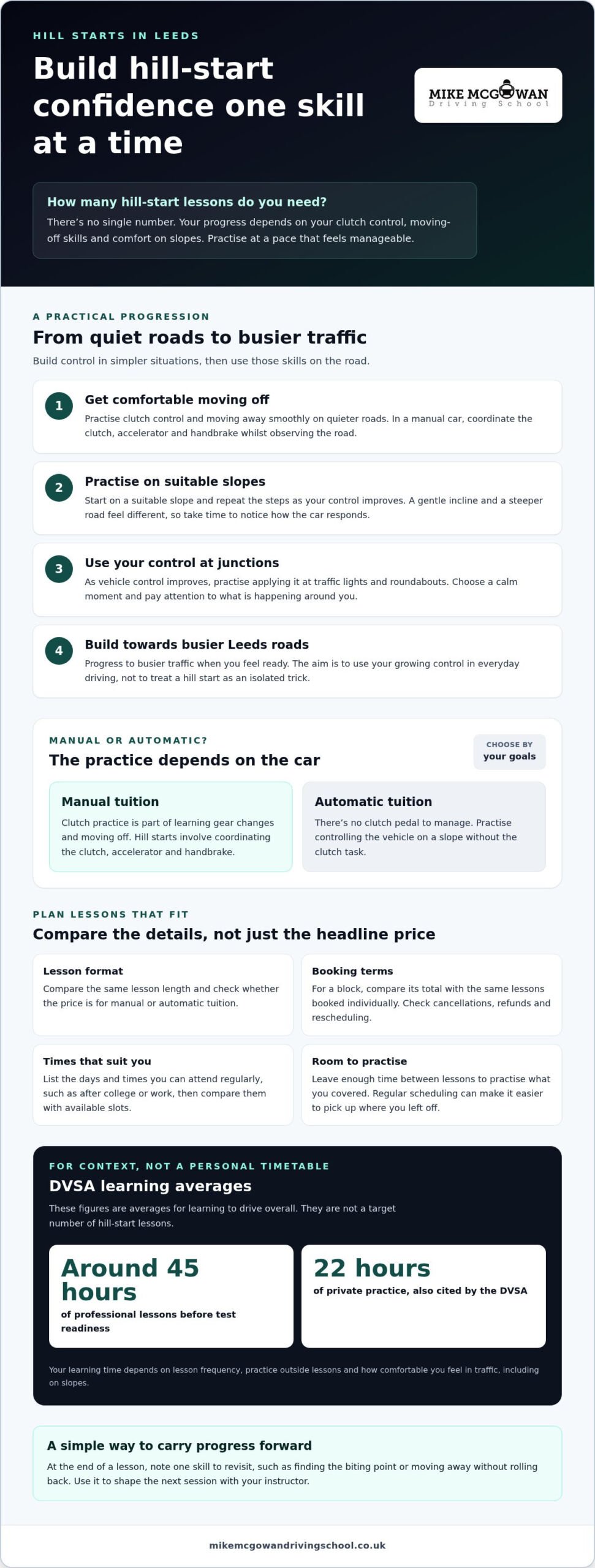
Lesson prices vary, so compare the quoted cost for the same lesson length. Check whether the price is for manual or automatic tuition and whether you pay per lesson or in a block. Comparing the same details makes it easier for learners and parents to plan spending, rather than relying on a headline rate alone.
Availability depends on the instructor’s diary and the times you can learn. Before settling on a schedule, list the days and times you can attend regularly, such as after college or work. Compare these with available lesson slots, and leave enough time between lessons to practise what you covered.
Lesson timing affects how well a session fits your routine. A quieter period can give you more space to focus on clutch control and moving off. Later, practising in busier traffic can help you apply those skills at junctions and roundabouts. Choose times that suit your confidence and learning goals.
Hill starts are part of broader vehicle control, not an isolated test trick. In a manual car, you coordinate the clutch, accelerator and handbrake while observing the road. An instructor can introduce the steps on a suitable slope and repeat them as your control improves. In an automatic, you practise managing the vehicle without a clutch pedal.
Consistent scheduling can make progress easier to follow. At the end of each lesson, note one skill to revisit, such as finding the biting point or moving away without rolling back. Use that note to plan the next session, so your instructor can build on a specific example rather than starting from scratch.
The DVSA average is around 45 hours of professional lessons before test readiness. It also cites 22 hours of private practice. These are averages, not a personal timetable. Your learning time depends on lesson frequency, practice outside lessons and confidence in traffic, including how comfortably you handle slopes.
For local details about lesson areas and learning options, see Leeds driving lessons. When comparing availability, consider whether the location and lesson times fit your regular routine. A workable schedule helps you return to skills such as hill starts before too much time passes between sessions.
Before booking, write down your preferred days, whether you want manual or automatic tuition, and the skills you want to practise. Use this list when comparing instructors in Leeds. It gives you a practical way to discuss lesson structure, timings and costs while keeping your priorities clear.
Lesson prices and block-booking discounts
Driving lesson prices in Leeds vary between schools and instructors, so compare like with like. Check the lesson length, whether tuition is manual or automatic, and what the quoted price includes. A lower headline rate is not a fair comparison if it covers a shorter session or a different type of lesson.
For a block-booking offer, compare the total with the cost of booking the same lessons individually. Read the terms for cancellations, refunds and rescheduling. A discount only helps if the lessons fit your plans and the block works with your budget.
Parents paying for lessons can make comparisons clearer by writing down each school’s price and lesson format. Add the learner’s priorities, such as manual clutch control on hills or practice at a particular junction. This keeps the decision focused on useful tuition, not just the biggest advertised saving.
Ask what a typical lesson covers at your current stage. A learner still practising clutch control needs time to repeat moving off and stopping. Someone preparing for a test at Horsforth needs broader practice on local roads. The session should match the skill being developed.
A driving school’s published price is only one part of the cost. Consider how often you can attend and whether the schedule fits around school, college or work. Regular lessons can help you pick up where you left off, while long gaps may mean revisiting earlier skills.
Discounts can affect flexibility too. Before choosing a block, understand how changes to lesson dates are handled and whether you can use remaining lessons if your plans change. For a learner balancing work shifts, clear rescheduling terms may matter as much as a reduced total.
Learning to drive in Leeds also means choosing between manual and automatic tuition. In a manual car, clutch practice is part of learning gear changes and moving off; an automatic removes the clutch task. Choose the vehicle type that suits your goals, rather than choosing a block solely because it appears cheaper.
Compare the written terms, lesson length and vehicle type side by side. Keep the total spend manageable, and avoid paying for more lessons than you can plan to use. If you’re ready to discuss a suitable lesson plan, you can arrange a driving lesson appointment.
Hill starts, roundabouts and traffic lights
Hill start driving lessons in Leeds can help you feel more confident joining everyday traffic. A hill start is not only about moving off on a slope. It also involves reading what is happening around you and choosing a calm moment to act.
Practising hill starts
During each attempt, notice how the slope affects the car’s response. A gentle incline and a steeper road feel different, so take time to recognise when the vehicle is ready to move. Your instructor can help you understand what you felt through the pedals and give you space to describe it in your own words.
Traffic behind you can add pressure, especially if you’re worried about holding someone up. Focus on the task rather than reacting to another driver’s impatience. If you feel flustered, tell your instructor. Pausing to settle and discuss the next attempt can make practice more useful.
Hill start driving lessons in Leeds can also connect the skill with decisions at junctions. You may need to judge whether to stop before a junction or wait until there is enough room to continue. Talk through what you can see and why you’re choosing to wait, rather than focusing only on the car’s controls.
Choosing suitable practice hills
A useful practice location gives you a clear view of the road and enough space to concentrate. The slope is only one consideration. Your instructor can also account for parked vehicles, road layout and passing traffic, choosing a setting that suits the lesson’s aim.
Before starting, look ahead and identify where you can safely pause. This helps you judge the space available if traffic changes or another vehicle approaches. If the road feels too busy for focused practice, discuss another location with your instructor instead of trying to push through distractions.
Roundabouts and traffic lights bring different decisions into a lesson. At a roundabout, notice how the road rises or falls near your chosen exit. At lights, watch whether traffic is moving steadily or stopping, while remaining aware of the vehicles around you. These observations help you prepare for changing conditions without treating each task as a separate test.
As your awareness improves, describe what you notice before acting: the road shape, traffic flow and available space. This habit helps you make deliberate choices during hill start driving lessons in Leeds and on everyday journeys. Ask your instructor to explain anything that felt uncertain, so your next practice has a clear focus.
Building driving confidence progressively
Confidence grows through manageable steps, not by tackling every road at once. Beginner learners in Leeds can progress over several weeks, moving from basic vehicle control towards busier traffic as their skills develop.
Start with a clear lesson goal, such as moving off smoothly, stopping accurately or steering steadily. Once those basics feel more settled, practise simple junctions and work on looking, judging speed and choosing when to emerge. A specific goal gives you something practical to review at the end of each lesson.
Next, add one new demand at a time. Practise a familiar junction before trying a roundabout, then focus on lane choice and observation. If a manoeuvre feels rushed, ask to repeat it in a quieter setting. Repeating one skill helps you understand what to change, rather than treating a difficult moment as failure.
As your control improves, lessons can progress to roundabouts, busier junctions and faster roads. In Leeds, an instructor can build these stages around the traffic conditions you’re ready to handle. Once you manage a quiet junction confidently, you can practise reading gaps and responding calmly in busier traffic.
Manual and automatic tuition involve different controls, but both require steady observation and planning. In a manual car, take time to coordinate clutch and gear changes before adding more complex traffic. In an automatic, practise smooth speed control and positioning. In either vehicle, focus on one new demand at a time.
Confidence also means recovering calmly when something doesn’t go to plan. If you stall during a hill start, secure the car, take a moment and follow your instructor’s guidance before moving off again. If a roundabout feels overwhelming, discuss what happened and practise the approach in a simpler setting at your next lesson.
A qualified instructor can help you track progress with clear feedback, such as which junctions feel comfortable and what needs more practice. After each session, note one skill that went well, one to revisit and one next step. This gives you and your instructor a shared plan without turning tuition into a pass-or-fail judgement.
Test preparation can include roads around the relevant Leeds test centre, alongside skills you’ve practised elsewhere. Booking a driving test is separate from building confidence. First, focus on handling familiar skills consistently in changing traffic. If you’ve failed before, use the experience to identify what needs attention, then work through it step by step.
Which Leeds driving instructors offer hill start lessons?
Hill-start practice can be part of ordinary driving tuition in Leeds. Local instructors introduce hill starts, roundabouts and traffic lights at a suitable stage, once you can focus on the vehicle and your surroundings. When comparing instructors, look for calm explanations, clear feedback and practice suited to your experience.
Ask how a lesson moves from explanation to practice. A useful approach is to talk through the controls, try a start on a suitable slope, then review what happened. This gives you space to understand clutch control in a manual car, rather than repeating the manoeuvre without feedback.
For automatic tuition, ask how the instructor will help you practise moving off and stopping on an incline. The car handles gear changes, but you still need to manage the brake, accelerator and observations. A patient instructor will explain the steps and give you time to repeat them at a manageable pace.
Teaching style matters, especially if a hill start has made you anxious. Notice whether the instructor explains what to do before the car moves, gives one instruction at a time and discusses mistakes without blame. After a stall, for example, they should help you secure the vehicle and calmly restart the process.
Local road knowledge is another useful comparison point. Ask how lessons progress from a quieter slope to more demanding traffic, roundabouts and junctions. As you approach test standard, practice can include areas around Leeds test centres such as Horsforth or Leeds (Fearnville), helping you become familiar with different road situations.
If you’re changing instructors, bring a short note of what you’ve already covered. Explain whether you’ve practised hill starts in a manual or automatic car, what feels difficult and which skills you can manage independently. This gives your new instructor a practical starting point without repeating every earlier lesson.
Compare lesson structure as well as the instructor’s manner. A useful session should have a clear focus, time to practise and a brief review of what to work on next. This makes progress easier to follow, whether you’re learning for the first time or rebuilding confidence after a test attempt.
Choose an instructor whose explanations make the next step clear. If you’re ready to plan your tuition, use the appointment page to arrange a lesson.
Mike McGowan Driving School: Beginner Driving Lessons
Mike McGowan Driving School offers beginner driving lessons with calm, personalised coaching in Leeds. If you’re starting from the basics, lessons build vehicle control gradually and introduce hill starts when you’re ready. Manual tuition includes clutch control practice, while automatic lessons focus on smooth control without a clutch pedal.
You can work on the skills that feel less settled, whether that’s moving off on a slope, approaching roundabouts or driving in traffic. Lessons are tailored to your progress, so you can discuss what you’ve practised and what you’d like to focus on next.
For steady support as you learn, contact Mike McGowan Driving School or visit mikemcgowandrivingschool.co.uk.
Take your next step at a pace that suits you
Hill start driving lessons in Leeds can be a practical next step if you want to feel more settled when moving off on a slope. Before your next lesson, choose one clear goal, such as staying calm through the set-up or moving away smoothly. A simple focus helps you notice progress without expecting every part of driving to feel easy at once.
If nerves return after a difficult lesson or a previous test, that doesn’t erase the skills you’ve already built. Use what you learned to decide what to practise next, then talk it through with your instructor. Learning works best when you can ask questions and take the time you need to understand each step.
When you’re ready to plan lessons around your goals, call or message Mike directly.
Each calm, considered practice session can help you become a more capable and independent driver.
Frequently Asked Questions
How much do hill start driving lessons cost in Leeds?
There’s no single fixed price for a hill-start session in Leeds. The cost depends on the instructor’s lesson rate and whether hill-start practice is part of a standard lesson or a focused session. Compare lesson length, manual or automatic tuition, payment terms and any block-booking conditions. Work out the total for the lessons you plan to take instead of judging value by a discount label alone.
Do Leeds driving schools offer standalone hill start lessons or include them in standard lessons?
Hill starts are generally introduced during ordinary driving tuition, at a stage that suits the learner. If this is your main concern, make it a focus for the session and agree on a manageable practice plan with your instructor. You can then apply the skill to other driving, such as stopping on an incline before moving off at a junction.
What should learners know before practising hill starts in a manual car?
In a manual car, learn where the clutch, accelerator and handbrake are, and take time to understand the biting point. Before moving, check your surroundings and know how to secure the vehicle if you need to pause. Start with your instructor’s explanation, then practise one controlled move at a time. A stall is a cue to reset calmly, not to rush.
How do you do a hill start without rolling back?
Use the handbrake to keep the car still while you find the biting point and prepare to move. In a manual, coordinate gentle acceleration with a controlled clutch release before lowering the handbrake. Keep your attention on the road and surrounding traffic, not just the pedals. Practise on a suitable slope with your instructor, focusing on one movement at a time.
What are common hill start mistakes and how can learners avoid them?
Common mistakes include releasing the handbrake before the car is ready, lifting the clutch too quickly or using too much acceleration. Rushing can make each harder to correct. If the start doesn’t work, pause, secure the car and reset the sequence. Ask your instructor whether clutch timing, acceleration or observation needs attention, then practise that part separately.
What UK driving test rules apply to hill starts?
Treat a hill start as part of safe, everyday driving, rather than a scripted performance. Follow the examiner’s directions, observe before moving and keep control of the vehicle in the conditions you meet. A hill start only arises if the route and traffic bring you to a slope where you need to stop. Focus on moving away safely and under control, rather than forcing a particular manoeuvre.
Disclaimer
This article is intended as general guidance for learner drivers and does not replace official DVSA advice or a lesson with a qualified instructor. Rules, test requirements, and local test centre procedures can change, so always check GOV.UK or speak to your instructor for the most current information. Mike McGowan Driving School accepts no responsibility for outcomes based solely on the content of this article.