Parallel parking lessons in Leeds and how many you may need
The number of lessons you need isn’t decided by parallel parking alone. There’s no single lesson count that suits every learner: it depends on your reversing control, observations, confidence judging the gap and how comfortably you can correct your position. Parallel parking driving lessons in Leeds can help you practise these skills at a pace that works for you.
If parallel parking feels awkward, you’re not alone. Watching the kerb, nearby cars and other road users at once can feel like a lot at first. The UK Government lists parallel parking as one of the reversing exercises an examiner may ask you to do during the practical test.
This guide explains what parallel parking involves, how to adjust your position if the car doesn’t settle neatly, and what affects how many lessons you may need. You’ll also see why short, focused practice on quieter Leeds roads can help you build confidence step by step, without expecting every attempt to be perfect.
Key Takeaways
- There’s no set number of lessons for parallel parking; your reversing control, observation and confidence all affect how much practice you need.
- A simple reversing and steering routine can make the manoeuvre easier to follow, but you’ll also need to keep checking around you.
- If your position isn’t quite right, a calm adjustment is part of learning. Keep observing and don’t rush to correct it.
- Quieter roads and short, focused practice sessions can help you build confidence before tackling busier Leeds streets.
- Whether you need focused practice or broader driving support depends on your current skills and what you want to work on.
How many lessons will I need to take in Leeds?
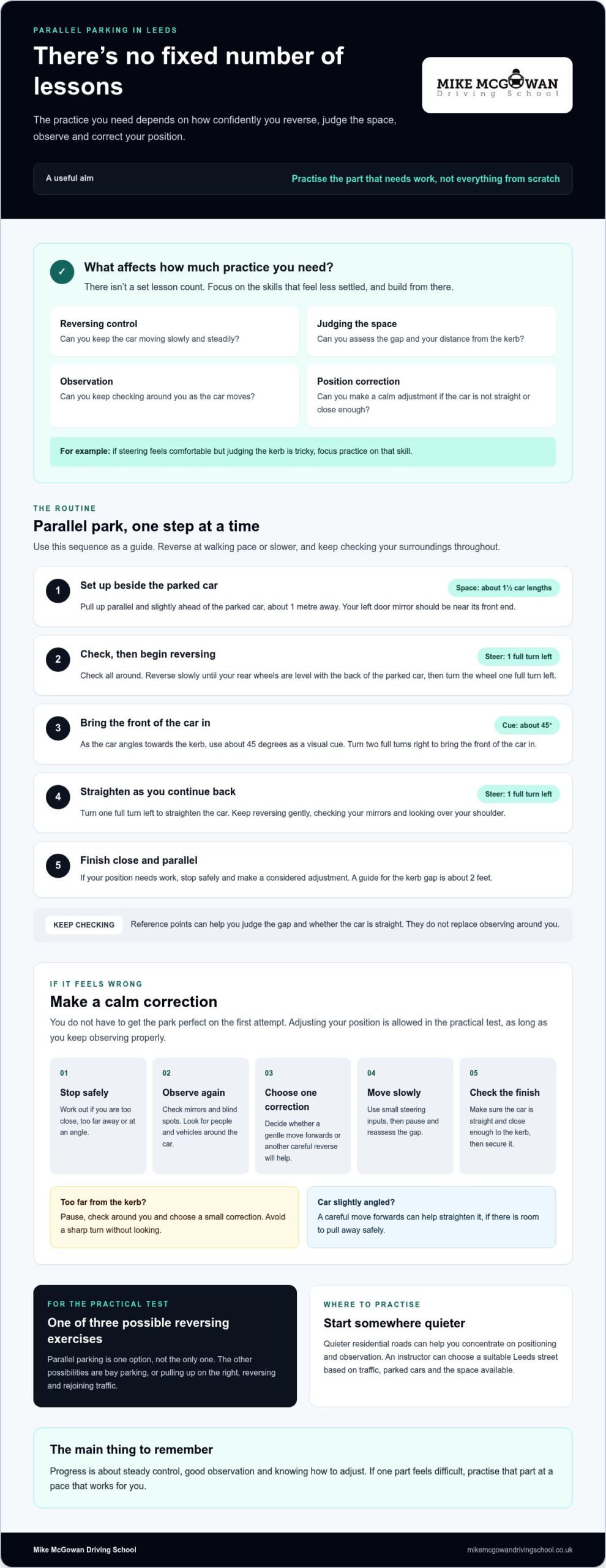
There’s no fixed number of lessons for parallel parking. Your progress depends on how confidently you control the car in reverse, judge the space, observe around you and correct your position. If steering feels comfortable but judging the kerb is tricky, focus practice on that skill rather than starting from scratch.
According to the UK Government, parallel parking at the roadside is one reversing exercise an examiner may ask you to do. The UK practical test has three possible reversing manoeuvres: parallel parking, bay parking, or pulling up on the right, reversing and rejoining traffic. Parallel parking is therefore one possible exercise, not the only one.
Automatic-car learners can practise parallel parking with an instructor. Steering and observation still matter, while an automatic removes the need to balance the clutch and brake during the reverse.
Which Leeds areas suit practice best? Start on quieter residential roads, away from crowded city streets, so you can concentrate on positioning and observation. Your instructor can choose a suitable street based on traffic, parked cars and the space available. The Leeds driving lessons page covers the local lesson area.
Use this steady routine as a guide. Reverse at walking pace or slower, and keep checking your surroundings throughout:
- Choose a space around one and a half times your car’s length. Pull up parallel and slightly ahead of the parked car, about one metre away, with your left door mirror near its front end.
- Check all around, then reverse slowly until your rear wheels are level with the back of the parked car. Turn the steering wheel one full turn left to begin moving into the space.
- As the car angles towards the kerb, use about 45 degrees as a visual cue. Turn two full turns right to bring the front of the car in.
- Turn one full turn left to straighten the car. Keep reversing gently, checking your mirrors and looking over your shoulder.
- Finish close and parallel to the kerb. If your position needs work, stop safely and make a considered adjustment.
You may need more practice with one part of the sequence than another. For example, if the car enters at the right angle but ends too far from the kerb, focus on steering back towards parallel. If setting up feels uncertain, practise positioning beside a parked car before reversing.
Reverse bay parking is a separate manoeuvre. It means reversing into a marked bay, rather than into a roadside gap behind another vehicle. Practising both helps you understand how steering changes the car’s path, but each manoeuvre needs its own reference points and observation routine.
Correcting position during the manoeuvre
A parallel park doesn’t have to be perfect on the first attempt. In the UK practical test, you can adjust your position as long as you keep observing properly. A small mistake, such as stopping slightly far from the kerb, can result in a minor fault rather than an automatic fail.
Use a clear reference point to understand what needs correcting. For example, check the gap between your car and the kerb in the left mirror, then compare it with the parked car ahead. Before steering to bring the car parallel, aim to be about 2 feet from the kerb.
If the car is too far from the kerb, don’t turn the wheel sharply without checking your surroundings. Pause, look around and choose a small adjustment. Aim to bring the car closer to the kerb while keeping it parallel, rather than making a quick correction that creates another problem.
Use this simple sequence when your position feels wrong:
- Stop safely. Hold the car still and take a moment to identify whether you’re too close, too far away, or at an angle.
- Observe again. Check mirrors and blind spots before moving. Look for pedestrians, cyclists and vehicles around the car.
- Choose one correction. Decide whether a gentle forward movement or another careful reverse will help.
- Move slowly. Use small steering inputs and pause to reassess the gap between the car and kerb.
- Finish with another check. Make sure the car is straight and close enough to the kerb, then secure it before moving away.
A forward adjustment can help if you can still pull away from behind the vehicle in front without reversing again. For example, if the car is slightly angled, a careful move forwards can straighten it. Keep checking around you during the adjustment instead of focusing only on the kerb.
Reference points are guides, not a reason to stop observing. The kerb’s position in a mirror can help you judge the gap, while the parked car helps you see whether your vehicle is straight. As your viewing angle changes, recheck both references instead of relying on one fixed picture.
Feeling hurried can make steering and observation harder. If a pedestrian appears behind you or another hazard develops, stop and wait until it’s safe. If the manoeuvre doesn’t feel right, pause and restart only after checking the space and surrounding traffic.
Practising these corrections with clear guidance can help you understand what to adjust, rather than repeating the whole manoeuvre without a plan. If you’d like to discuss lesson options, use the appointment booking page.
What is parallel parking?
Parallel parking means placing your car beside the kerb, in line with parked vehicles. Preparation matters because you need to assess the space, traffic and people around you before reversing.
Preparing before parking
Choose a suitable gap and signal early, giving other road users time to understand your intention. Before stopping, check the traffic behind and around you, then position the car safely beside the space. Look for pedestrians near the kerb, cyclists approaching from behind and vehicles that could pass while you manoeuvre.
Clear the windows before starting if rain, mist or dirt affects your view. Settle into a comfortable driving position so you can turn to look behind without losing control of the car. For example, if a parked van blocks your view of the pavement, take extra care before reversing and be ready to pause.
Using mirrors while observing
Use your mirrors to build a picture of what’s happening, not as a substitute for looking around. The left mirror helps you judge the kerb and the space beside the car. The interior and right mirrors help you monitor traffic approaching from behind or passing on the road.
Keep checking as the car moves, because a clear view can change quickly. A cyclist could approach after your first mirror check, for example, or a pedestrian could step towards the space. Look over your shoulder as you reverse, then return to your mirrors to check the car’s position. Each glance should support your next safe movement.
Checking all around
Before reversing, make a full 360° observation. Check forwards, behind, both sides and the blind spots over your shoulders. This helps you spot people or vehicles that mirrors alone can miss. Continue observing throughout the manoeuvre, especially when switching your view between sides.
Use this simple sequence before and during the reverse:
- Check for pedestrians on the pavement and anyone crossing behind the car.
- Look for cyclists and traffic approaching from either direction.
- Check mirrors and blind spots immediately before moving.
- Pause if someone approaches or your view behind becomes unclear.
- Resume only after checking all around again.
Give way to other road users, including pedestrians crossing behind you. If an approaching vehicle needs room, stop and let it pass rather than trying to finish quickly. If you briefly lose sight behind you while looking over each shoulder, pause until you can check all around again.
Good observation is active, not a single check at the start. Keep updating what you see as the car moves, and stop whenever a new hazard appears. This steady routine helps you make each decision deliberately.
Building confidence through structured driving lessons
Confidence grows when each practice session has a clear focus. In Leeds, start on a quieter residential road, then work towards busier streets as your control and awareness improve. A familiar route lets you concentrate on one challenge at a time, rather than managing heavy traffic and an unfamiliar manoeuvre together.
Before practising, identify the part that feels hardest. It could be judging the gap, coordinating steering or keeping track of traffic while reversing. A clear goal helps you notice progress. For example, focus first on setting up calmly, then review how well you judged the car’s position.
Short, focused sessions are easier to learn from than one long session spent repeating the same attempt. Pause between attempts and talk through what you noticed. If the vehicle ended too far from the kerb, identify what changed during the reverse before trying again. Each attempt then provides useful feedback, not a pass-or-fail judgement.
Nerves can affect concentration, especially after a disappointing test experience. Before starting, take two slow, deep breaths and give yourself time to settle. Then agree a simple plan with your instructor, such as practising in a quiet spot before moving to a road with more parked cars. A steady pace helps you focus on decisions rather than feeling rushed.
Track progress through practical signs, not just a perfect final position. Notice whether you prepare without prompting, keep observing as the car moves and recognise when to pause. If one part still feels uncertain, make that the focus of your next session. One awkward attempt doesn’t mean you can’t do it.
A mock driving test can connect manoeuvre practice with the wider demands of driving independently. It gives you a chance to practise responding to instructions and managing the vehicle while staying observant. You can then work on any issues identified before the real test, giving further practice a clear focus.
If traffic or a tight space makes practice feel too demanding, return to a quieter residential road and rebuild the routine there. Then introduce one new challenge, such as a different parked vehicle or a busier stretch. Gradual progression helps you adapt your judgement instead of relying on one familiar space.
Briefly review each practice: what felt controlled, what needs work and what you’ll focus on next. This simple check gives the following session a purpose and helps you see steady progress, even when the final park still needs an adjustment.
Can I book a single parallel parking lesson in Leeds or do I need a package?
Parallel parking can be a focus within a driving lesson; it doesn’t need to be a separate course. How much practice you need depends on your starting point, how confidently you control the car and whether the difficulty is parking itself or wider driving skills.
If you already drive comfortably and only need to practise this manoeuvre, a focused session can make sense. Work on setting up, reversing slowly, observing and correcting your position. If you’re still building basic control, parallel parking fits more naturally into broader practice alongside steering, junctions and moving safely in traffic.
You don’t need a package to learn the skill. Think about what would make practice useful for you rather than choosing a fixed number of lessons before you know what needs work. For example, if you understand the steering routine but lose confidence near traffic, practising in a quieter area first can help identify the next step.
To make a lesson productive, agree on a specific aim before you start. You could complete one park, then discuss where the car ended and what you noticed. If the setup was sound but the car finished too far from the kerb, focus next on judging the gap and making a measured correction.
For cost-conscious learners and parents, review progress after each session. Note what the learner can do independently, where prompts are still useful and what to practise next. This gives you a clearer basis for deciding whether another focused session or wider driving practice is the better use of lesson time, without paying for practice that doesn’t match the learner’s needs.
If you’re changing instructors, give a clear summary of your experience. Mention which manoeuvres you’ve practised, what feels comfortable and what still causes hesitation. A learner who can reverse steadily but struggles to judge space needs different practice from someone still learning to control the vehicle backwards.
After a test attempt, a focused session can help you revisit parallel parking without treating one result as the whole story. Identify the specific issue, such as observation or positioning, then practise it alongside the wider skills needed for independent driving. A calm review makes the next step more purposeful.
Mike McGowan Driving School: Beginner Driving Lessons
Mike McGowan Driving School offers beginner lessons for learners who want to build core skills, including reversing and parking, at a steady pace. Calm, personalised coaching can help you work on what feels difficult, whether that’s judging the space or keeping your observations consistent.
Lessons are available in manual and automatic cars, so you can practise in the type of vehicle that suits your learning. If you already hold a licence and want to improve a particular skill, refresher lessons are another option. The right starting point depends on your experience and whether you need broader driving practice alongside parallel parking.
If you’re ready to discuss lessons, contact Mike McGowan Driving School or visit the Mike McGowan Driving School website.
Take your next step at your own pace
Your next lesson can start with one clear aim: understand what makes parallel parking feel difficult for you. That could be deciding when to begin, staying settled while reversing or knowing how to respond when your position needs adjusting. Sharing that aim before you set off gives the session a useful focus.
If you’re looking for parallel parking driving lessons in Leeds, choose a next step that fits your experience rather than comparing yourself with other learners. Progress is easier to recognise when you know what you’re practising and what you want to feel more confident doing. You don’t need every detail worked out before arranging a conversation.
Take the manoeuvre one decision at a time. With a clear focus for your practice, you can keep building towards calm, independent driving.
Frequently Asked Questions
How much does driving tuition cost in Leeds?
Tuition fees vary between instructors and lesson types, so compare the full amount you’ll pay rather than a headline offer alone. Ask whether the quoted fee covers lesson time and car use, and how payment is arranged. If a parent is paying, agree who will handle bookings and payments before lessons begin. This keeps the practical details clear for both learner and payer.
Why do you need to know how to parallel park?
Knowing how to parallel park gives you another option when choosing where to leave your car. It can be useful outside a home, on a residential street or near a destination where roadside spaces are available. Confidence with the skill also helps you consider a suitable space between other vehicles. Practising supports everyday independence after the test.
Which Leeds driving schools offer lessons focused on parallel parking?
Mike McGowan Driving School is a Leeds option for learners seeking parallel parking lessons in Leeds. Before arranging tuition, describe what you want to practise, such as judging the available gap or feeling comfortable in a manual or automatic car. This helps you understand whether the teaching approach suits your needs. It also gives you a clear point to discuss with whoever is helping pay.
How much do driving lessons in Leeds cost, including specialist parking lessons?
Ask for the total fee for the lesson you plan to take, including any parking practice you want to cover. Clarify whether the instructor charges by lesson type or offers a separate session for a specific skill. Don’t assume a specialist label means a different price or format. A clear quote makes it easier to plan your spending and compare like-for-like options.
What are the steps for parallel parking on the left in a UK driving test?
Follow the examiner’s instruction and use a safe, controlled approach rather than relying on a memorised steering count. Choose a suitable space, position the car, then reverse while responding to what you can see around you. If the position needs adjusting, take time to do so safely. The examiner is assessing your control and decisions, not whether you follow one fixed method.
What mistakes do learners commonly make during the parallel parking manoeuvre?
A common trap is treating a remembered reference point as exact, even when the car or gap is different. That can lead to steering at the wrong moment or making a correction that doesn’t solve the original issue. Another mistake is focusing only on getting into the space, then forgetting to check whether the final position leaves room to move away. Review both entry and exit.
How many lessons does it usually take to learn parallel parking?
Rather than counting attempts, look at how independently you can complete the task. Can you decide where to position the car, adapt when the gap differs from practice and explain what you’d change after an untidy finish? Practise in more than one suitable space with your instructor. If you can make sensible decisions in each, you’re building a skill you can use beyond one familiar spot.
What should I look for when comparing Leeds driving instructors for parking practice?
Check that your instructor is DVSA-approved and can explain how practice will suit your current ability. Ask how they adapt if you feel anxious, need a slower explanation or have changed instructors partway through learning. Also consider whether the lesson car suits your preference for manual or automatic driving. These practical points matter more than a broad promise that parking will feel easy straight away.
Disclaimer
This article is intended as general guidance for learner drivers and does not replace official DVSA advice or a lesson with a qualified instructor. Rules, test requirements, and local test centre procedures can change, so always check GOV.UK or speak to your instructor for the most current information. Mike McGowan Driving School accepts no responsibility for outcomes based solely on the content of this article.