

Dual Carriageway Driving Lessons in Leeds: Prices and Pickups
A ring-road lesson doesn’t have to begin on the busiest stretch. Dual carriageway driving lessons in Leeds can build towards local roads at a pace that feels manageable, with practice on the inner and outer ring roads, Dewsbury Road and the M621 corridor as confidence grows.
It’s sensible to want clear answers before booking, especially when comparing lesson costs, offers and pickup areas. Feeling unsure about faster roads is common. Calm, structured practice helps you get used to joining traffic, keeping a safe gap and planning ahead.
This guide explains what Leeds areas and routes lessons can cover, what to look for in prices and offers, and how dual carriageway and ring-road practice can fit into your learning. You’ll also find out what to consider when arranging a pickup, so you and whoever is paying can make a clear, comfortable plan.
Key Takeaways
- Lessons can build from quieter residential streets towards busier Leeds roads as your confidence and control grow.
- Look for learner feedback that describes the teaching experience, not just pass outcomes, which can’t promise your own result.
- Dual carriageway practice can progress to Leeds routes such as the inner and outer ring roads, Dewsbury Road and the M621 corridor.
- Before arranging a lesson, clarify whether pickup and drop-off can fit your location and schedule.
- Compare lesson options by what you need to practise, whether you’re a beginner, learning in a manual or automatic car, or returning to driving.
Which areas do you cover for driving lessons?
Driving lessons cover Leeds, Morley and surrounding parts of West Yorkshire. Around Leeds, named areas include Headingley, Horsforth, Moortown, Roundhay, Chapel Allerton, Meanwood, Kirkstall, Hyde Park, Armley, Burley and Bramley. The Leeds driving lesson area page gives a local overview. Your starting point helps shape where a lesson begins and which roads make sense to practise.
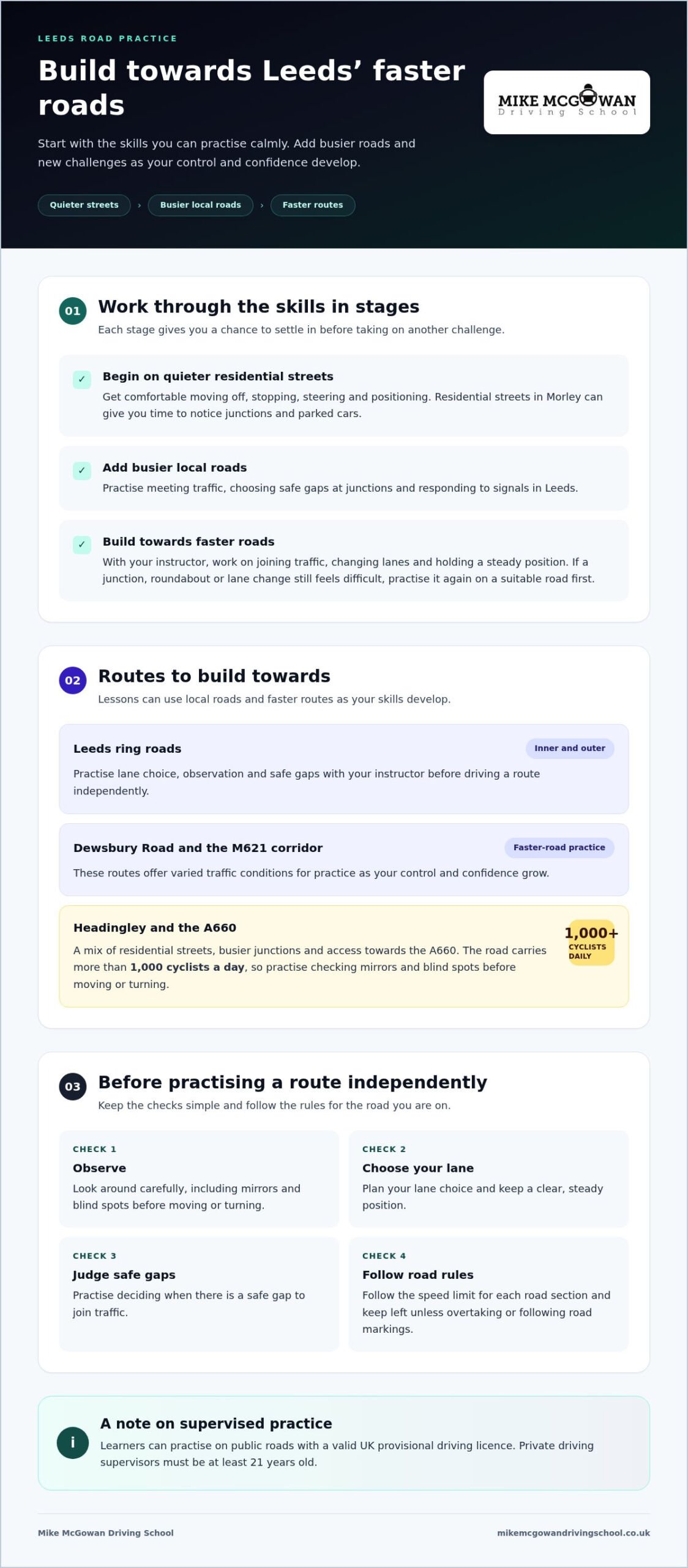
Progress usually starts on quieter residential streets, where you can settle into the car and practise moving off, stopping, steering and positioning. A route through a residential area in Morley, for example, gives you time to notice junctions and parked cars before adding faster traffic. Once those basics feel steadier, you can move on to busier local roads.
Each step adds a manageable challenge. After quiet streets, practise meeting traffic, choosing safe gaps at junctions and responding to signals on busier roads in Leeds. Then work towards faster roads and dual carriageways. Your instructor can shape the route around the skills you need, such as joining traffic, changing lanes or holding a steady position.
The car’s transmission affects how you practise, but not which Leeds roads you can learn on. In a manual car, you coordinate gear changes with observation and steering. In an automatic, you can focus more on road position, speed and traffic flow. Either way, build these core skills before taking on busier roads.
Local test centres can also help give lessons a practical focus. Horsforth Driving Test Centre is at Woodside House, 261 Low Lane, Horsforth, Leeds, LS18 5NY. It is within 400 metres of the Leeds Ring Road, the A6120. Nearby roads can form part of local practice as you build towards test-standard driving, rather than being your first experience of faster traffic.
For dual carriageway driving lessons in Leeds, gradual progress matters more than simply travelling further. Start with road skills you can practise calmly, then add one new challenge at a time. If a junction, roundabout or lane change still feels difficult, practise it again on a suitable road before moving to a faster route.
At the end of each lesson, consider what you can now do more independently: move off safely, judge a gap, follow signs or maintain a clear lane position. These are practical markers for planning your next step with your instructor. From a Morley residential street to a busier Leeds route, the aim is to build skills that transfer to unfamiliar roads.
Learner reviews and pass experiences
Reviews can give you a sense of what learning to drive with a school is like. Look for detail about lesson structure, communication and how the instructor responds when a learner feels nervous. A review describing help with lane positioning on the Leeds Ring Road offers more context than a brief “great lessons” comment.
Pass stories can be encouraging, but they describe one learner’s experience, not a promise about your result. Notice what helped that learner prepare, such as practising a particular junction or becoming more comfortable with feedback. Those details can help you judge whether the teaching approach may suit your needs.
Centre figures need the same care. Horsforth recorded a 49.7% car-test pass rate from April 2025 to March 2026. Leeds (Fearnville) recorded 51.8% over that period. These are centre-wide results, not a measure of what any one learner will achieve.
Reviews vary in how much useful detail they provide. One learner might describe returning after a failed test and rebuilding confidence on roundabouts. Another might mention practising routes near Horsforth Test Centre. Specific examples help you decide whether the feedback relates to your concerns.
If you’re nervous, look for comments about patience, clear explanations and manageable goals. For example, a review describing practice with a lane change before moving into heavier traffic tells you more about the teaching process. If you’ve changed instructors, look for examples of lessons adapting to your experience rather than repeating every skill from the beginning.
Learning resources can complement practical tuition. Use them to revisit a topic from a lesson, such as road positioning, then note what you want to practise next. Keep the goal specific: identify what feels unclear, practise it with support and review how it went. This connects independent study with real driving.
When choosing a school, look for repeated themes in reviews rather than relying on one dramatic pass story. Check whether learners explain what they practised, how they received feedback and what changed over time. A useful review helps you picture the learning process, not just the test result.
If you want to talk through your learning goals or nerves before arranging lessons, book an appointment to discuss your needs.
Practice on dual carriageways and Leeds ring roads
Practice can build from local roads to Leeds’s faster routes as your control and confidence develop. The inner and outer ring roads, Dewsbury Road and the M621 corridor offer varied traffic conditions.
Learners can practise on public roads with a valid UK provisional driving licence. The UK Government says private driving supervisors must be at least 21 years old.
Practice Around Headingley and the A660
Headingley offers a mix of residential streets, busier junctions and access towards the A660. The road carries more than 1,000 cyclists a day, so practise checking mirrors and blind spots before moving or turning. A lesson can focus on sharing space, positioning and reading traffic without rushing towards faster sections.
Roundabouts and side roads around Headingley offer opportunities to practise planning ahead. Talk through the signs and lane markings before each junction, then review what you noticed afterwards.
Joining and Leaving Faster Roads
Before joining a dual carriageway, build speed on the slip road while checking your mirrors and looking for a safe gap. Match the traffic flow when conditions allow, signal clearly and avoid forcing another driver to change speed or position. Once on the carriageway, maintain a safe distance and scan well ahead.
To leave, read direction signs early, signal and move into the exit lane when it’s safe. Practise the sequence with your instructor before trying it in private practice. Calm preparation is especially helpful if lane changes or faster traffic feel unfamiliar.
Practice Before the Test
There’s no fixed number of dual carriageway lessons that suits everyone. A more useful measure is whether you can join, maintain lane position, respond to signs and leave safely without constant prompts. Ask your instructor to revisit any part that still feels unsettled.
Before your driving test, practise in different traffic conditions and combine faster-road skills with other tasks, such as roundabouts and route planning. An intensive approach isn’t right for everyone. Steady practice gives you time to identify gaps and work on them before test day.
Leeds gives learners access to dual carriageways alongside a variety of other road environments. Make each practice purposeful by choosing one skill to focus on, such as keeping a steady distance, checking mirrors before changing lanes or reading direction signs early. Ask your instructor what to look for, then practise the sequence until it feels controlled. If traffic or a manoeuvre feels difficult, return to an easier section before trying again.
After each drive, talk through what went well and what still needs attention. Consider whether you spotted signs in good time, chose a suitable lane and left enough space around the car. Keep the review specific, so your next lesson has a clear focus instead of trying to improve everything at once. As confidence grows, combine these skills with the observation and planning you’ve practised on local roads. This helps faster-road driving feel like a connected part of learning, not a separate challenge.
Driving lesson availability and pickups
Driving lessons are available from 6:30 AM to 9:00 PM, seven days a week. Those hours give learners options around college, work and family commitments. When choosing a slot, think about whether you’ll be alert and ready to concentrate, not just which time fits your diary.
Pickups are available across Leeds and surrounding areas in West Yorkshire. Choose a clear meeting point, such as your home, college entrance or workplace, and be ready there at the agreed time. A specific location helps avoid confusion at busy places, including campus entrances and town-centre streets.
When arranging lessons, share your preferred days, available times and pickup area together. For example, if you finish college in Leeds in the afternoon, say where you’ll meet and when you can start. These details help plan a lesson that fits your schedule.
If you’re fitting lessons around shifts, suggest more than one suitable time. If your working hours change, share the days you’re free and times you need to avoid. Putting those details in one message makes it easier to plan a consistent schedule.
Parents arranging lessons can agree on the pickup plan with the learner first. Decide who will be waiting, where the car can stop safely and what to do if a class or shift ends late. A simple plan reduces last-minute confusion and helps the lesson start calmly.
For a regular learning routine, choose a time you can keep most weeks. A lesson before college feels different from one after work, so consider travel, tiredness and other commitments. If your timetable changes, let your instructor know which times still work.
Your pickup location can shape the start of a lesson. Meeting near home may make it easier to begin on familiar streets, while a central Leeds pickup can mean starting in busier traffic. Choose a starting point that suits your experience and the session’s aim.
Before arranging a lesson, have your preferred pickup point and available times ready. This makes it easier to compare options with your actual week and agree on a plan that works for the learner and family.
Which driving schools in Leeds offer dual carriageway driving lessons?
Driving schools in Leeds can include dual carriageway practice within practical tuition as your skills develop. Local routes include the inner and outer ring roads, the A6120 and the M621 corridor. The useful comparison is how an instructor builds towards these roads, not simply whether a school mentions them.
Before choosing a school, look for a clear explanation of how lessons progress from quieter streets to faster traffic. If you’re still working on mirror checks and lane position, for example, practise those skills before tackling a busy merge. Ask how your instructor will adapt the route if you feel nervous or find a junction difficult.
Compare the teaching approach
Reviews and lesson descriptions can help you understand what a school’s teaching looks like. Look for local examples, such as practising a merge near the M621 or navigating a roundabout on the Leeds Ring Road. Specific detail gives you a better sense of whether lessons include supported practice and useful feedback.
- Road progression: Look for a plan that starts with manageable roads and builds towards the A6120 or M621.
- Clear feedback: Check whether learners describe specific guidance on joining, lane choice or leaving a carriageway.
- Relevant practice: Look for examples involving Leeds routes, rather than general claims about confidence.
- Steady support: Notice whether reviews mention patient teaching when a learner feels nervous or needs repetition.
Pass stories provide context, but they can’t predict your test result. Focus on what learners say happened during lessons, such as practising a challenging junction again or discussing an earlier test attempt. That’s more useful than a pass announcement without details about the learning process.
Choose lessons around your needs
When comparing dual carriageway driving lessons in Leeds, write down the skills you want to practise. These might include joining from a slip road, keeping a safe gap, changing lanes or following signs towards a Leeds exit. Then consider how a school approaches those specific tasks.
If you’ve failed a test before, explain which roads or situations made you feel uncertain. That can turn a concern into a practical focus, such as practising lane positioning before using a busier part of the ring road. Parents can discuss the lesson plan with the learner so everyone understands the next steps.
Choose the school whose approach gives you a clear, manageable way to build skills on Leeds roads.
Mike McGowan Driving School: Beginner Driving Lessons
Mike McGowan Driving School offers beginner lessons with calm, personalised coaching to help learners build confidence on Leeds roads. Choose manual or automatic tuition and work towards faster roads as your control and confidence grow.
If you’re returning to driving, refresher lessons can help you revisit skills and work on areas that feel uncertain. Learners preparing for local tests can practise on relevant Leeds routes. There’s no need to feel embarrassed about nerves or a previous test result. Sharing what you find difficult helps shape a useful starting point.
For a steady start, think about whether you prefer manual or automatic lessons and which road situations you want to practise. Visit Mike McGowan Driving School’s website to find out more and get in touch.
Choose your next step with confidence
Before your next lesson, choose one road skill you want to feel more confident with. It could be judging a gap, holding your lane or following signs towards an exit. A clear goal gives you something practical to discuss and practise without trying to tackle everything at once.
With dual carriageway driving lessons in Leeds, steady progress matters more than trying every route straight away. Explain what feels difficult, agree on a suitable starting point and build from there. If you’re arranging lessons with a parent or changing instructors, sharing the same goal helps everyone understand what you’re working towards.
A first conversation with Mike can help you talk through your learning needs and decide on a sensible next step. You don’t need to have every answer ready before you begin.
Take it one skill at a time. Confidence grows with practice, and each lesson can help you move forward.
Frequently Asked Questions
How much do dual carriageway driving lessons in Leeds cost?
Lesson costs depend on the lesson length and whether you choose manual or automatic tuition. A longer session costs more overall than a shorter one, so compare the total time as well as the rate. If you’re budgeting with a parent, agree how often lessons fit your schedule and spending limit before arranging them. This helps you plan without relying on an assumed package or discount.
What does a dual carriageway driving lesson in Leeds cover?
A lesson can help you read road signs, judge traffic flow and maintain a steady speed and safe following distance. Your instructor can also help you observe how other vehicles behave, giving you time to plan rather than react at the last moment. Before setting off, choose one focus, such as spotting signs early. Afterwards, discuss what felt clear and what needs more practice.
Do Leeds driving instructors offer dual carriageway lessons for nervous drivers?
Yes. With supported practice, nervous learners can become more familiar with faster roads. Before the lesson, note what worries you most, such as traffic passing close by or the sound of vehicles at speed. Sharing that concern gives the session a clear starting point. Afterwards, reflect on what helped you feel more settled and what you’d like to practise again.
Which Leeds roads are commonly used for dual carriageway driving lessons?
Lessons can include suitable sections of Leeds’s ring roads and connected A-roads. The route depends on where you start, your experience and the traffic conditions on the day. A road that suits a learner near Horsforth may not be the best starting point for someone elsewhere in Leeds. Discuss the type of road you want to practise, then build a route that fits your current skills.
What speeds and lane rules apply on UK dual carriageways?
Follow the speed limit for each road section and keep left unless overtaking or following road markings.
Disclaimer
This article is intended as general guidance for learner drivers and does not replace official DVSA advice or a lesson with a qualified instructor. Rules, test requirements, and local test centre procedures can change, so always check GOV.UK or speak to your instructor for the most current information. Mike McGowan Driving School accepts no responsibility for outcomes based solely on the content of this article.


