Driving Instructor in Harehills for Automatic Lessons and Support
Switching from manual to automatic isn’t giving up; it’s choosing the car that suits how you want to learn. A driving instructor in Harehills can help you build confidence with automatic lessons, DVSA-approved instruction and focused support after a failed test.
It’s understandable to wonder whether changing your lesson type or starting again with a different instructor will set you back. A calm, patient approach can help you identify what’s been difficult and make steady progress without feeling judged.
This guide explains what to expect from automatic lessons around Harehills, how local practice can prepare you for driving in Leeds, and what support after a test failure can involve. It also covers practical points to consider when choosing an instructor, including finding a teaching style that feels comfortable for you.
Key Takeaways
- Work out whether automatic lessons suit your needs, and consider the full cost before booking a block of lessons.
- Understand what DVSA-approved instruction means and how calm, tailored teaching can support steady progress.
- After a failed test, use the result to identify what to practise next rather than treating it as a measure of your ability.
- Build familiarity with Harehills roads and local traffic situations step by step, including roundabouts and one-way systems.
- If you’re considering a move from manual to automatic, think about which parts of learning you want to make more manageable.
Why Automatic in Harehills?
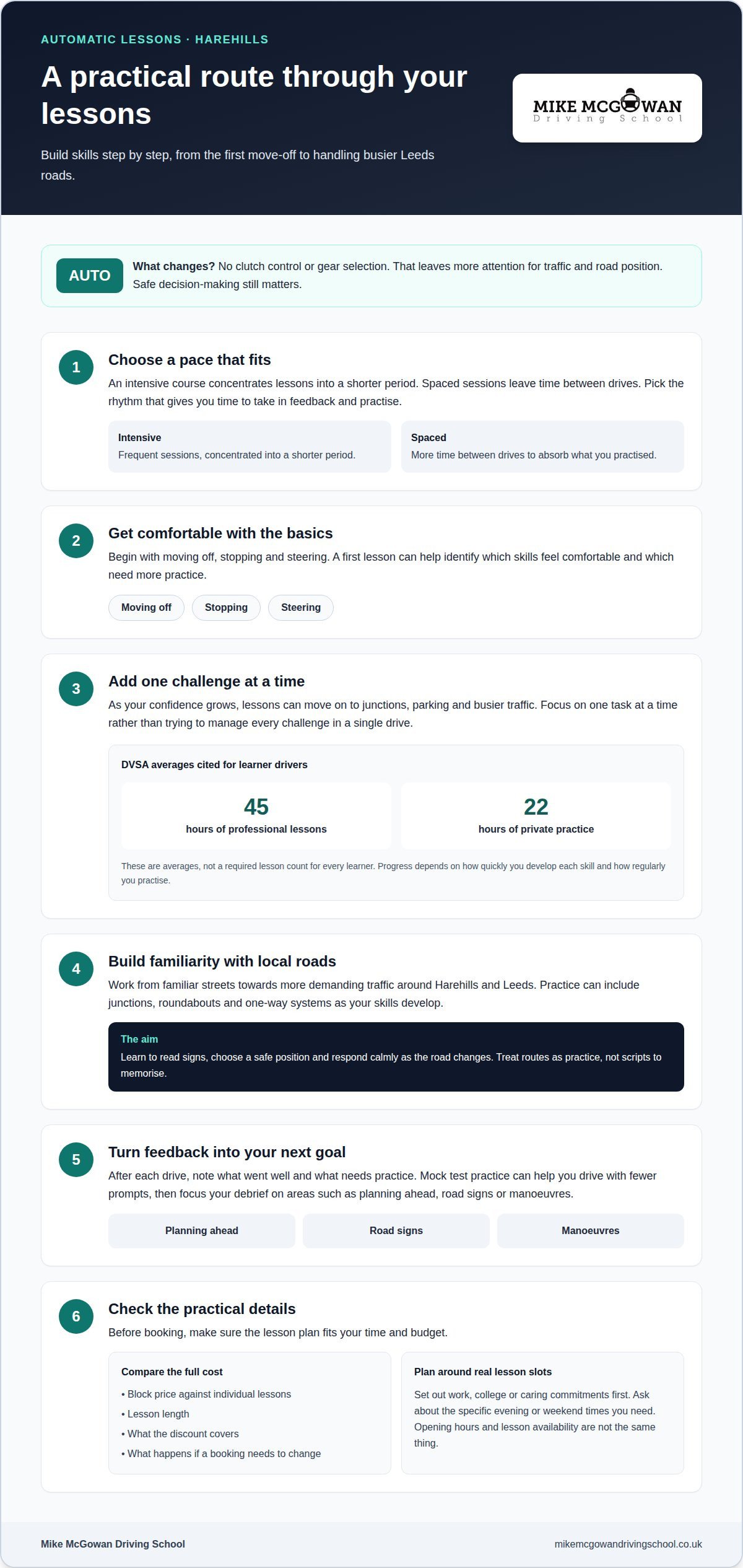
Automatic lessons remove gear changes, leaving more attention for traffic and road position. An intensive course concentrates lessons into a shorter period, while spaced sessions allow time between drives.
Lessons for beginners and nervous learners
Beginners can build skills in a clear order, starting with moving off, stopping and steering. In Harehills, later practice can introduce junctions, parking and busier traffic as confidence grows. Nervous learners can focus on one task at a time instead of tackling every challenge in a single drive. When choosing a driving instructor in Harehills, look for calm explanations and lessons shaped around what you need to practise.
Automatic driving also removes clutch control and gear selection from the tasks you need to manage. That can leave more attention for observation, speed and planning. You still need to learn safe decision-making, but the demands inside the car are different. A first lesson can help identify which skills feel comfortable and which need more practice.
Lesson prices and block-booking discounts affect both the total cost and how much you pay upfront. Before committing to a block, compare its full price with the cost of individual lessons. Check how long each lesson lasts, what the discount covers, and what happens if you need to change a booking. A lower total only helps if the lesson length and booking terms suit your plans.
The DVSA average cited for learner drivers is around 45 hours of professional driving lessons and 22 hours of private practice. These are averages, not a required lesson count for every learner. Progress depends on how quickly you develop each skill and how regularly you practise. In Harehills, a lesson plan can build from quieter roads towards more demanding traffic.
Scheduling depends on the times you can learn and the instructor’s available slots. Set out your regular commitments first, such as college, work or caring responsibilities. Then agree lesson times that fit around them. If you need evening or weekend sessions, ask about those specific times before planning a routine. Opening hours and lesson availability are not the same thing, so focus on actual lesson slots.
Reviews and pass rates in Harehills
Reviews can show how learners describe an instructor’s communication, punctuality and support when progress feels slow. Look for specific examples, such as clear feedback after a lesson or patient help with a difficult manoeuvre. The Leeds Driving Test Centre is at Hillcrest House, 386 Harehills Lane, Leeds, LS9 6NF. Its listed pass rate is 48.9%, but that figure does not tell you how a particular learner will perform.
Intensive driving courses in Harehills Leeds concentrate practice into a shorter period. They suit learners who can commit to frequent sessions, while spaced lessons leave more time between drives. Choose a pace that allows you to absorb feedback, practise skills and return with questions. That matters whether you’re starting out or rebuilding confidence after a break.
DVSA-approved driving instructor in Harehills
A DVSA-approved instructor provides professional instruction for learning around Harehills. Lessons can connect core driving skills with local traffic, junctions and test preparation. Clear feedback after each drive helps you understand what went well and what to practise next.
When choosing an instructor in Leeds, focus on teaching style, communication and lesson planning. Reviews can offer insight into whether learners found the instruction calm and useful, but look for specific details rather than relying on general praise. In an initial conversation, explain your experience, goals and any concerns, such as nerves at busy junctions.
For driving schools and instructors near Harehills LS9, consider where lessons can begin and which local roads you want to practise on. A convenient meeting point can make regular lessons easier to fit around college, work or family commitments. Ask how the instructor builds lessons from familiar streets towards more demanding traffic, rather than expecting you to manage everything at once.
Mock test practice gives you the chance to drive with fewer prompts and receive focused feedback afterwards. Your instructor can observe how you plan ahead, respond to road signs and manage manoeuvres. A useful debrief turns each point into a clear practice goal. If lane choice needs work, for example, the next lesson can include junctions where you can build that skill steadily.
The Leeds Driving Test Centre is at Hillcrest House on Harehills Lane. Lessons near the centre can help you practise local road conditions and prepare for the decisions you may face on test day. Treat routes as practice, not scripts to memorise. Strong preparation means learning to read signs, choose a safe position and respond calmly as the road changes.
Before a mock test, agree what feedback would be most useful afterwards. You could focus on observation, meeting traffic or manoeuvres, then review each point with your instructor. This makes practice specific instead of leaving you with only a general sense of how the drive went. If you feel nervous, discuss which parts of a test-style drive seem most difficult.
If you’re ready to discuss lesson goals or test preparation, you can book an appointment. Bring one or two examples of situations you want to practise, such as busy junctions near Harehills or choosing lanes early. That gives the conversation a practical starting point and helps shape lessons around your priorities.
Support for learners who have failed before
A failed test can leave you unsure what to practise next. Start with the parts of the drive that felt hardest, then turn each into a clear lesson goal.
Support after a previous test failure
Begin with what you remember from the test, such as hesitation at junctions or difficulty choosing a lane. If you have written feedback, use it to identify specific skills rather than judging your whole drive. A focused practice plan gives each lesson a purpose. You’re building on experience, not starting from nothing.
Separate driving errors from nerves. Needing a prompt during a manoeuvre, for example, points to a different practice need than feeling tense before setting off. Naming the situation helps your instructor understand what support would be useful. You can then practise the manoeuvre in manageable steps, repeating each part until it feels more familiar.
Keep a short record after each lesson. Note one skill that felt steadier and one situation to revisit, such as meeting traffic on a narrow road. Use those notes to agree a starting point at your next session. This gives you a visible thread of progress and stops one difficult moment from defining the whole learning process.
Test preparation should reflect your current driving, not a fixed timetable. If independent decisions still feel difficult, practise planning and observation before adding pressure. If your control is steady but confidence drops in busy traffic, build up from familiar roads to more complex situations. A careful pace helps turn feedback into practical work.
Communication and learner guidance
Useful guidance is specific, calm and easy to act on. After a drive, ask which situation needs attention first and what you should do differently next time. “Look earlier for the exit” is clearer than “be more confident”. Good communication also leaves room for you to explain when a task feels overwhelming.
Agree how feedback will work before lessons begin. Some learners prefer a brief explanation before trying again; others benefit from talking through the drive afterwards. Clear instructions, time for questions and a shared plan can make lessons feel more predictable. If you’re changing instructors, explain what you’ve already covered and what you want to retain.
Theory study can support practical progress, especially when road signs or hazard awareness feel uncertain. Use official DVSA theory test learning resources to revisit a topic, then connect it with an example from a lesson. For instance, discuss how a sign changes your approach to a junction. Focus revision on topics you find difficult rather than trying to study everything at once.
Before your next drive, choose one practical goal and one theory topic to review. You might practise a junction sequence, then revisit signs linked to priority. A small, clear plan gives you something useful to carry forward, whatever happened on your previous test.
Roundabouts, ring roads and one-way systems
Driving in Harehills can help you build confidence with busy junctions one decision at a time. At a roundabout, approach at a controlled speed, check signs and markings, then choose a suitable lane. Keep checking for traffic as you enter and leave. If the exit is unclear, focus on the road signs rather than guessing from memory. This helps you respond to the layout in front of you.
Roundabouts can feel demanding because several things happen at once. Break the task into steps: observe early, position correctly, check for a safe gap, then steer towards your chosen exit. If a vehicle blocks your view, wait until you can assess the traffic clearly. After leaving, check your mirrors and settle into the correct road position. Practising this sequence on different roundabouts builds understanding, not just route memory.
Practice on the Leeds ring road adds another useful challenge: holding a steady position while watching signs and surrounding traffic. Before joining, identify your direction and look ahead for lane guidance. Once on the road, leave enough space from the vehicle in front and avoid last-second lane changes. If a turn is approaching, plan early from the signs. A calm, planned adjustment is easier to manage than a last-minute reaction.
One-way systems require careful attention to signs, especially when several turns appear close together. In central Leeds, practise reading direction signs before reaching a junction, then check the road markings as you approach. Don’t assume a familiar street always works in the same direction. If you miss a turn, continue safely and let the route adjust. A missed turn is easier to manage than a sudden change of direction.
Harehills Lane is a local reference point for practising how to scan ahead and respond to changing road layouts. A useful lesson can combine a quieter stretch with a busier junction, then review what you noticed. For example, identify a sign early, check mirrors before changing position and leave room for other traffic. This links observation to action instead of treating each skill as a separate exercise.
Before trying a more demanding route, agree on one focus for the drive, such as lane choice or signalling. Afterwards, talk through where you made decisions and what information helped. You can then practise the same type of situation elsewhere in Leeds without relying on a memorised route. If nerves rise at a roundabout, give yourself time to plan, focus on signs and traffic, and take the next safe opportunity.
Switching from manual to automatic
Changing from manual to automatic is a practical choice, not a step backwards. In Harehills, it can help you focus more on steering, observation and road position. The right decision depends on what feels difficult in the car and what kind of driving you want to do. Consider whether clutch control and gear changes are taking attention away from traffic.
Some skills transfer directly. You’ll still need to steer accurately, use mirrors, judge gaps and respond to signs. Planning early at a junction matters in both types of car. Automatic driving removes the need to coordinate the clutch and gear changes, but you still need to control your speed and make safe decisions.
Before switching, talk through what you’ve already learnt. Note which manual skills feel steady and where lessons become stressful, such as moving off on a slope or changing gear in busy traffic. That conversation can shape a sensible starting point. You can keep building your road awareness instead of treating every part of learning as new.
Your first automatic drive can focus on getting used to the car’s controls and response. Practise moving off, stopping smoothly and maintaining a safe speed on quieter roads in Harehills. Then add junctions, parked cars and busier traffic as those basics settle. A different car can feel unfamiliar at first, so give yourself time to adjust before judging your progress.
If you’ve already taken lessons or booked a test, include that in your planning. Talk through the test arrangements and the car you’ll use so your practice supports your next step. If you’ve failed before, identify whether the difficulty came from vehicle control, nerves or a particular driving situation. The answer helps you decide what to practise first.
Switching doesn’t erase your previous experience. Skills like reading traffic and spotting hazards remain useful as you adapt to automatic controls. A lesson can revisit a familiar route near Harehills, then work on one new challenge. For instance, practise a roundabout while focusing on lane choice and traffic rather than gear changes.
Consider the longer-term choice too. Think about the cars you expect to drive and whether you want to continue learning in an automatic. Discuss the trade-offs with your instructor, including which tasks currently demand the most attention. Having a clear reason for switching makes it easier to set goals and notice progress from one lesson to the next.
Choose your next step based on your experience, not embarrassment about changing direction. Bring a short list of manual tasks that feel comfortable and those you want to leave behind. That gives your first automatic lesson a clear starting point and helps keep practice focused.
Mike McGowan Driving School
Mike McGowan Driving School offers calm, personalised driving lessons for learners in Leeds. A DVSA-approved instructor can help you build skills at a steady pace, whether you’re starting out, returning after a break or learning in an automatic.
Beginner Driving Lessons, Automatic Driving Lessons and Refresher Lessons each suit a different starting point. Manual lessons are coming soon. If you’re nervous about Harehills traffic, changing instructor or preparing after a failed test, explain what you’ve found difficult. That gives your instructor a useful place to begin and helps shape lessons around your needs.
Choose a learning route that suits you
Your next step is to decide what would make learning feel manageable. If changing from manual to automatic feels right, or you’re returning after a test setback, talk through your choice before setting lesson goals. The right driving instructor in Harehills should help you make a clear plan around your experience and the skills you want to build.
Mike McGowan Driving School offers Beginner Driving Lessons, Automatic Driving Lessons and Manual Driving Lessons. You can explain what you’ve already practised, which situations still feel difficult, and what you want to achieve next. That gives the conversation a useful starting point, whether you’re beginning or building on previous lessons.
You don’t need to have every decision worked out beforehand. Start with what matters most to you and take the next step at a pace that feels comfortable.
Frequently Asked Questions
What makes the best driving school in Leeds?
The best fit is an instructor whose teaching suits your learning pace, preferred car and way of taking feedback. Look for clear explanations, calm communication and lessons shaped around your goals. If you’re a parent helping someone choose, discuss what the learner wants from lessons before booking. You should both understand the teaching approach and what the learner hopes to work on.
Driving instructors in Harehills, Leeds
Mike McGowan Driving School provides one-to-one automatic lessons in Leeds, with a DVSA-approved instructor and calm, personalised coaching. A driving instructor in Harehills should make it easy to discuss your experience, preferred lesson type and any concerns. Explain which parts of driving feel unfamiliar and agree on a useful starting point, even if you haven’t set learning goals yet.
Driving instructor prices in Harehills, Leeds
Automatic lessons cost £39 per hour, fully insured. A block of 10 automatic lesson hours costs £380, fully insured. Before booking, consider how often you plan to practise and whether paying for a block suits your budget. This gives learners and parents a clear way to plan the cost of lessons without relying on an industry-wide estimate.
Manual vs automatic driving lessons in Harehills
Automatic lessons remove clutch control and gear changes, while manual driving involves learning both. Think about which car you want to learn in and which tasks currently take most of your attention. Mike McGowan Driving School currently offers automatic lessons; manual lessons are coming soon. If you’re part-way through learning, explain what you’ve already practised before deciding on your next step.
Are there DVSA-approved instructors near Harehills?
Mike McGowan Driving School’s instructor is DVSA-approved and teaches learners in Leeds. When choosing a driving instructor in Harehills, consider how they explain progress and respond to questions. For example, ask how feedback from a lesson will shape your next practice goal. A clear answer can help you understand the teaching approach and decide whether it feels right for you.
Driving lessons for beginners in Harehills
Yes. Beginner lessons suit people starting without previous driving experience, and Mike McGowan Driving School offers one-to-one tuition with calm, personalised coaching. Before your first drive, share any concerns, such as feeling unsure about the controls or being watched by other road users. That helps the instructor understand your starting point and shape the lesson around what you need to learn first.
Disclaimer
This article is intended as general guidance for learner drivers and does not replace official DVSA advice or a lesson with a qualified instructor. Rules, test requirements, and local test centre procedures can change, so always check GOV.UK or speak to your instructor for the most current information. Mike McGowan Driving School accepts no responsibility for outcomes based solely on the content of this article.