Anxious driver coaching in Leeds to build confidence
Confidence doesn’t have to come before you start driving. Anxious driver coaching in Leeds can help you build it gradually through calm support, practice on local roads and simple ways to pause when nerves rise.
It’s understandable if busy junctions, roundabouts or the thought of making a mistake leave you tense. You don’t have to tackle everything at once. A steady pace gives you room to practise each part of driving and become more comfortable as you go.
This guide explains how supportive lessons can focus on what feels difficult, why starting with manageable routes can help, and how breathing or taking a pause can help you settle before setting off. You’ll also find practical ways to approach specific worries, including test nerves, so your next step feels clearer and more within reach.
Key Takeaways
- Build confidence gradually by practising on quieter roads before moving on to busier routes and more complex junctions.
- Break manoeuvres into smaller steps and talk through what’s coming before you reach it.
- Try slow, steady breathing at the kerb before setting off, and pause safely if you need a moment.
- Choose lessons that can adapt to your experience, the roads you find difficult and whether you’re learning in a manual or automatic car.
- Progress doesn’t have to be rushed. Calm, patient coaching can help you work towards feeling more settled behind the wheel.
Building confidence and overcoming driving anxiety
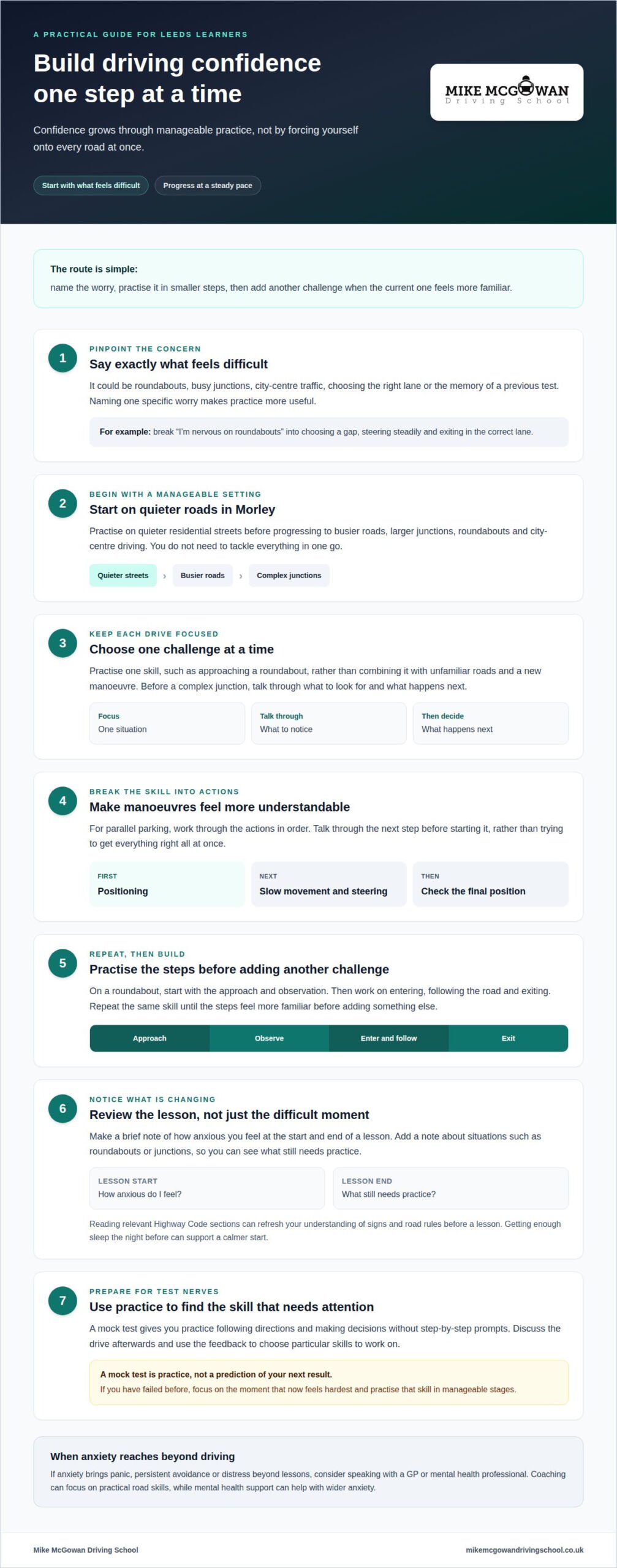
Driving confidence grows through manageable practice, not by forcing yourself onto every road at once. In Leeds, start with the situation that feels difficult and build from there, such as practising on quieter streets in Morley before moving on to busier routes.
Common driving anxieties in Leeds
Leeds learners can feel tense about roundabouts, busy junctions, city-centre traffic or choosing the right lane. A previous driving test can also make familiar skills feel uncertain again. Naming the exact worry helps make practice more useful. For example, separate “I’m nervous on roundabouts” into choosing a gap, steering steadily and exiting in the correct lane. Local Leeds driving lessons can include practice on routes around the city and towards the Harehills test centre.
Busy roads and junctions
Busy traffic can make it harder to judge gaps and process several things at once. Begin on quieter residential streets in Morley, then progress to busier roads, larger junctions, roundabouts and city-centre driving. Before reaching a complex junction, talk through what to look for and what happens next. Breaking the drive into smaller decisions gives you a clearer focus than trying to manage the whole route at once.
A steady progression keeps each practice drive focused. Choose one challenge, such as approaching a roundabout, rather than combining it with unfamiliar roads and a new manoeuvre. First practise the approach and observation, then work on entering, following the road and exiting. Repeat the same skill until the steps feel more familiar before adding another challenge.
Manoeuvres are easier to approach when you divide them into clear actions. For parallel parking, for example, focus on positioning first, then slow movement and steering, followed by checking the final position. Talk through the next step before starting it. This replaces the pressure to “get it right” all at once with a sequence you can understand and practise.
To notice changes, record how anxious you feel at the start and end of each lesson. A brief note about roundabouts or junctions can show which situations still need practice. Reading relevant sections of the Highway Code can also refresh your understanding of signs and road rules before a lesson. Getting enough sleep the night before can support a calmer start.
If driving anxiety brings panic, persistent avoidance or distress beyond lessons, consider seeking support from a GP or mental health professional alongside coaching. This is especially worth discussing when anxiety affects everyday activities, not just driving. Coaching can focus on practical road skills, while mental health support can help with wider anxiety. The two approaches address different needs and can sit alongside each other.
If you have failed a test, identify the specific moment that now feels hardest, such as meeting traffic at a junction. Practise that skill in manageable stages rather than treating one result as proof you cannot drive. Each lesson can then have a clear focus, such as calmer observations or more settled decisions at roundabouts.
Driving lessons in Leeds and nearby areas
In Leeds and Morley, the right lesson plan depends on your experience and what feels difficult. A clear focus for each session helps you use practice time well. If you’re preparing for a test at Harehills or Horsforth, ask to practise on nearby roads and junctions.
Choosing a patient instructor
Look for an instructor who listens to your concerns and explains how lessons can address them. A useful first conversation covers your driving experience, any previous test and the situations you want to practise. Notice whether the instructor gives clear explanations and welcomes questions. A calm teaching style should leave you knowing what you worked on and what comes next, rather than feeling rushed through a fixed plan.
Mock tests and test nerves
A mock test can help you get used to following directions and making decisions without step-by-step prompts. It also gives you a chance to discuss the drive afterwards, including moments that unsettled you. If you’ve failed before, use the feedback to identify particular skills to practise. A mock test is practice, not a prediction of your next result, so its value lies in preparation and useful feedback.
Coaching services and costs
There isn’t one set total for anxious driver coaching in Leeds. Your overall spend depends on the lesson rate, lesson length and how often you practise. Check the current rates and lesson lengths on the driving lesson options page before booking, then ask what each session covers and how progress is reviewed. Refresher lessons are available for drivers who already hold a licence. Lesson options can vary, so ask which transmission types are available before booking.
Motorway driving can bring separate concerns, such as joining, choosing a lane and keeping a steady pace. Defensive driving involves noticing hazards early, leaving space and making measured decisions. These are useful skills to discuss when planning practice. Keep the focus on the situations you need to handle, rather than assuming every lesson includes motorway driving.
Before choosing a driving school, ask practical questions that help you understand the learning arrangement:
- Can lessons focus on the specific roads or skills I find difficult?
- How will the instructor explain feedback after a lesson or mock test?
- Are automatic lessons available for the type of learning I need?
- What does the quoted lesson rate cover, and how long is each lesson?
- Can I continue if I have already had lessons with another instructor?
Clear answers help you compare the learning approach and likely ongoing spend. Check the current lesson rates and options before deciding what fits your budget. If you’re ready to discuss a suitable next step, you can book a driving lesson.
Breathing and pause strategies
Before setting off, sit at the kerb and settle your position. Let your hands rest comfortably and keep your attention on the car. Take a slow, steady breath in, then breathe out gently. Repeat at a comfortable pace. This gives you a simple routine before starting, rather than rushing straight into traffic.
Keep your breathing natural. Forcing a very deep breath can feel uncomfortable, so use a pace that feels manageable. Notice whether your shoulders are raised or your grip feels tight. As you breathe out, soften your shoulders and hands. These small checks help you notice tension before moving away from the kerb.
Give your attention one simple job at a time. For example, quietly name the next action: “check mirrors”, “signal”, then “move off”. A short sequence can feel clearer than thinking about the whole journey. Keep your focus on driving and the road around you, not on trying to make every anxious thought disappear.
If nerves build before a lesson, use a short routine while parked:
- Settle into the seat and place your feet comfortably.
- Take slow, steady breaths at the kerb.
- Name one immediate task, such as moving away safely.
- Start only when you feel ready to focus on driving.
A pause can also help when you’re safely parked between practice tasks. Take a moment to loosen your grip, breathe steadily and talk through what felt difficult. For example, after practising a roundabout, identify the part that needs attention next time. Keep the discussion brief and specific, such as judging the approach or choosing an exit.
If anxiety rises during a moving lesson, keep your attention on the road and follow the instructor’s directions. Save breathing practice or a longer pause for when the car is safely stopped. Agreeing on a simple phrase before setting off, such as “Could we pause when safe?”, can make it easier to speak up.
Breathing is a support, not a test you have to pass. If counting breaths distracts you, skip the counting and focus on a slow exhale. If a technique makes you feel less settled, stop using it. A calm routine should be simple enough to remember at the kerb, before a junction or after a challenging practice task.
After the drive, note which pause or breathing cue felt useful. For example, record whether the kerbside routine helped you begin more steadily, or whether a parked pause helped you discuss a difficult moment. That gives your next lesson a practical starting point. Keep the routine flexible, so it supports your attention rather than adding another demand.
Calm, supportive coaching for nervous drivers
In a first session, expect a conversation about your experience, concerns and goals. Then agree a manageable starting point, such as moving off on a quiet residential street before practising more complex situations.
A useful session begins with listening, not rushing into a difficult route. You can explain what feels uncomfortable, such as stalling, meeting traffic or approaching a roundabout. Your instructor can use this to shape the practice. If you have driven before, mention what felt easier and what still unsettles you.
Agree on one clear focus for the drive. For example, you could practise moving away smoothly, then return to the same skill on another quiet road. Breaking the task into steps makes feedback easier to follow. It also gives you a specific point to discuss afterwards, instead of judging the whole drive as good or bad.
As confidence grows, practice can move towards busier roads and more demanding junctions. The pace should reflect how you’re managing each step. If a roundabout feels difficult, talk through the approach, observations and exit before trying it. Clear explanations help you understand what to look for, rather than simply being told to “be more confident”.
Supportive coaching gives you room to ask questions and say when you feel overwhelmed. You could say, “Can we talk through that junction before we reach it?” Your instructor can explain the next decision in advance. If you need a pause, the car should be stopped safely before you take time to regroup.
Feedback works best when it points to something specific. After a drive, discuss one decision that went well and one skill to practise next. For example, note that you checked your mirrors before moving off, then plan another go at choosing a suitable gap. This keeps progress practical and makes the next lesson easier to plan.
If you have failed a test, explain which part now causes the most worry. A calm session can focus on that skill without treating the previous result as a judgement of your ability. A mock-test-style drive can come later, once the relevant skills feel steadier. Preparation should build understanding, not add pressure.
For a nervous learner, the first session is also a chance to see whether explanations feel clear and respectful. Notice whether the instructor listens, adapts the route and gives feedback you can use. Those details matter more than covering a long route. A steady plan, clear communication and manageable practice give each session a purpose.
What anxious driver coaching services are available in Leeds?
Support in Leeds can suit a new learner, someone returning to driving or a driver preparing for a test. The right format depends on your experience, the car you want to learn in and the situations causing concern.
For someone starting from scratch, beginner lessons build skills from the basics. A session can focus on moving off, steering and stopping before adding more demanding traffic. Learners who prefer an automatic can choose that format, while manual lessons include learning clutch control and gear changes. The best starting point is the car type that fits your needs.
Drivers who already hold a licence can use refresher lessons to revisit particular skills. For example, you could practise parking, roundabouts or driving on roads you’ve avoided. Test preparation offers another focus for learners approaching a practical test. It can include working through areas that feel uncertain and becoming familiar with the decisions a test drive requires.
Before lessons begin, explain what you find difficult. “I lose confidence at roundabouts” gives a clearer starting point than “I’m nervous about everything”. Your instructor can then shape practice around that concern, beginning with manageable steps and building towards the situations you want to handle more comfortably.
Local practice matters because driving in Leeds involves varied road conditions. You can build up from quieter streets in Morley towards busier Leeds roads, then practise around the area of your test centre, such as Horsforth or Harehills. Keep the next goal specific, such as approaching a junction, choosing a safe gap or following directions through an unfamiliar area. This makes it easier to review progress after each drive.
The car type can affect what feels comfortable during lessons. An automatic removes gear changes from the tasks you’re learning, while a manual requires practice with the clutch and gears. Neither choice removes the need to observe, plan and make safe decisions. Talk through your preference and learning experience before settling on a format.
Cost-conscious learners can ask for the current lesson rate, session length and how practice can focus on priority skills. No lesson price is given here, so check the rate before booking and work out the cost of the sessions you plan to take. A clear goal for each session helps you understand what you’re paying to work on. Your experience, confidence and areas for practice should guide the plan.
For your first discussion, note your driving history, preferred car type and one situation you want to address. If you’ve had lessons elsewhere, describe what you’ve already covered and where progress stalled. That gives your instructor a practical starting point, whether you’re beginning, returning to driving or preparing for a test.
Mike McGowan Driving School
Mike McGowan Driving School offers calm, personalised driving lessons for nervous learners in Leeds. If busy junctions, manoeuvres or previous test nerves are holding you back, lessons can focus on the skills and situations you want to work on. Beginner, automatic and refresher lessons suit different stages of driving, whether you’re starting out or returning after a break.
Each learner brings different concerns, so it helps to explain what feels difficult and what you hope to achieve. From there, practice can build steadily around your experience and preferred car type. Confidence takes shape through clear guidance and consistent practice, not pressure to rush.
Before a lesson, note one situation you want to practise and review it afterwards.
Take your next step at a pace that suits you
You don’t need to feel fully confident before you begin. Anxious driver coaching in Leeds gives you a way to start with one clear priority, whether that’s returning to driving after a break or preparing for independent driving. Explain what feels hardest, so your practice has a useful direction.
Mike McGowan Driving School offers beginner and automatic driving lessons, as well as refresher lessons. Talk through your experience and choose a starting point that fits your needs, without treating nerves or a previous test result as a measure of your ability.
Before getting in touch, note one situation you’d like to feel more comfortable with and whether you prefer an automatic car. This gives you, or the family member helping arrange lessons, a simple focus for the conversation.
Progress can begin with one manageable goal. You can take it one step at a time.
Frequently Asked Questions
Which Leeds driving instructors specialise in nervous or anxious drivers?
Mike McGowan Driving School provides calm, personalised coaching for nervous learners in Leeds. Its DVSA-approved instructor teaches one-to-one automatic lessons in a Toyota Yaris, with support shaped around your experience and concerns. If you feel uneasy about a particular situation, such as setting off in traffic, explain that before the drive. It gives the session a clear focus and helps you understand what you’ll practise.
What techniques do anxious driver coaches use to build confidence?
Coaching can use calm explanations, manageable practice goals and time to discuss what felt difficult. For example, your instructor can agree a simple focus before a drive, then review how it went afterwards. Slow breathing at the kerb can help you prepare to set off. These techniques support practical learning; they don’t require you to hide your nerves or pretend you feel comfortable.
Can I book a taster lesson or meet an instructor before committing in Leeds?
A separate taster lesson or pre-lesson meeting isn’t the stated booking format. The stated first step is to arrange a lesson by phone on 07535 457621. You can explain that you feel nervous and share what you’d like help with, such as returning to driving or building confidence in an automatic car. This gives the first lesson a practical starting point.
How do I choose a qualified and patient driving instructor in Leeds?
Look for relevant approval and an approach that suits your needs. Mike McGowan Driving School’s instructor is DVSA-approved and focuses on calm, personalised support for nervous learners. Before a lesson, think about what helps you learn, such as having instructions explained clearly or feedback discussed after practice. A useful session should leave you understanding what you worked on and why.
Are there driving routes or areas in Leeds that instructors use for confidence-building practice?
Confidence-building practice can start on quieter residential roads, then move towards busier routes and more complex junctions as your skills develop. The best practice area depends on what you need to learn and how comfortable you feel with each step. For instance, you could first work on turning at quieter junctions, then practise similar decisions in busier Leeds traffic.
Disclaimer
This article is intended as general guidance for learner drivers and does not replace official DVSA advice or a lesson with a qualified instructor. Rules, test requirements, and local test centre procedures can change, so always check GOV.UK or speak to your instructor for the most current information. Mike McGowan Driving School accepts no responsibility for outcomes based solely on the content of this article.