Anxiety friendly driving tuition in Leeds
Anxiety-friendly driving tuition in Leeds should give you room to learn at a steady pace, with clear explanations and calm support when nerves rise. Choose an instructor who listens to what feels difficult and helps you build confidence step by step, rather than rushing you towards a test.
If you feel tense before a lesson, worry about busy roads or fear failing again, you’re not alone. Those feelings don’t mean you can’t learn to drive. A calm, supportive approach can help you understand what to expect and focus on one skill at a time.
This guide explains what to look for in an instructor, how to prepare for lessons and practise safely, and what to do when anxiety shows up behind the wheel. You’ll also find practical ways to prepare for your driving test, including how to approach manoeuvres and familiar Leeds roads such as the routes around Horsforth Driving Test Centre at a manageable pace.
Key Takeaways
- Look for an instructor whose calm explanations and patient approach suit the way you learn, and talk through what helps you feel at ease.
- Before practising with a friend or relative, make sure they meet the legal requirements to supervise and the car is suitably insured.
- Use the Highway Code and small lesson goals to make preparation feel more manageable.
- If nerves rise behind the wheel, pause safely when you can and use slow, steady breathing before setting off again.
- Build towards your test in steps, and mention a health condition when booking if you think you need additional support.
Choosing an instructor and discussing teaching preferences
For anxiety-friendly tuition, choose an instructor whose explanations are clear and whose pace suits you. In Leeds, share your worries before driving so your first lesson can begin with a manageable plan.
When reading reviews, look for specific mentions of patience, calm teaching and clear explanations. A review describing how an instructor handled a missed turn tells you more than a general five-star comment.
There is no Leeds-wide rule that a first lesson or introductory assessment must be free. Lesson arrangements and charges differ, so check the terms before agreeing to a booking and include the cost in your budget.
Use a short conversation to explain what unsettles you, such as stalling, busy junctions or feeling watched. You can also say whether you prefer instructions before a manoeuvre or calm commentary while driving.
- Share one road situation that worries you.
- Say whether you prefer step-by-step guidance or time to think.
- Agree how you will signal that you need a pause.
These details give your instructor a useful starting point. If you’re returning after a test fail, explain which parts felt difficult, such as independent driving or reversing into a bay.
Check that the teaching area works for your routine too. A lesson starting near home, college or work can make the journey simpler; the Leeds driving lessons page covers local tuition.
Anxiety-friendly tuition options
In Leeds, anxiety-friendly tuition can mean calm teaching, clear explanations and lessons shaped around your confidence. Discuss beginning on quieter residential streets and building towards busier roads and more complex junctions as you feel ready. Explain your preferred pace and how you’d like feedback.
Automatic lessons for anxious learners
Automatic lessons are available in Leeds for learners who prefer to focus on steering, observation and road decisions without changing gears. An automatic car removes gear changes from the lesson, but you’ll still need to practise junctions, manoeuvres and traffic awareness. Consider which transmission helps you concentrate.
Before choosing, think about the learning environment you need, not just the car. For example, if gear changes are taking up much of your attention, automatic tuition could let you give more focus to reading the road. If you want to learn in a manual, ask for gear changes to be introduced at a pace that leaves room for other skills.
Switching instructors is a reasonable step if the teaching approach doesn’t suit you. Write down what isn’t working, such as rushed instructions or little time to ask questions, then explain what would help in future lessons. Clear preferences make it easier to discuss what you need.
For a first conversation, keep your points practical: roads you avoid, instructions you find easiest to follow, and what helps you reset after a mistake. A suitable instructor should listen and discuss how lessons can respond to your needs, rather than treating every learner the same.
Practising between lessons with a supervising driver
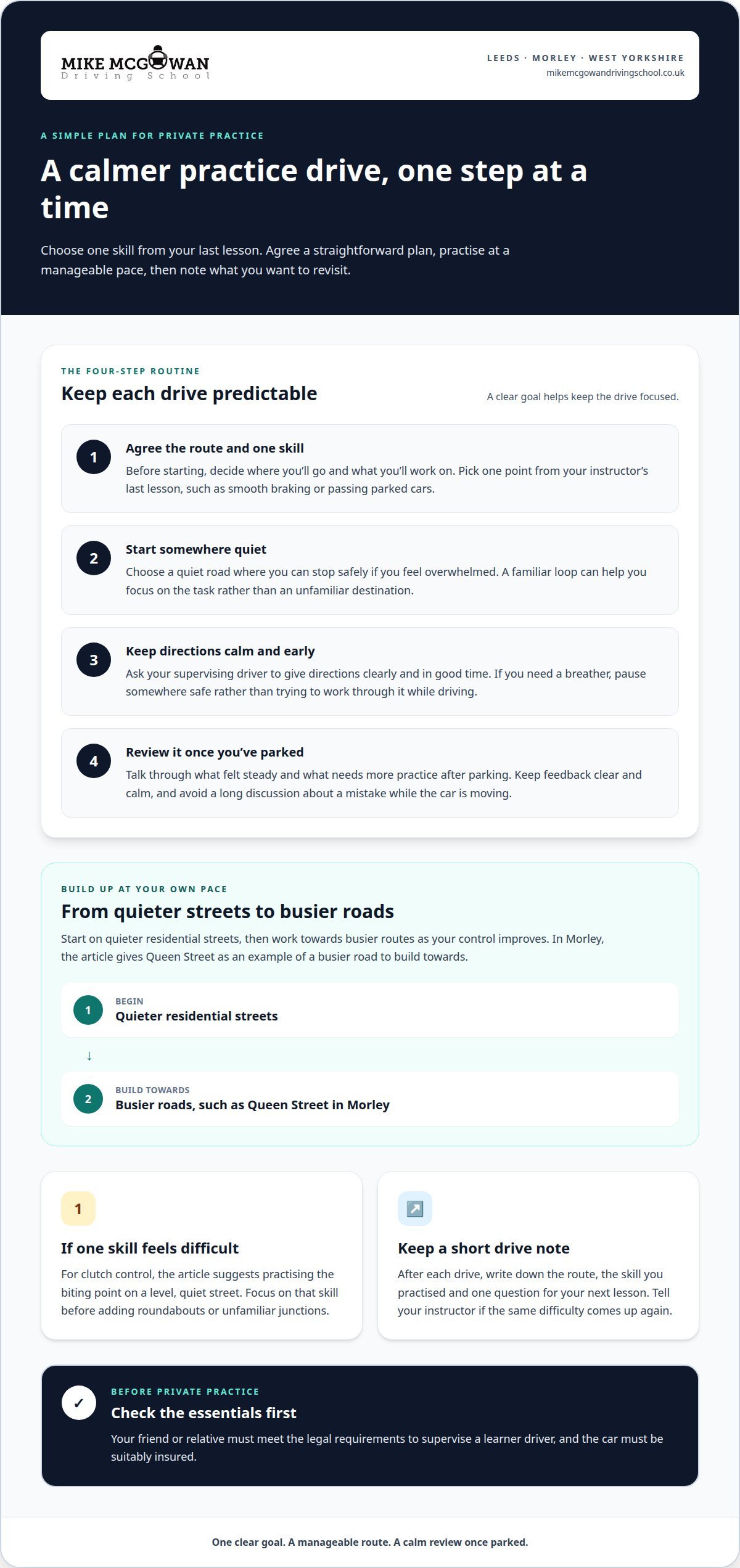
Practice between lessons can help a skill feel more familiar. In Leeds, use each drive to work on one point from your instructor’s last lesson, such as smooth braking or passing parked cars.
Driving lesson costs in Leeds depend on the instructor and lesson arrangement, so there isn’t one set price for nervous learners. To plan your budget, compare the stated lesson length and cost, then consider how often you can practise with a supervising driver.
Start on quieter residential roads, then build towards busier routes as your control improves. In Morley, for example, you could practise on quieter streets before working up to busier roads such as Queen Street. A familiar loop can help you focus on one task without the pressure of an unfamiliar destination.
Before setting off, agree a simple plan with your supervising driver. For example, practise pulling away and stopping on a quiet road, then take a short break before repeating the task. A clear goal helps keep the drive focused.
Anyone supervising a learner must meet the legal requirements, and the car must be suitably insured. Keep both points in mind before arranging practice with a friend or relative.
Use a short routine to make each practice drive predictable:
- Agree the route and one skill to practise before starting.
- Choose a quiet road where you can stop safely if you feel overwhelmed.
- Ask your supervisor to give directions calmly and early.
- After parking, talk through what felt steady and what needs more practice.
For example, if clutch control feels difficult, practise finding the biting point on a level, quiet street. Focus on that skill rather than adding roundabouts or unfamiliar junctions straight away.
Practising with a relative can feel different from a lesson. Agree that feedback will stay clear and calm, and that you can pause safely if you need time to settle. Avoid turning a small mistake into a long discussion while the car is moving.
Keep a brief note after each drive. Write down the route, the skill you practised and one question for your next lesson. If the same difficulty comes up again, tell your instructor so you can revisit it.
To connect private practice with structured tuition, you can book a driving lesson and bring one specific practice goal to discuss.
Before relying on private practice, check that your friend or relative meets the legal requirements for supervising a learner driver, and confirm that the car is suitably insured. This keeps the arrangement within the necessary safeguards.
Preparing for lessons and setting manageable goals
A little preparation can make a lesson easier to follow. Before setting off in Leeds, choose one skill to focus on, such as checking mirrors before changing direction or keeping a steady speed. A clear goal gives you something specific to practise, rather than feeling you must master everything at once.
Use the Highway Code between lessons to review signs, road markings and priorities. If roundabouts leave you unsure, for example, read the relevant rules and note one question to discuss with your instructor. This helps connect what you learn on the page with what you see from the driver’s seat.
Keep your goal small enough to describe in one sentence. “Practise approaching a junction and choosing a safe gap” is clearer than “get better at driving”. If that feels manageable, build on it next lesson with another step, such as turning left at a quiet junction.
A short preparation routine can help you arrive ready to concentrate:
- Check the lesson time and arrange your journey so you are not rushing.
- Choose one skill to revisit, such as setting off smoothly.
- Write down a question about a sign, manoeuvre or road situation.
- Plan a calm activity before the lesson, such as taking a few quiet minutes.
Sleep matters too. Getting enough sleep the night before a lesson can support a calmer session and make it easier to focus on instructions. If you’ve slept poorly, tell your instructor at the start so you can take that into account when deciding what to practise.
A simple progress journal can help you see what changes from lesson to lesson. After driving, note the skill you worked on, one moment that felt easier and one point you want explained again. For example, record whether you spotted a junction early, even if choosing when to emerge still felt difficult.
Judge progress by the skill you practised, not by whether the whole drive felt perfect. If your goal was mirror checks, notice when you remembered them without a prompt. That gives you a useful measure of learning and helps identify what needs more practice.
Before your next lesson, look at your last note and pick one question to take with you. If “I lose track of signs near junctions” appears in your journal, ask to practise recognising signs before reaching the junction. A specific example gives the lesson a practical starting point.
Keep preparation simple. A Highway Code question, a rested start and one achievable goal can give your next lesson direction without turning it into another test.
Recognising and responding to anxiety while driving
Anxiety can affect attention, breathing and how easily you process instructions. Notice what changes for you during a lesson, such as tense shoulders or difficulty concentrating.
In the UK, anxiety alone does not automatically mean you must notify the DVLA. According to the Driver and Vehicle Licensing Agency, you must notify it if a diagnosed anxiety condition affects your ability to drive safely. Tell your instructor if you need a pause, and stop only somewhere safe.
Recognising anxiety while driving
Look for signs that appear before or during a difficult task. You might notice a racing heartbeat near a busy junction, shallow breathing when approaching traffic lights, or trouble following directions after a stall. Naming the situation helps you explain what’s happening and identify a useful next step.
A brief note after a lesson can help you spot patterns. Record the road situation, what you noticed physically and what helped, such as slowing down or hearing instructions earlier. Share that example with your instructor before practising the same situation again.
Responding to anxiety during lessons
If you feel overwhelmed, focus on driving safely and tell your instructor when you can. Before setting off at the kerb, try slow, steady breathing. During a lesson, your instructor can talk through the next situation, break a manoeuvre into small steps or offer calm commentary.
Agree how to request a pause before driving. For example, use a simple phrase such as “I need a moment” when the car is stationary or safely pulled over. A clear signal means you won’t need to explain at a busy junction.
Try these steps when you notice anxiety building:
- Keep your focus on the road and follow your instructor’s immediate directions.
- Ask for a pause when the car is stopped safely.
- Take steady breaths at the kerb before deciding whether to continue.
- Afterwards, identify the moment that felt difficult and discuss it calmly.
A pause isn’t a failure or a reason to rush back into traffic. If a roundabout has left you unsettled, take time somewhere safe, then decide with your instructor whether to continue or finish the drive.
Practise one response at a time. If junctions trigger worry, for example, discuss the approach while parked, then focus on one quiet junction when you’re ready. If anxiety repeatedly affects safe control, stop driving and speak with an appropriate health professional.
Preparing for a driving test with anxiety
Test preparation can focus on the situations that make you nervous, not just repeating whole drives. In Leeds, you can build up from quieter residential streets to busier roads and complex junctions, including the routes around the Harehills test centre.
A previous test result can make the next attempt feel pressured. Treat it as information: note which situation unsettled you, such as a manoeuvre or an unfamiliar junction, then practise that skill in smaller steps. One difficult moment doesn’t define every part of your driving.
Ask your instructor to explain an upcoming situation before you reach it. For a manoeuvre, talk through the steps while parked, then practise each part calmly. Commentary during the drive can also help you focus on what’s happening now, rather than trying to predict the whole test.
Use a familiar practice drive to rehearse the decisions you’ll need to make. You could picture how you approach a junction, check for traffic and choose a safe response. Trusted driving explainer videos can also preview road situations, but use them to support practice, not replace it.
Keep your test preparation specific. A short record after practice can capture the task, what felt difficult and what improved. For example, write “checked mirrors before changing direction” rather than “drove better”. This gives your next lesson a clear starting point.
- Practise one challenging task in a quieter setting first.
- Ask for calm commentary before a situation that feels uncertain.
- Revisit a familiar route and mentally rehearse decisions in order.
- Write down one question to discuss at the next lesson.
In the UK, candidates with a health condition who think they need additional support should mention it when booking their test. They’re assessed to the same driving standard, though the examiner may be able to make adjustments.
On test day, focus on the next decision rather than judging the whole drive after one mistake. If a turn feels awkward, listen to the instruction, check the road and respond safely. Preparation is about building reliable habits, not promising a perfect drive.
If nerves are affecting your preparation, use a lesson to practise the situations that feel hardest.
Before a lesson, tell your instructor which upcoming situation you want to work through. They can talk it through with you, divide a manoeuvre into small steps and offer calm commentary as you drive. Afterward, note which skills you tried, where you felt difficulty and what questions remain. Keeping your record specific can help you return to a particular concern rather than treating the whole drive as one judgement.
Use a progress journal to record the skills you tried, difficulties, questions and your anxiety level before and after lessons. Reviewing those notes can give you a clear account of what you worked on and what still feels difficult. You can also mentally rehearse a route you have already driven, imagining its steps in order. Bring to mind the route and the sequence of decisions as you know them, keeping the rehearsal focused on a familiar drive.
Mike McGowan Driving School
Mike McGowan Driving School offers calm, personalised one-to-one driving lessons in Leeds for learners who want steady support. You’ll have space to explain what feels difficult, whether you’re new to driving, returning after a break or preparing for a test.
Beginner, automatic and refresher lessons support different starting points. Discuss your learning needs with DVSA-approved instructor Mike McGowan and build confidence at a pace that suits you.
If you’d like to talk about lessons, contact Mike McGowan Driving School.
Take your next step at your own pace
Choosing anxiety-friendly driving tuition in Leeds is a personal decision. Take time to consider what helps you feel comfortable enough to learn and what you want your next step to be. You don’t need to resolve every concern before you begin.
If you’re weighing up whether to start, focus on a practical question: what would make beginning feel manageable? It could be talking through your expectations before your first drive or choosing the transmission that suits you. A clear preference can help you decide what feels right without comparing your progress with anyone else’s.
Give yourself credit for taking the time to make a thoughtful decision. Learning to drive is a process, and your next step can be a small one.
Frequently Asked Questions
Which Leeds driving instructors specialise in anxious or nervous learners?
Mike McGowan Driving School supports nervous learners with calm, personalised driving tuition in Leeds. Look for teaching that responds to your needs, not just a label. If you’re comparing options, consider whether the instructor’s approach would help you speak up when something is unclear.
What qualifications or experience should an anxiety-friendly driving instructor have?
Choose a DVSA-approved instructor for your driving tuition. This qualification relates to driving instruction, but doesn’t by itself describe how someone teaches nervous learners. Consider how clearly they explain road decisions and whether their feedback helps you understand what happened. For example, ask yourself whether you leave a conversation knowing what you’ll practise next.
Can learners request quieter routes, shorter lessons, or a gradual lesson plan in Leeds?
You can raise those preferences when arranging tuition. For anxiety-friendly driving tuition in Leeds, explain what lesson format feels manageable and what you want to work towards. A shorter session or a particular route depends on the arrangements available for your lessons, so discuss your preferred structure before settling on a plan. This helps you make an informed choice without assuming every lesson can be arranged the same way.
What steps help reduce driving anxiety before and during lessons?
Before a lesson, prepare the day before by setting out what you need and allowing time to travel. If anxiety rises during a drive, tell your instructor as soon as it’s safe. After the lesson, choose one useful question to carry forward. This gives you a clear next step without expecting every concern to disappear at once.
Disclaimer
This article is intended as general guidance for learner drivers and does not replace official DVSA advice or a lesson with a qualified instructor. Rules, test requirements, and local test centre procedures can change, so always check GOV.UK or speak to your instructor for the most current information. Mike McGowan Driving School accepts no responsibility for outcomes based solely on the content of this article.