Intensive vs Weekly Driving Lessons in Leeds: Compare Costs
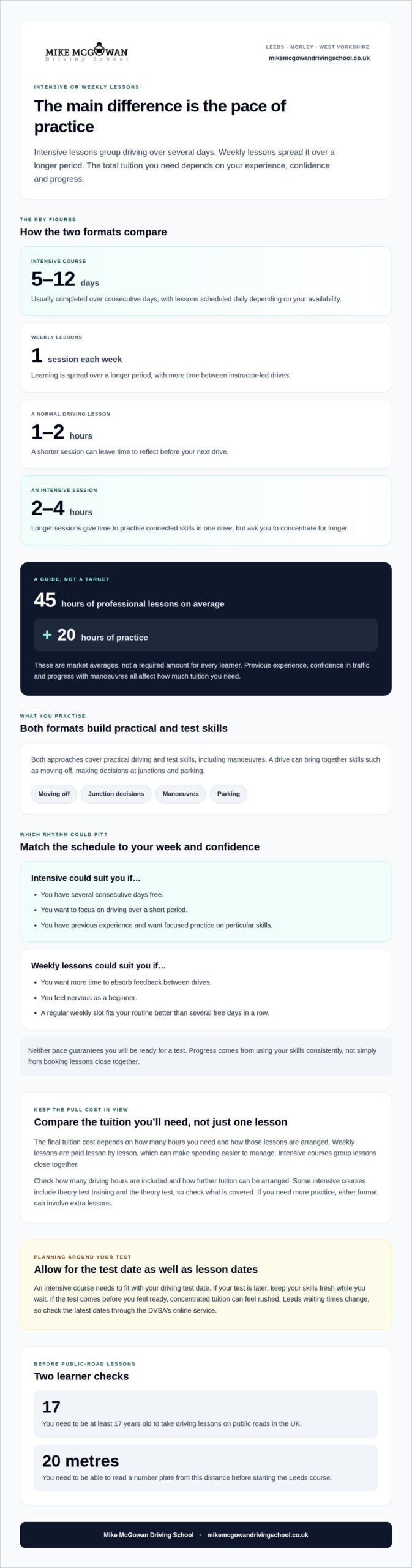
An intensive course isn’t automatically the cheaper choice. Intensive versus weekly driving lessons in Leeds mainly differ in how often you practise: an intensive course is usually completed over 5 to 12 days, while weekly lessons spread learning over a longer period. The total tuition cost depends on how many hours you need and how those lessons are arranged.
When comparing intensive vs weekly driving lessons in Leeds, look beyond the price of a single lesson. Consider how long each session lasts, how quickly you want to progress, and whether regular practice fits your confidence and routine.
This guide compares the two approaches in practical terms. You’ll see how lesson frequency and length affect the cost, what both formats cover, and which pace may feel more manageable if you’re nervous or returning to driving after a break. Use these points to decide what could work for you.
Key Takeaways
- Compare the total tuition needed, not just the cost of one lesson, to understand which pace fits your budget.
- Intensive lessons group practice close together, while weekly lessons spread it over a longer period.
- Both approaches cover practical driving and test skills, including manoeuvres.
- Test date availability can affect how well an intensive course fits your plans.
- Your previous experience, confidence and time to practise can help guide your choice.
Extra tuition costs
The headline cost of intensive or weekly lessons is only part of your total tuition spend. The final amount depends on how much practice you need before you feel ready for the driving test. Your previous experience, confidence in traffic and progress with manoeuvres all affect whether you need more lessons. Compare the tuition included, then consider how any further lessons would fit your budget.
As a guide to the learning involved, students need an average of 45 hours of professional driving lessons, plus 20 hours of practice, according to the market figures. That is an average, not a target every learner must reach. Someone who has already driven with a qualified supervisor could need a different amount of paid tuition from a complete beginner. The deciding factor is the skills still needing practice.
Weekly lessons spread tuition over a longer period, so paying lesson by lesson can make spending easier to manage. Intensive courses group lessons close together, which may suit learners with several days free who want to focus on driving. Neither format removes the need for more practice if key skills are not secure. Before choosing, compare the included lesson hours and how you can arrange further tuition.
If you don’t pass your driving test after an intensive course in Leeds, you can keep practising and take another test when you’re ready. Use the result to identify what needs more work, such as observations, parking or lane changes. One unsuccessful attempt doesn’t erase the progress you’ve made.
Before starting, check the practical requirements. A learner needs to be at least 17 years old to take driving lessons on public roads in the UK, according to the Driver and Vehicle Standards Agency. The same organisation says learners starting the Leeds course must be able to read a number plate from 20 metres away. These checks are separate from tuition costs, but they help establish whether you’re ready to begin.
Other course details can affect your budget. Some intensive courses in Leeds include theory test training and the theory test, while learners who have already passed their theory test may have different costs. Check what the course covers, how many driving hours it includes and whether you may need further lessons. That gives you a clearer comparison than the course label alone.
For a local overview of driving lessons in Leeds, consider how your starting experience and preferred pace affect the tuition you’ll need. A nervous beginner who wants time to revisit each skill can plan differently from someone returning after previous lessons. The useful next step is to list the skills you’ve already practised and the areas where you still want guided support.
Lesson frequency and length
Intensive courses schedule lessons over consecutive days, while weekly lessons leave more time between sessions. Compare the pace and session length with your routine, concentration and opportunities to practise between drives.
Choosing lesson frequency
Intensive driving courses take place daily, depending on the student’s schedule, and are designed to be completed in 5 to 12 days. Weekly lessons spread learning across a longer period, with a regular session each week. The right rhythm depends on how often you can set aside time and how easily you pick up skills between drives.
Think about a typical week before booking. An intensive schedule requires several days free close together, while weekly lessons need a regular slot you can keep. If work, college or caring responsibilities change often, weekly lessons may be easier to maintain. If you have a clear stretch of free days, daily practice can help keep new skills fresh.
Planning lesson length
A normal driving lesson usually lasts 1 to 2 hours. Intensive sessions typically last 2 to 4 hours, so learners spend longer behind the wheel each day. A longer session gives an instructor room to practise several connected skills, such as moving off, junction decisions and parking, without spreading them across separate weeks.
Longer sessions also require you to concentrate for more time. Consider how you feel after a demanding lesson, then choose a session length that suits your focus and learning pace. If reversing needs careful repetition, for example, a shorter weekly session can give you time to reflect before your next drive. Daily sessions may suit learners who prefer to build on recent practice quickly.
Suitability for intensive courses
An intensive course may suit learners with several consecutive days free and a clear reason to group lessons together. It can also work for drivers with previous experience who want focused practice on specific skills. Daily sessions keep learning close together, rather than leaving a full week between instructor-led drives.
Weekly lessons may feel more manageable if you’re a nervous beginner, need time to absorb feedback or have a busy timetable. Neither pace guarantees that you’ll be ready for a driving test. Progress depends on using your skills consistently, not simply on how quickly lessons are booked. Make time for theory study alongside practical learning.
Before choosing, write down your available days, preferred session length and the areas you want to practise. Then use those points to plan a booking that fits your routine. If you’re ready to arrange lessons around your schedule, book driving lessons.
How do Leeds driving test waiting times affect intensive courses?
A short intensive course needs to fit with your driving test date. If your test is booked well after your lessons finish, you’ll need to keep your skills fresh while you wait. If the test comes before you’re ready, concentrated tuition can feel rushed. Leeds waiting times change, so there’s no reliable current estimate to give. Check the latest dates through the DVSA’s online service for booking and managing driving tests.
Start with your test booking, then plan backwards. Note the test date, the days you can drive and the time you’ll have to practise between sessions. This makes it easier to see whether an intensive schedule fits. A test date is useful only if you have enough time to practise difficult skills, such as meeting traffic or reversing into a bay.
If your test date is further away, weekly lessons can provide a steady way to keep learning. Each session gives you a chance to revisit earlier feedback and build on it gradually. If junction observations need attention, for example, you can practise them across several drives instead of completing all your tuition well before the test. The gaps between lessons can also give you time to build confidence on Leeds roads.
An intensive course can still help if your test date is not close to the end of your tuition. Use the course as a focused period to build or refresh skills, then plan how you’ll keep practising before the test. Focus on the areas identified during lessons rather than repeating every topic equally. The key is to avoid a long period without driving before test day.
If you’re already test-ready, the date itself becomes a bigger part of the decision. A learner who has practised regularly and needs a short period of focused preparation can arrange lessons around the booked test. Someone still learning core skills needs time for those skills to settle, regardless of how quickly a test slot appears. Let your instructor’s assessment guide your final preparation plan.
Use this simple sequence to make a practical plan:
- Write down your booked test date and the days you can take lessons.
- List the skills that need the most practice, such as parking or lane changes.
- Choose a lesson pattern that leaves time to practise those skills before the test.
- Review your progress with your instructor and adjust the plan if priorities change.
Your test date and an intensive schedule don’t need to line up perfectly. What matters is continuing your preparation between the final lesson and the driving test. If waiting for a suitable Leeds test date leaves a gap, use that time for purposeful practice based on the feedback you’ve received. Don’t let the end of the course become the end of your learning.
Which Leeds areas and driving test centres do intensive courses cover?
For learners in Leeds and Morley, check whether the lesson starting point and practice routes suit your location and booked test centre. The area covered by a course and the centre where you’ll take your test are separate details. Mike McGowan Driving School ensures that your intensive vs weekly driving lessons leeds preparation aligns with your specific needs, though you should always confirm exact coverage before booking.
Leeds has distinct neighbourhoods, from Headingley and Hyde Park to Morley, Armley and Bramley. Other named areas include Horsforth, Moortown, Roundhay, Chapel Allerton, Meanwood, Kirkstall and Burley. Your starting point matters because travel to a lesson can affect how much time you spend practising. Start by considering your usual pick-up point and the areas you need to reach across Leeds.
Test centres are not interchangeable. The centre shown on your booking determines where your practical test begins, so use its name when planning your preparation. Practising nearby can help you become familiar with local junctions, lane choices and traffic patterns. The aim is not to memorise a fixed route, but to make safe decisions in different situations.
Before lessons begin, note three details: your home or meeting area, the test centre on your booking and the dates you can practise. For example, a learner based in Morley with a test booked in Leeds needs a plan that allows for practice around both areas. Sharing these details with Mike McGowan Driving School helps make lesson time more useful.
Ask how your lesson plan will cover local driving. Useful practice includes everyday roads as well as busier routes, with time for the skills you find less comfortable. If multi-lane junctions make you uneasy, focus on observation and lane position. If parking is difficult, practise the manoeuvre calmly in a suitable place.
You don’t need to treat a test centre as a route to memorise. Traffic, roadworks and other conditions change, so good observations and decisions matter more than knowing one sequence of turns. If you’re switching instructors, share your test centre and previous practice areas early. This helps your new instructor understand what you’ve covered and what still needs attention.
For learners across Leeds and Morley, location planning can stay simple. Match the lesson starting point to your routine, then plan local practice around the test centre shown on your booking. This helps your location, schedule and test preparation work together seamlessly.
Who is best suited to an intensive driving course rather than weekly lessons?
An intensive course can suit learners who have several consecutive days available and prefer driving regularly. Sessions usually take place daily and last 2 to 4 hours, so you need time and energy for sustained practice. Weekly lessons, usually 1 to 2 hours, can feel more manageable if you prefer a slower pace or need time between drives.
Your previous experience is a useful starting point. A learner returning after a break, or someone who has already practised moving off and basic junctions, may use concentrated sessions to build on familiar skills. A complete beginner can also learn intensively, but should be comfortable with several longer sessions close together. The hours you need still depend on your experience and aptitude.
Your response to longer sessions matters as much as your calendar. If concentration tends to dip after driving for a while, several 2 to 4-hour days could feel tiring. Weekly lessons can give you more space to absorb feedback before practising again. If you stay focused through longer drives, daily lessons can help keep skills fresh from one session to the next.
Feeling nervous doesn’t automatically rule out intensive learning. Focused practice on roundabouts or parking may help, provided the pace feels manageable. Repeating one manoeuvre, for example, can make its steps more familiar. If pressure builds over consecutive days, weekly sessions offer more breathing room and time to reflect between lessons.
Consider your commitments before choosing. Intensive learning is designed for completion over 5 to 12 days, so work, college or caring responsibilities need to leave room for daily sessions. Weekly lessons suit a routine with one regular opening each week. Neither format is better for everyone; the sensible choice is the one that lets you attend consistently and concentrate during each drive.
Use these questions to weigh up the fit:
- Can you set aside consecutive days for 2 to 4-hour sessions?
- Do you already have driving experience to build on?
- Do longer drives help you focus, or leave you feeling overloaded?
- Would a weekly routine give you useful time to practise between lessons?
If you’ve failed a test before, consider what the result showed you. A concentrated block can focus on specific skills, while weekly lessons allow for steady practice. The key question is whether you need a short, focused learning period or more time to build confidence. Choose based on your current driving, not pressure to finish quickly.
Mike McGowan Driving School
Mike McGowan Driving School provides calm, personalised driving lessons in Leeds to help learners find a steady way forward. If you’re unsure whether weekly lessons suit you, or want support rebuilding confidence after a break, start by considering your experience, routine and learning goals.
Lessons are available for beginners in automatic cars, as well as for drivers looking for refresher tuition. You can discuss a manageable pace and the areas you want to practise, such as junctions, parking or busy local roads.
Contact Mike McGowan Driving School to discuss your driving lesson needs.
Choose a pace that supports your next step
Choosing between intensive and weekly driving lessons in Leeds is a personal decision, not a test of how quickly you can learn. Consider the routine you can sustain, how you feel behind the wheel and what kind of support helps you take in feedback. Talking openly with whoever is paying can make the choice feel less uncertain.
Before arranging lessons, write down what you want from your learning. You may want time to build confidence, a focused period of practice or help settling back in after a difficult test experience. Share those priorities with your instructor so the discussion starts with your needs, not pressure to choose one format.
Mike McGowan Driving School offers calm, personalised support as you decide how to move forward. The next step can simply be discussing what feels manageable and what you’d like to improve.
You don’t need to have every detail worked out first. Start with what matters to you, then build confidence one drive at a time.
Frequently Asked Questions
What is it like taking an intensive driving course in Leeds?
An intensive schedule can feel focused, with your attention on driving rather than fitting occasional lessons around a busy week. Your instructor can build on earlier practice and adjust each session to your progress. If a manoeuvre feels uncertain, for example, you can give it focused attention before moving on. This approach suits some learners, but it isn’t the only way to learn well.
How long does the course take?
The course follows its planned tuition schedule, while the time it takes to pass also depends on your starting point and test appointment. Treat the lesson block and the date you pass as separate milestones. Finishing tuition, for example, doesn’t mean you’ve taken the practical test. A clear plan leaves room for both learning and test preparation.
How many lessons does it take to learn to drive in Leeds?
There’s no fixed lesson count that guarantees you’re ready. You need enough practice to handle different road situations safely and make sound decisions without prompts. Review your instructor’s feedback after each lesson and note which skills still need support. Confidence with one manoeuvre alone doesn’t show readiness for every part of a drive.
What is the difference between intensive and weekly driving lessons in Leeds?
The main difference is how learning fits around your life. A concentrated block makes driving a short-term priority, while weekly bookings become part of an ongoing routine. Consider whether you prefer to focus on driving for a set period or fit lessons alongside work, study or family commitments. The best fit is the one you can attend consistently.
How much do intensive driving courses cost in Leeds?
For manual intensive courses, a market sample of 14 prices from two sources, collected on 12 November 2026, puts typical offers between £589 and £1,300, with a median of about £908. These are market figures, not Mike McGowan Driving School prices, and they don’t represent automatic courses. Compare the tuition included and any extras before judging the total value.
What is the average cost of weekly driving lessons in Leeds?
Your total spend on weekly lessons depends on the hourly rate and the number of sessions you take. Estimate it by multiplying your hourly rate by your planned tuition hours, then allow for any further practice you may need. Two learners paying the same rate can spend different totals if one needs more lesson time. Compare the same number of hours when planning your budget.
How many hours or days does an intensive driving course in Leeds take?
The total depends on the tuition hours included in the course and how the sessions are arranged. Check the number of practical driving hours first, then consider how they fit your available days and energy. A course with more tuition requires more time behind the wheel, even if the schedule is compact. Your experience can help you decide which course length is a sensible starting point.
How long does it usually take to pass with weekly driving lessons in Leeds?
A normal driving course usually takes 5 to 11 months to complete. The time from your first lesson to passing depends on how regularly you learn, how your skills develop and when you take your test. Keep a record of the areas your instructor asks you to practise. That makes it easier to see progress and plan the next stage without treating a target date as a measure of ability.
Disclaimer
This article is intended as general guidance for learner drivers and does not replace official DVSA advice or a lesson with a qualified instructor. Rules, test requirements, and local test centre procedures can change, so always check GOV.UK or speak to your instructor for the most current information. Mike McGowan Driving School accepts no responsibility for outcomes based solely on the content of this article.