Driving Coaching in Leeds for Learners Who Failed Tests
A failed test is feedback, not a verdict. If you’ve failed more than once, a driving coach in Leeds for learners who have failed multiple tests can help you understand what’s going wrong and focus your lessons on the areas that need work.
It’s understandable to feel less confident about trying again, especially if nerves affect your decisions or the same manoeuvre keeps catching you out. You don’t need to start from scratch or feel judged. Useful support starts by recognising what you already do well and what needs more practice.
This guide explains what to look for in a Leeds instructor, how to apply theory knowledge while driving and how focused coaching can help after a failed test. You’ll also find practical points to consider if you’re part-trained, feeling nervous or thinking about changing instructors. The aim is steady progress, with lessons shaped around your experience and the challenges you want to tackle next.
Key Takeaways
- Use feedback from your test to focus coaching on the skills that need attention, rather than starting again without a plan.
- Look for an instructor who listens, explains mistakes clearly and adapts lessons to your experience.
- Choose lesson support that suits your needs, whether you’re learning in a manual or automatic car.
- Connect road knowledge with practical decisions so signs, hazards and junctions make sense behind the wheel.
- If nerves or a change of instructor are holding you back, a calm assessment of your current driving can help shape a useful next step.
Booking lessons and contact details
A concentrated lesson schedule brings practice closer together. After repeated test failures, choose a pace that leaves time to work on specific weaknesses and build steady habits, rather than simply adding more hours behind the wheel. The aim is purposeful practice, not rushing towards another test.
Before arranging lessons, note what happened on your last test: the manoeuvre, road situation or decision that caused difficulty. Share those details when enquiring, along with your experience, whether you prefer manual or automatic, and when you’re available. This gives the instructor a clearer starting point than simply saying you want to pass.
For local details, the Leeds driving lessons page covers the area. If you’re considering a block booking, weigh the number of lessons against your available time and budget. Think about whether you can attend regularly and use the lessons at a pace that supports progress. A larger booking is only useful if it fits your plans and learning needs.
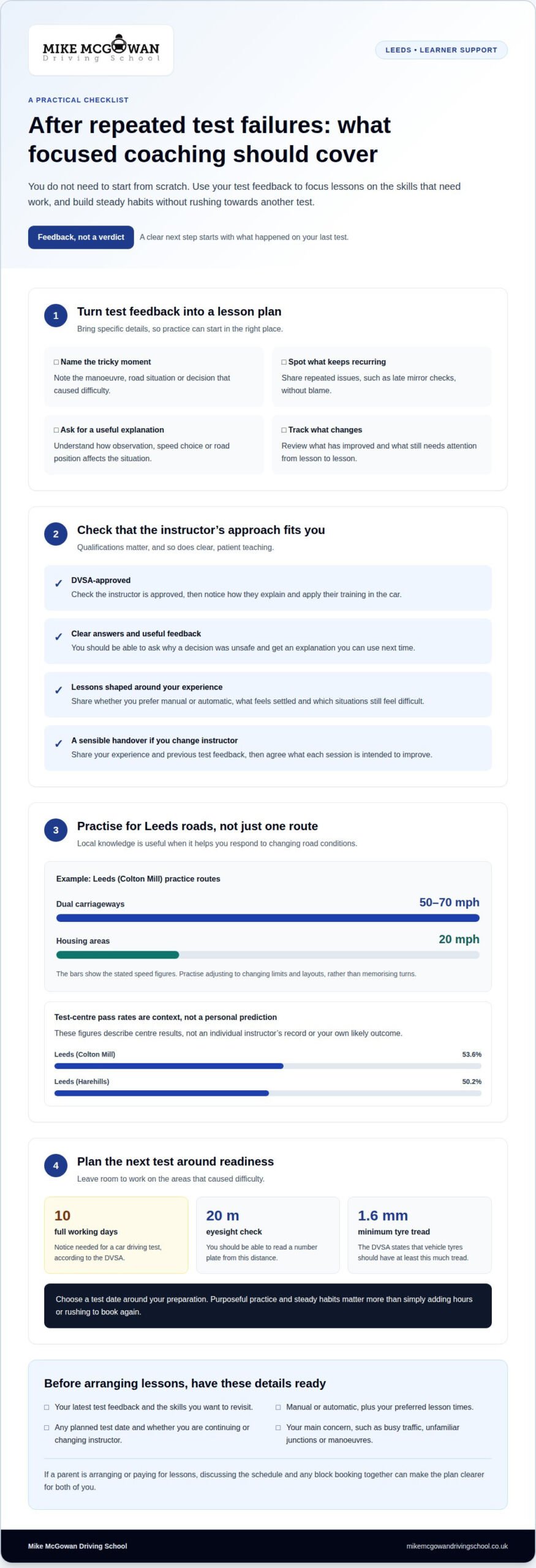
Booking a practical test is separate from arranging lessons. According to the Driver and Vehicle Standards Agency, car driving tests need 10 full working days’ notice. Factor that notice into your plan, so lessons can focus on preparation rather than fitting all your practice into the final days.
Useful details to share when arranging lessons include:
- Your latest test feedback and the skills you want to revisit.
- Whether you’re learning in a manual or automatic car.
- Your preferred lesson times and any planned test date.
- Whether you’re continuing with an instructor or changing instructors.
If you’re unsure what to book, explain which parts of driving feel settled and which still need work. For example, you might handle familiar roads comfortably but feel less certain when directions change. That helps the instructor understand what you want lessons to address.
Local practice can include roads around Leeds and routes near Leeds test centres. When discussing lessons, explain whether busy traffic, unfamiliar junctions or manoeuvres are your main concern. Those details help make practice purposeful.
According to the Driver and Vehicle Standards Agency, you should be able to read a number plate from 20 m for the eyesight check. The agency also states that vehicle tyres should have at least 1.6 mm of tread. Keeping these test-day requirements in mind helps you prepare for more than the driving itself.
If a parent is arranging or paying for lessons, include them in the booking conversation if helpful. Agreeing the schedule and any block-booking commitment together can make the plan clearer for both learner and payer.
What to look for in a Leeds driving instructor after failing multiple tests
Choose an instructor who listens to what happened on your tests and turns that feedback into practical coaching. Look for clear explanations, a teaching style that suits you and progress you can track from lesson to lesson.
Instructor qualifications
Check that your instructor is DVSA-approved, then notice how they apply their training in the car. A useful first discussion covers your previous test feedback, experience and difficult situations. If you lose confidence approaching a roundabout, for example, the instructor should explain what to observe and help you practise safely.
Good communication matters alongside formal qualifications. You should be able to ask why a decision was unsafe and get an explanation you can use next time. Clear feedback helps you understand how observation, speed choice or road position affects the whole situation.
Pass rates and learner reviews
Leeds test-centre pass rates describe centre results, not an individual instructor’s record or your own likely outcome. The listed rate is 53.6% at Leeds (Colton Mill) and 50.2% at Leeds (Harehills). Treat those figures as context, not as a promise about how a lesson will go.
Reviews can give you a better sense of the teaching experience. Look for specific comments about patience, useful feedback and support when learners feel nervous. A review describing how an instructor helped someone handle a difficult junction says more about their approach than a general statement about passing.
Support after multiple test failures
An instructor supporting learners after repeated failures should review test feedback without blame. Ask how they would turn a recurring issue, such as late mirror checks, into focused practice. Progress is easier to recognise when feedback shows what has changed and what still needs attention.
You can book another practical test after failing. Plan the date around the required notice and your readiness, rather than choosing one before you’ve had time to work on the areas that caused difficulty.
Local route knowledge is useful when it helps you handle real road conditions, not just memorise turns. Leeds (Colton Mill) practice routes can include 50-70 mph dual carriageways and 20 mph housing areas. An instructor should help you adjust to changing limits and road layouts, so you can make sound decisions even when a test route differs from one you’ve practised.
Continuity between lessons can help an instructor spot patterns over time. If you change instructors, sharing your experience and previous test feedback gives the new instructor a sensible starting point. Agree how lessons will be reviewed, and make sure you understand what each session is intended to improve.
Driving lessons in Leeds
After a failed test, the next lessons should focus on the skills that need attention, not repeat every part of your learning. A driving coach for learners who have failed multiple tests in Leeds can shape practice around a specific concern, such as meeting traffic at a busy junction or keeping a steady pace on an unfamiliar road.
Lesson formats can suit different routines and ways of learning. Some learners prefer regular, shorter sessions with time to reflect between drives; others prefer lessons closer together. What matters is that each session builds on the last, with a clear aim, such as improving observation before a turn.
An instructor can explain a manoeuvre, demonstrate the key observations, then guide you through practice. Some learners find it helpful to talk through decisions after driving a route. A good plan adapts the explanation and practice to what helps you learn, rather than expecting everyone to learn in the same way.
Manual and automatic cars involve different tasks. In a manual car, you practise clutch control and gear changes alongside steering and observation. Automatic driving lessons let you focus on traffic and road position without changing gears. Manual lessons are coming soon; learners looking to book now can choose automatic tuition.
If you’re considering a different transmission, explain what feels difficult about driving. If managing several controls at once distracts you at junctions, for instance, an automatic car can let you focus more on safe decisions. The right choice depends on your plans and the type of car you want to drive.
Lesson costs depend on the hourly rate and the amount of tuition you book. To plan your spending, decide what you can comfortably budget, then review your progress with your instructor before arranging further lessons. If a parent is helping with costs, agree the plan together so you both know what each booking covers.
Ask what each lesson will focus on and how progress will be reviewed. After a mock test, for example, the instructor can identify whether observation, positioning or hesitation needs more attention. A driving coach for learners who have failed multiple tests in Leeds can use that feedback to guide focused practice instead of repeating familiar drives.
Local practice should include different traffic and road layouts, not just familiar streets. Lessons around Leeds and Morley can help you build experience in places you’ll use regularly. The driving lesson options include automatic tuition to suit your current learning needs.
Before you book, decide what you want to improve, which transmission suits your plans and what spending pattern feels manageable. Those points give your first discussion a practical starting point, whether you’re returning after a test or continuing part-trained.
Connecting theory knowledge with practical lessons
Theory knowledge is most useful when it guides a decision in the car. A learner can know what a road sign means yet still struggle to respond in time. Practical lessons connect that knowledge to what’s happening around the vehicle, such as choosing a safe position before a junction or spotting a developing hazard.
Mock-test mistakes can show whether a difficulty relates to knowledge, observation or pace. An instructor can review each error and identify what happened beforehand. Missing a sign, for example, could point to observation, while reacting late to a hazard could mean you need more time to recognise what is changing.
That review should lead to a practical exercise. If you hesitate at a give-way line, the instructor can discuss priorities, then practise approaching similar junctions. The focus is on applying the rule to the view, traffic and available space, rather than recalling an answer without using it.
Hazard perception also connects theory to driving. Recognising a developing hazard means noticing how a situation is changing and responding appropriately. In a lesson, an instructor can help you talk through what you see, such as a parked vehicle narrowing the road or a pedestrian approaching a crossing.
Reading the road matters as much as knowing a rule. Even if you understand speed limits, you still need to notice signs and adjust to road conditions. Lessons can connect that knowledge with choosing a safe speed and checking for changes, rather than treating each sign as an isolated test question.
Practical preparation also includes the official Show Me, Tell Me questions. There are 19 questions to study. An instructor can connect a question about vehicle checks with the relevant control or check in the car, making the answer easier to understand in context.
The theory test is a separate step. You need a provisional driving licence to book it, and must pass the theory test before booking a practical driving test in Great Britain. If you’ve already passed theory, lessons can focus on applying that knowledge while driving.
After a failed practical test, theory and driving feedback can be considered together. If you missed a sign, the instructor can help you recognise it earlier and make the right decision. If the issue was pace, lessons can build a calmer routine for scanning, judging and responding.
Useful progress is specific. At the end of a lesson, the instructor can explain which decisions improved and what still needs practice. That gives the next session a clear focus, whether it’s understanding a road situation, applying a rule or responding to hazards with more confidence.
Support for part-trained and nervous learners
Part-trained learners don’t all need the same amount of coaching after a failed test. An instructor can assess what you manage independently, where you need prompts and which situations affect your confidence. That gives lessons a clear starting point without treating your previous experience as if it counts for nothing.
To assess how many lessons you need before retaking a test, an instructor can review your test feedback and observe your driving. A 1-hour Driver Ability Test can help determine the training required, including work on junctions, manoeuvres or independent decisions.
The assessment should look beyond one difficult moment. An instructor can observe how you approach junctions, respond to signs, position the vehicle and recover after a mistake. They can then distinguish a skill that needs practice from a situation that triggers nerves or rushed decisions.
For someone who feels anxious, a predictable lesson structure can make driving easier to manage. The instructor can explain the focus before setting off, practise it in a suitable area, then discuss what went well afterwards. If a busy roundabout feels difficult, they can build towards it through calmer roads and clearer decisions.
After a failed test, feedback can guide the next stage of training. If the report points to observation, lessons can focus on checks before moving off, changing lanes or turning. If hesitation was the issue, the instructor can help you practise judgement at junctions and discuss when it’s safe to proceed.
Changing instructors mid-course doesn’t mean losing the progress you’ve made. A new instructor can begin by discussing your experience, previous test feedback and the skills you feel confident using. They can then observe your driving before deciding where you need more support.
Feeling ready to retake a test involves more than performing one manoeuvre correctly. An instructor can look for consistent decisions across different roads, including when directions change or traffic builds. If you’re preparing at a Leeds test centre, practise adaptable driving rather than relying on memorised routes.
A useful plan makes the purpose of your next lesson clear. It can name the skill being practised, the support the instructor will provide and how progress will be reviewed. That gives you a practical way to decide whether your training addresses the concerns from your last test.
Mike McGowan Driving School: Test Preparation
Mike McGowan Driving School offers Test Preparation for learners who want focused support after a failed test. Lessons can build on your experience, address areas that need work and include practice on local test routes. The aim is steady, personalised coaching, not pressure to book another test before you feel prepared.
If you’re part-trained, manual or automatic lessons can help you work on specific driving skills. If you’re starting again, Beginner Driving Lessons provide a way to build those skills step by step. The right next lesson depends on what you already manage and where you want more support.
To discuss your next step, contact Mike McGowan Driving School.
Take your next step at a pace that suits you
A previous test result doesn’t define what you can do next. It can help you decide what support would be useful, whether that means rebuilding confidence or sharpening specific skills. A driving coach for learners who have failed multiple tests in Leeds should make the next step clear, with teaching shaped around your experience rather than pressure to rush.
Think about the kind of support that would help you move forward. Beginner Driving Lessons can suit someone who wants to rebuild from the basics, while manual or automatic lessons let you focus on the car that matches your plans. You can discuss what feels manageable and choose a sensible starting point.
You don’t need to have every answer before asking about lessons. A calm conversation can help you explain what you’ve found difficult and what you want to feel more confident doing. Your next lesson can then become a practical step towards greater independence on the road.
Take it one lesson at a time. Progress can start with a plan that feels right for you.
Frequently Asked Questions
How much do remedial driving lessons cost in Leeds?
The total cost depends on the lesson rate and how much tuition you need. To estimate your spending, decide whether you need occasional practice or regular lessons, then review the cost of that format. If someone else is paying, agree a spending limit and review it as your skills develop. A focused plan can help you understand what each lesson is working towards.
What should a driving instructor offer after I’ve failed my test several times?
Look for a calm review of your test feedback, followed by a plan for the skills that need attention. A useful session should include clear explanations and time to practise, not just a general drive around Leeds. Test Preparation can include mock tests and local route practice, with feedback that helps you understand decisions as well as vehicle control.
Why do learners fail driving tests repeatedly, and how can they improve?
Repeated difficulties often involve patterns such as missed observations, poor positioning or hesitation, rather than a lack of ability. Identify what happens just before each mistake. If you miss a mirror check when changing direction, for example, lessons can help you practise that routine across different roads until it becomes more consistent.
What support is available for driving test anxiety in Leeds?
Support can begin by agreeing on a manageable lesson focus and discussing what makes driving feel difficult. If you feel tense at roundabouts, for example, you can practise the approach in a calmer setting before building towards busier traffic. Patient coaching at a steady pace can make lessons feel more predictable while keeping attention on safe driving decisions.
Disclaimer
This article is intended as general guidance for learner drivers and does not replace official DVSA advice or a lesson with a qualified instructor. Rules, test requirements, and local test centre procedures can change, so always check GOV.UK or speak to your instructor for the most current information. Mike McGowan Driving School accepts no responsibility for outcomes based solely on the content of this article.