Driving lessons in West Park, Leeds: tuition costs and payment
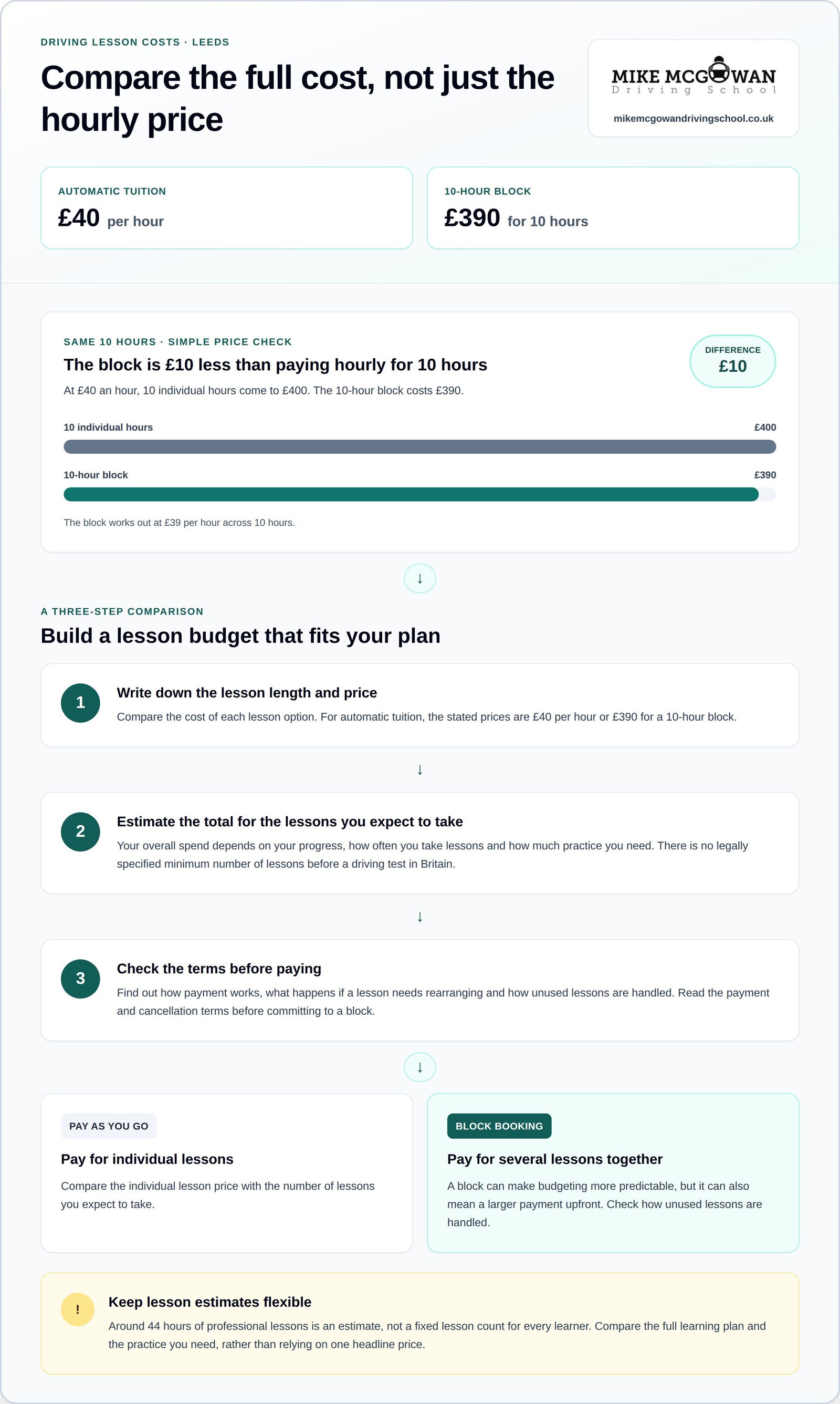
Automatic tuition in Leeds costs £40 per hour, or £390 for a 10-hour block. The total you spend depends on your progress and how much practice you need. If you’re comparing driving lessons in West Park, Leeds, these prices give you a clear starting point.
It makes sense to compare costs before committing, especially if you’re paying for lessons yourself or helping a family member budget. Manual and automatic tuition suit different learners; the right option is the one that fits your plans and supports steady progress.
This guide explains what affects driving lesson costs in Leeds, how to compare payment options and why continuity with an instructor can help you feel settled. It also considers learning on West Park’s local roads, so you know what to expect from lessons in the area.
Key Takeaways
- See what affects the overall cost of tuition, so you can plan your budget without relying on one hourly figure.
- Understand the practical differences between manual and automatic lessons and choose the format that suits your goals.
- Learn how lesson payments and booking choices can shape your learning plan.
- Find out what to expect from a qualified instructor and why a steady teaching relationship can help build confidence.
- Discover how learning on West Park roads can help you practise everyday driving skills and prepare for local test routes.
How much does driving tuition cost in Leeds?
Your total cost depends on how many lessons you need, how often you take them and whether you choose manual or automatic tuition. There is no legally specified minimum number of lessons before a driving test in Britain, so the total depends on the skills you need to develop and when you’re ready to drive independently.
Lesson availability in West Park, Leeds depends on the instructor’s schedule and how flexible you can be with times. A regular slot can help you practise consistently, while long gaps may make it harder to retain what you have learned.
In your first lesson, an instructor can assess your starting point and explain the car’s controls before you practise moving off and stopping. Lessons can then progress to junctions, traffic awareness, roundabouts and manoeuvres. As your control improves, you can practise longer journeys and a wider range of road conditions around Leeds.
Test preparation brings those skills together. It can include independent driving, manoeuvres and the Show Me, Tell Me vehicle safety questions. Around 44 hours of professional lessons is an estimate, not a fixed lesson count for every learner. Mock driving tests can highlight areas to practise before you book.
Some course terms include corrective lessons after a failed practical test. One Leeds course offers unlimited corrective lessons, subject to its terms and conditions. Treat this as a specific offer, not a standard feature of every tuition arrangement. Check what the course includes and whether its terms cover the extra practice you need.
West Park learners can practise for tests at Leeds (Horsforth) and Bradford (Thornbury). The stated pass rate for Horsforth is 50.34%; Bradford (Thornbury) is also a nearby centre. A pass rate describes previous test outcomes at a centre, not the result an individual learner will achieve. Local preparation should focus on safe decisions, including roundabouts and junctions, rather than memorising a route.
Leeds (Harehills) Driving Test Centre is at Hillcrest House, 386 Harehills Lane, Leeds, LS9 6NF. A centre’s pass rate can provide context, but it does not predict an individual learner’s result. From May 2026, pupils need to book their own practical driving test under the new DVSA test rules. An instructor can help assess test readiness, but booking should follow steady practice across the skills assessed.
Manual learners must follow the usual learning rules, including displaying L plates, according to the UK Government. For local tuition details, the Leeds driving lessons page covers the area. The most useful cost comparison is the full learning plan, including the practice and preparation that will help you approach test day calmly.
Manual and automatic lessons
The types of tuition available can vary, so check which options are offered before booking. Your choice depends on the car you want to learn in and the skills you want to develop.
Manual Lesson Options
Manual lessons are available to book. If you’re considering learning in a manual car, think about whether clutch control and gear changes fit your plans. These skills differ from driving an automatic, where you don’t change gears yourself.
Take time to decide. Consider the car you expect to drive after passing and whether you want to learn manual controls. Check the booking details and price before you plan your tuition.
Automatic Lesson Options
Automatic lessons are available in Leeds in a Toyota Yaris. The car is described as comfortable and learner-friendly, with good visibility and easy handling. Driving an automatic removes gear changes from your tasks, leaving you to focus on steering, observations and decisions in traffic.
Automatic lessons can cover setting off, stopping, choosing a safe position and responding to changing road conditions. As your skills develop, you can move on to more complex situations, such as judging gaps at junctions and positioning around roundabouts. The pace should reflect what you have already practised and what still needs work.
Automatic tuition can suit learners who want to avoid coordinating a clutch and gear stick. You’ll still need to develop road awareness, vehicle control and safe decision-making. If several tasks at once make you tense, discuss which situations feel hardest and use lesson time to practise them.
Before choosing, consider the car you expect to drive and which transmission suits your goals. Automatic and manual lessons are available now. Keeping that distinction in mind helps you make a realistic plan without assuming both options can be booked.
If automatic tuition fits your plans, book an automatic driving lesson.
Driving lesson prices and payment options
Your total learning costs depend on lesson frequency, progress and payment arrangements. Compare the full plan, not just the headline price. A low introductory rate may cover only one lesson or come with terms that don’t fit your schedule.
Pay-as-you-go means paying for individual lessons, while a block booking means paying for several lessons together. A block can make budgeting more predictable. Before choosing, find out how payment works, what happens if a lesson needs rearranging and how unused lessons are handled.
A useful comparison has three steps:
- Write down the lesson length and price for each option.
- Work out the total for the number of lessons you expect to take.
- Read the payment and cancellation terms before committing to a block.
Comparing the full cost helps you assess options fairly. A package with a lower per-lesson price, for example, may still require a larger payment upfront. If a parent is paying, agreeing a budget and payment plan can help without assuming the learner will need a fixed number of sessions.
Read the terms of any starter offer or discount carefully. Check whether it applies to a first lesson, a set of lessons or a particular payment method. Note any end date and conditions, then compare the full cost with the ordinary rate. A discount is useful only if the lessons and terms suit your needs.
Keep lesson costs separate from other driving expenses. Practical test preparation, test bookings and extra practice are distinct parts of the overall budget. On Leeds roads, progress with traffic, junctions and roundabouts helps determine how much tuition a learner needs. A steady plan makes it easier to see what you’re paying for at each stage.
Intensive driving is a different format from regular lessons, with practice concentrated into a shorter period. Consider whether that pace suits your confidence, availability and budget. Don’t assume an intensive course and ordinary lessons have the same structure or terms.
For someone learning near Horsforth, the best payment choice is still the one that fits their own routine. A regular weekly lesson can support continuity, while occasional sessions can suit a changing timetable. Ask the person paying and the learner to agree on a budget and payment plan before lessons begin.
Keep a simple record of payments and lessons used. It helps you track a block booking, anticipate costs and discuss progress clearly. Whether you pay per lesson or in advance, clear terms and a manageable budget matter more than a headline discount.
For comparison, the stated total price for the Leeds intensive driving course is £1480.00. The Leeds intensive driving course fee is £1452.00, including VAT. Check which figure applies to the course and what each price covers before choosing a payment arrangement.
Course options include a 10-hour intensive driving course at £569.00, a 20-hour intensive driving course at £899.00, a 30-hour intensive driving course at £1,299.00 and a 40-hour intensive driving course at £1,599.00. Compare the course length and full fee with your budget and preferred pace of learning.
Instructor qualifications and continuity
Anyone you pay to teach you to drive must be a qualified and approved driving instructor or a trainee driving instructor, according to the UK Government. That qualification is a starting point. A good fit also depends on how clearly the instructor explains tasks, responds to mistakes and adapts lessons to your current confidence.
Reviews of West Park driving instructors are most useful when they describe specific teaching experiences. Look for comments about calm explanations, helpful feedback or support with a skill such as reversing or roundabouts. A review that says only “great instructor” tells you less about what lessons might be like.
Instructor listings can show who works around West Park, Leeds, but a listing alone won’t explain how lessons are taught. Compare what matters to your learning: manual or automatic tuition, experience supporting nervous learners and clear explanations of your progress. These details offer a better sense of fit than a name on a page.
Some learners feel more comfortable with a female driving instructor. That preference is valid, particularly if feeling at ease helps you concentrate and speak up when something is unclear. Teaching style matters too: respectful communication, steady feedback and patience can help any learner feel more comfortable.
Continuity can help an instructor understand which skills feel settled and where you need more practice. If you’re comfortable at junctions but tense at busy roundabouts, for example, a familiar instructor can build on what you know rather than start from scratch. If you change instructor, explain what you’ve covered and what still feels difficult to give the next lesson a clear starting point.
Instructor support can include refresher lessons for drivers returning after a break, as well as beginner tuition. After a test, focused practice can help you work on areas that need attention. Look for feedback that leads to a clear next step, such as repeating a manoeuvre slowly before trying it in busier traffic.
The vehicle is part of the learning environment, so being comfortable with its layout matters. Before moving off, an instructor can explain the key controls and help you get settled. Practising in the same vehicle can make it easier to focus on observations, positioning and traffic rather than adjusting to different controls each time.
Choose an instructor whose explanations make sense to you and whose style makes you comfortable asking questions. Trust supports honest feedback, steady practice and a clearer understanding of what to work on next.
Learning on local roads in West Park
West Park gives learners the chance to develop everyday driving skills close to home. Local practice can cover quiet residential streets, busier junctions and roundabouts, with routes chosen to suit your confidence and stage of learning.
In England, learner drivers must follow the applicable learning rules. For manual practice, L plates must be displayed, according to the UK Government.
A lesson can progress from familiar streets to busier traffic as your control improves. An instructor might start with safe positioning and observations, then help you practise judging gaps at junctions. If roundabouts feel stressful, breaking the approach into observations, lane position and a safe exit gives you clear steps to focus on.
Driving around Leeds also gives you practice responding calmly when plans change. If you miss a turn on a one-way system, continue safely rather than cutting across lanes. Bus lane restrictions vary, so check the signs and timings on each journey. These habits help you make decisions without rushing.
Practice routes can prepare learners for roads around Leeds (Horsforth) and Bradford (Thornbury) driving test centres. Test routes vary, so focus on flexible skills rather than memorising one sequence of turns. Practising junctions, roundabouts, lane choices and independent navigation can help you manage unfamiliar directions more confidently.
Road conditions matter, too. Quieter traffic can give you time to settle into steering and observation, while busier periods offer practice with following distances and safe decisions. Your instructor can adjust the route to your progress, letting you repeat a task before adding another challenge.
Lesson availability depends on when you can learn and the instructor’s schedule. Agreeing a regular slot can make it easier to build on previous practice. If you have a provisional licence and feel nervous about a particular road or manoeuvre, mention it at the start so the instructor can focus the lesson.
The aim of local lessons is to prepare you to respond safely, not just recognise familiar streets. Practice in West Park can lead to wider journeys around Leeds, with each drive building experience in real traffic and changing road conditions.
A mock driving test can help you identify which areas need more attention before booking your practical driving test. Treat the result as a guide to what you may want to practise next, rather than as a reason to rush into booking. If a particular part of the drive needs attention, tell your instructor so you can focus on it during a lesson.
You can then use further practice to work on the areas you have identified and build confidence in your decisions. This keeps preparation connected to your own learning needs: the aim is to understand where more attention would be useful and address it before booking the practical driving test.
Mike McGowan Driving School
Mike McGowan Driving School offers one-to-one tuition in Leeds, with calm, personalised coaching for learners who want to make steady progress. Whether you’re a beginner, returning after a break or choosing between manual and automatic lessons, Mike can tailor practice to your experience and confidence.
Lessons can help you develop skills on local roads, work through situations that feel uncertain and prepare for independent driving. If you’re nervous about making mistakes or have changed instructors before, explain what helps you learn and what you’d like to practise.
To discuss your learning needs and arrange a first lesson, contact Mike McGowan Driving School.
Take the next step at your own pace
Your first lesson doesn’t have to answer every question about learning to drive. It can give you a feel for the teaching, let you explain what you find difficult and help you agree on where to begin. That can be especially useful if you feel nervous, have had a break from driving or are still deciding which car suits you.
Mike McGowan Driving School offers beginner and automatic driving lessons. For driving lessons in West Park, Leeds, a useful next step is to think about what would help you feel settled: clear explanations, time to practise a skill again, or a steady plan towards driving independently. You can share those preferences before lessons begin.
You don’t have to feel completely confident before you start. Confidence can grow through practice, patient feedback and manageable steps. Choose a pace that suits you, then build from there.
Frequently Asked Questions
How many lessons will I need to take in Leeds?
There isn’t one lesson count that fits every learner. The Driver and Vehicle Standards Agency (DVSA) gives an estimate of around 44 hours of professional lessons to pass, but your starting experience and progress affect the time you need. For example, someone who has practised before can begin at a different point from a complete beginner. Your instructor can use early lessons to identify skills to develop and review progress as you go.
Driving lesson reviews for West Park Leeds instructors
Look for reviews that describe real teaching experiences, such as calm explanations, useful feedback or help with skills like reversing.
Disclaimer
This article is intended as general guidance for learner drivers and does not replace official DVSA advice or a lesson with a qualified instructor. Rules, test requirements, and local test centre procedures can change, so always check GOV.UK or speak to your instructor for the most current information. Mike McGowan Driving School accepts no responsibility for outcomes based solely on the content of this article.