Combining Private Practice with Professional Driving Lessons in Leeds
Private practice can support, not replace, professional lessons. In Leeds, a friend or family member can supervise if they’re at least 21 and have held a full driving licence for at least 3 years, according to the Driver and Vehicle Standards Agency. They must also be qualified to drive the type of car you’re practising in, and shouldn’t charge you for supervising. Combining private practice with professional driving lessons in Leeds works best when your instructor knows what you’re practising, so both settings support the same steady progress.
It’s understandable to want extra time behind the wheel, especially when you’re watching costs or feeling unsure about a manoeuvre. Private practice isn’t compulsory, though, and it’s fine to learn through professional lessons alone. This article explains who can supervise, how to make practice complement your lessons, and where lessons are available across Leeds and nearby areas. You’ll also see how calm, consistent coaching can help you build confidence without adding pressure.
Key Takeaways
- Find out what makes someone suitable to supervise your practice, beyond simply having a full licence.
- See how lessons around Leeds connect with local test centres, including Harehills, Horsforth and Thornbury.
- Learn which car, insurance and equipment details need to be in place before private practice.
- Use quieter roads and agree practice goals with your instructor to help keep learning consistent.
- Explore how calm, personalised manual, automatic, beginner and test-preparation lessons can support your progress.
Who Can Offer Private Driving Practice?
Private practice can add useful time behind the wheel between professional lessons. In Leeds, a supervisor must meet specific requirements, and your instructor can help keep practice focused.
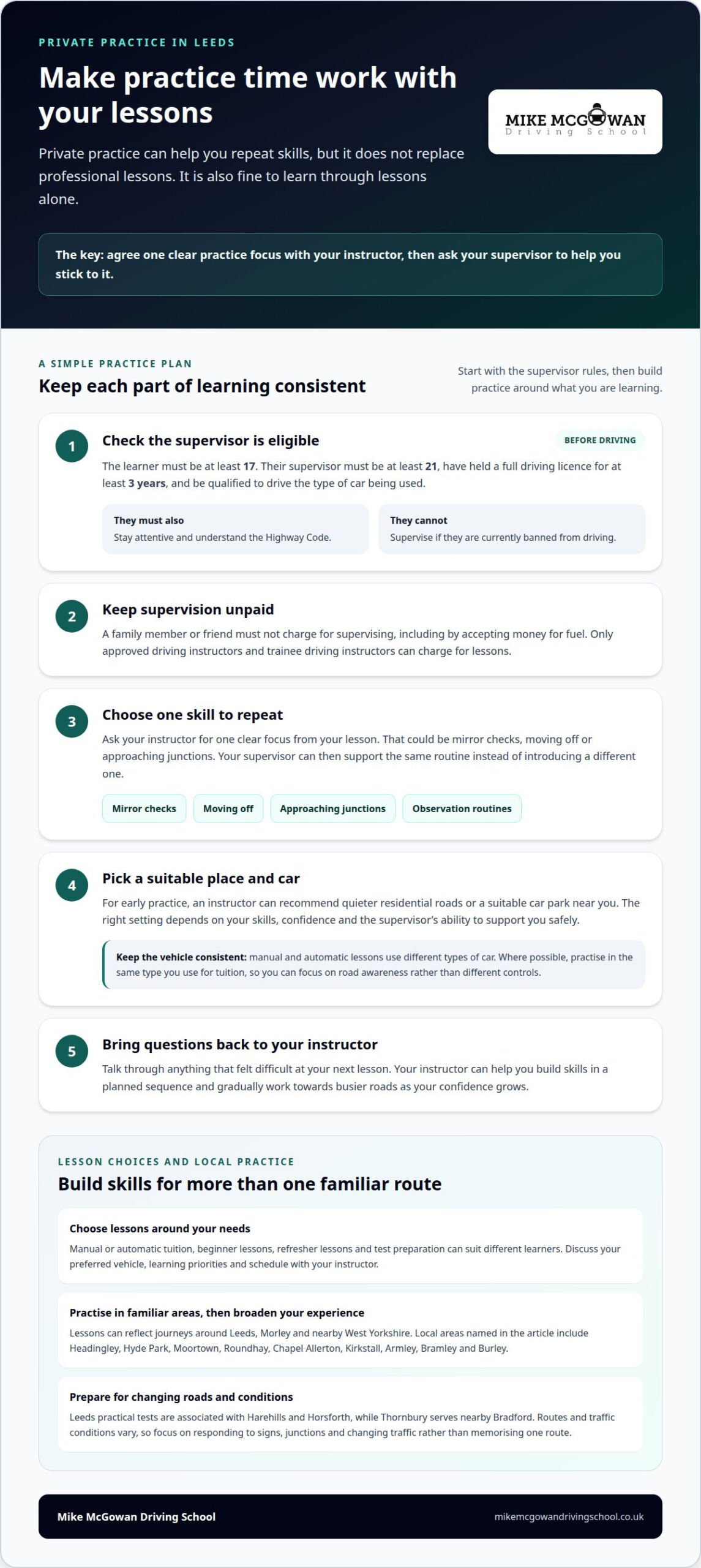
The Driver and Vehicle Standards Agency (DVSA) says a learner driver must be at least 17 years old to practise driving. The supervisor must be at least 21 years old and have held their driving licence for at least 3 years. They must also be qualified to drive the type of vehicle the learner is using.
A supervisor must stay attentive and understand the Highway Code, rather than simply sit beside the learner. Anyone currently banned from driving cannot supervise. Private supervision must be unpaid, including when a family member accepts money for fuel. Only approved driving instructors and trainee driving instructors can charge for lessons.
Private Practice Alongside Instructor Tuition
Occasional practice can help you repeat skills introduced during a professional lesson. Ask your instructor to suggest one clear focus, such as mirror checks, moving off or approaching junctions. Your supervisor can then support that practice without introducing a different routine. This approach helps keep learning consistent, especially if nerves make a new manoeuvre feel unfamiliar.
Your instructor can help structure private practice by suggesting a suitable focus at the end of a lesson. For example, practise observation routines after learning them together, then discuss any sticking points at your next lesson.
Lesson Options and Instructor Flexibility
Manual and automatic lessons suit different learner preferences, while beginner tuition gives new drivers a structured starting point. A refresher lesson can help someone returning to driving rebuild confidence. Discuss your preferred vehicle and learning priorities with the instructor, then use those needs to shape lesson content and timing.
Lesson scheduling depends on your routine and instructor availability. Agreeing a regular slot can make progress easier to follow. If work, study or nerves affect your plans, explain that early so a practical schedule can be discussed.
Professional Driving Instruction in Leeds
Professional driving instructors can teach vehicle control, observation and road positioning in a planned sequence. They can also recommend quieter residential roads or suitable car parks near your area for early practice. The right setting depends on your current skills, confidence and the supervisor’s ability to support you safely.
Leeds practical tests are associated with Harehills and Horsforth, while Thornbury serves nearby Bradford. Test routes and traffic conditions vary, so lessons can build skills across different local road settings rather than rely on memorising one route. You can explore Leeds lesson areas to see where local tuition is available.
Driving Lessons Across Leeds and Nearby Areas
Leeds learners often travel between home, college, work and lesson locations. Choosing a convenient area can make regular practice easier to fit around those commitments. Central Leeds, Morley and nearby West Yorkshire communities each offer different road settings, so lesson planning can reflect where you need confidence.
In Headingley or Hyde Park, a learner can build confidence around residential streets before progressing to busier roads. Areas such as Moortown, Roundhay and Chapel Allerton provide other familiar starting points for local tuition. The instructor can shape each lesson around your current skills, rather than expecting you to master every setting at once.
Morley learners can focus on routes that connect familiar local streets with wider roads. In Kirkstall, Armley, Bramley or Burley, lessons can help you practise observation and positioning in the places you are likely to travel. A useful first step is to tell the instructor where you live or study and which journeys feel most important.
Manual and automatic lessons offer different ways to learn vehicle control. The choice affects the type of car used during tuition and the licence you work towards. Think about which vehicle suits your plans, then keep private practice in the same type where possible. Consistency helps you focus on road awareness instead of adjusting to different controls.
The theory test and practical driving test develop different parts of learning to drive. Theory knowledge supports safer decisions on Leeds roads, while lessons build the skills needed to control a car. An instructor can connect topics such as hazard awareness with real situations, helping you understand why a decision matters, not just remember a rule.
Leeds test centres can influence the roads and conditions learners encounter during preparation. However, memorising one route is not a reliable way to become an independent driver. Lessons should build adaptable skills, such as responding to signs, junctions and changing traffic. That preparation remains useful if your test follows an unfamiliar route.
Progress is easier to review when each lesson has a clear focus. For example, use one session to practise roundabouts, then discuss what felt difficult before choosing the next step. If you feel nervous in busy traffic, the instructor can build towards it gradually through quieter roads and familiar areas.
A driving school’s local coverage matters when you need lessons near home, study or work. Your regular journeys can help guide lesson locations across Leeds and surrounding areas. Practising in more than one setting can help you build confidence beyond a single familiar route.
When comparing options, consider how easily lesson arrangements fit your regular journeys and whether the instructor can meet you in a convenient area. The listed prices give you another point to weigh alongside vehicle type and location. Driving lessons listed for Leeds include a lesson priced at £41 per lesson, an automatic lesson priced at £37 per lesson, a manual lesson priced at £38 per lesson and a manual lesson priced at £28 per lesson. A Leeds driving instructor listing offers lessons for £27 per lesson and a manual lesson for £25 per lesson. These are separate listed options, so check which type of lesson each price applies to before making a choice.
A lower listed price is one factor to consider when comparing lesson options, but the right fit also depends on your learning needs and where you want to practise. Ask about the lesson type and meeting arrangements, then consider whether the proposed area supports the skills you want to develop.
If you are choosing between manual and automatic tuition, compare the relevant listed options with the vehicle you plan to learn in. It can also help to discuss your priorities before lessons begin, such as becoming more comfortable on familiar streets or preparing for varied local traffic. A clear conversation about location, lesson type and price helps you make a choice that suits your routine and gives your practice a practical focus.
Keep reviewing what feels manageable as your confidence grows, and discuss how upcoming lessons can build on the skills you have already worked on. This makes it easier to keep local practice connected to your wider learning goals.
Combining Private Practice with Professional Driving Lessons
Combining private practice with professional driving lessons in Leeds works best when each drive has a clear purpose. Your instructor can introduce and assess skills, while a suitable supervisor helps you repeat tasks you already understand. This keeps practice connected to tuition, whether you’re learning in a manual or automatic car.
After a lesson, choose one skill to revisit. For example, if you’ve worked on junctions, focus on observation and approach during a familiar drive. At your next lesson, tell your instructor what felt comfortable and where you needed help. This gives the session a practical starting point and helps address misunderstandings early.
The main risk is developing habits that differ from your instructor’s guidance. A supervisor might suggest a different routine, leaving you unsure about observations or positioning. Private practice can also reinforce mistakes if nobody spots them. Keep your instructor informed about what you’ve practised and anything that felt unclear.
Before practising in a family car, make sure it is correctly insured for learner practice. It must be taxed, have a valid MOT, be registered with the DVLA and display L plates at the front and back. An additional rear-view mirror lets the supervisor see behind the vehicle. Remove or cover the L plates when a full licence holder drives.
Start on quieter roads and build towards busier settings as your confidence grows. In Leeds or Morley, choose a calm area where you can focus on vehicle control and observation. A suitable car park can help with basic manoeuvres. Keep each drive manageable rather than adding unfamiliar traffic and new skills at once.
Combining private practice with professional driving lessons in Leeds can help you make purposeful use of lesson time. Share what you practised, then agree which skill needs attention next. Private practice isn’t compulsory, and family availability doesn’t have to dictate your learning pace. A steady routine leaves space to reflect between drives.
Where practical, use the same type of vehicle for lessons and private practice. Manual driving involves clutch control and gear changes, while an automatic has different controls to learn. If you’re preparing for a manual test, practising in an automatic won’t build the same manual skills. Keep your vehicle choice consistent with your learning plan.
After a drive, remember one point that felt easier and one question for your next lesson. For example, you could ask about judging a gap at a junction. Your instructor can revisit the situation and explain the decisions involved. This turns everyday practice into useful feedback and supports progress towards independent driving.
Practice between lessons can support progress when it follows the same learning plan as tuition. MQW Driving School advises learner drivers that they can improve their learning at home or with family or friends as well as during lessons. Use that time to revisit a skill already introduced, then tell your instructor what seemed straightforward and what still needs explanation. The risk of developing bad habits is a disadvantage of private practice, so pause if you are uncertain rather than repeatedly practising a routine you may have misunderstood. A clear question for the next lesson can help your instructor address the uncertainty and guide what to practise afterwards.
Before setting off, check that the car used for private learner practice in the UK is correctly insured, taxed, has a valid MOT and is registered with the DVLA. It must display L plates at the front and back, and an additional rear-view mirror should be fitted so the supervisor can see behind the car. Begin in quieter areas and on minor roads until you feel comfortable with the supervisor and car. Keep practice focused on familiar tasks, and discuss any difficulty with your instructor before moving on to a more challenging setting. This lets private driving complement lessons without replacing the guidance needed to build consistent skills.
Combining Professional Lessons with Private Practice
A balanced plan gives professional tuition and private practice different roles. Your instructor introduces and assesses skills, while a suitable supervisor helps you repeat familiar tasks. Keep both parts connected through one agreed focus, such as junction routines or reversing. This makes practice purposeful without turning every family drive into a test.
The DVSA average for becoming test-ready is around 45 hours of professional lessons and 22 hours of private practice. These figures describe an average, not a target you must reach. Your progress depends on how quickly you develop control, observation and independent decision-making. Use the figures as context, not a reason to rush or book more tuition than you need.
Build a simple weekly rhythm around lesson availability and your supervisor’s time. After a lesson, choose one skill that feels settled enough to practise. A short drive focused on mirror checks and moving off can be more useful than trying several new manoeuvres. At the next lesson, tell your instructor what felt comfortable and where you needed support.
Private practice should reinforce your instructor’s approach, not introduce competing routines. For example, agree how to approach a roundabout before practising with a family member. If your supervisor gives different advice, pause and raise it during tuition. Your instructor can explain the reasoning and help you return to one consistent method.
Keep the vehicle type consistent where possible. Manual practice helps develop clutch control and gear changes, while an automatic removes those tasks from the learning process. If you’re preparing for a manual driving test, private practice in an automatic won’t rehearse manual control. Make the car choice part of your plan before arranging regular practice.
Use private drives to revisit familiar roads before adding new challenges. In Leeds, a learner who has practised on quiet streets can gradually build towards busier junctions with professional guidance. Your instructor can assess when a skill is ready for more demanding conditions. This progression supports confidence without making one difficult drive feel like a measure of your overall ability.
Some learners consider intensive driving courses to fit tuition into a short period. That pace does not suit everyone, especially when time between sessions helps skills settle. Regular lessons combined with occasional practice can create a steadier routine. Choose a schedule that leaves room to reflect, rather than filling every available day behind the wheel.
As test preparation develops, use lessons to identify remaining gaps rather than focusing only on a pass date. If you still need prompts at junctions, keep practising those decisions with an instructor. Private practice can support familiar skills, but professional assessment helps show whether you can use them independently. That distinction matters more than simply counting drives or booking a test quickly.
Mike McGowan Driving School
Mike McGowan Driving School offers one-to-one automatic tuition in Leeds, with calm coaching shaped around each learner. If you’re combining lessons with time in a family car, use professional tuition to understand how to approach a skill. Bring questions from practice to your next lesson, giving Mike a clear starting point for supporting your progress.
Lessons are one-to-one, with a calm approach for learners who feel nervous or need time to settle behind the wheel. Explain what feels difficult, such as judging gaps or approaching a particular junction. Mike can then give that concern proper attention during tuition, rather than expecting you to move on before you feel ready.
Beginner Driving Lessons provide a structured starting point for new learners. Automatic Driving Lessons are available for people who want to learn in an automatic car. Manual lessons are coming soon and are not currently available. Refresher Lessons support drivers returning to the road, while Test Preparation helps learners focus on practical test skills.
Private practice can provide useful experience between lessons, but it can also leave questions. You might feel comfortable with a manoeuvre at home yet hesitate when practising somewhere unfamiliar. A lesson gives you space to talk through that difference and work on the parts that need more attention.
Preparation can also include becoming familiar with Leeds test routes. The aim is not to memorise a route, but to build skills that help you respond to different road situations. Professional guidance can help identify what still needs work, keeping test preparation relevant to your progress.
If you’re changing instructors or returning after a break, explain what you’ve already learned and what you want to improve. Previous practice and lessons provide useful context for planning your next session. A patient review can help you regain a sense of direction without treating earlier learning as wasted.
You don’t need to arrive with a perfect plan. A learner or parent can note what you want to learn, whether you’re starting out, building confidence in an automatic car or preparing for a test, and discuss it at your next lesson.
Frequently Asked Questions
Do you teach in an automatic or a manual car?
Automatic driving lessons are available in Leeds. Manual lessons are coming soon, so they aren’t available at present. If you’re choosing automatic tuition, think about the type of car you expect to drive after passing and what feels comfortable for you. A clear preference helps shape your learning plan and gives you a practical starting point for discussing lessons.
Can you combine a private practice drive with a professional driving lesson in Leeds?
Yes. Treat private practice and professional lessons as separate parts of your learning plan. For example, use a lesson to work through a new situation, then arrange private practice on another occasion to revisit familiar skills. Note anything confusing or unexpectedly difficult. That gives your next lesson a specific point to explore and helps you make useful use of the time.
Disclaimer
This article is intended as general guidance for learner drivers and does not replace official DVSA advice or a lesson with a qualified instructor. Rules, test requirements, and local test centre procedures can change, so always check GOV.UK or speak to your instructor for the most current information. Mike McGowan Driving School accepts no responsibility for outcomes based solely on the content of this article.