

Handling Tricky Junctions on Your Leeds Driving Test
If you searched for “handling tricky junctions Leeds driving test”, the practical answer is not to memorise every junction. Use signs, road markings and traffic to make a safe decision, even when the road is unfamiliar. If you’re worried about choosing the right lane, judging a gap or missing a turn, a steady routine can help you focus on what’s in front of you.
This guide explains how to read the junction layout, observe what’s happening around you and decide when it’s safe to move. If traffic changes or you miss a direction, don’t rush or make a sudden move. Continue safely and follow the road ahead.
With local test preparation from Mike McGowan, you can practise junction decisions on Leeds roads without relying on memorised routes. The aim is to build skills you can use wherever you drive. We’ll start with a simple observation routine, then look at ways to practise unfamiliar layouts without adding pressure.
Key Takeaways
- Check signs and road markings early so you have time to understand the junction layout.
- Use a steady sequence: notice, assess, observe, decide, then move when it’s safe.
- Sat nav directions can guide you, but they don’t replace checking signs, markings and traffic yourself.
- Start with quieter junctions, then practise busier layouts as your confidence grows.
- Practising decisions that transfer to unfamiliar roads can make junctions on your Leeds test feel more manageable.
Why tricky junctions feel challenging on a Leeds driving test
Careful observation and safe decisions matter more than knowing a junction by heart. On an unfamiliar Leeds road, you need to make sense of the signs, markings, visibility and traffic together. That can feel like a lot to process when you’re also thinking about steering, speed and what comes next.
Junction layouts vary. Some have clear lane arrows and open views; others have several possible directions, traffic close behind or buildings and parked vehicles that restrict what you can see. Learning to read the clues in front of you helps you respond to the junction you’re approaching, rather than relying on a remembered picture.
What makes an unfamiliar junction harder to read?
Limited visibility can make it harder to judge what’s approaching from either side. A parked vehicle, wall or hedge can obscure part of your view, so keep checking as the view changes. Don’t let pressure from traffic behind persuade you to move before you’re satisfied it’s safe.
Signs and road markings help explain the layout. Direction signs can show which destinations are served from each lane, while arrows and lane lines help you understand where to position your vehicle. Junction designs vary, so a quick look at different road junction designs can help you recognise why it’s the layout, rather than its name, that you need to read.
Traffic flow adds another layer. Vehicles in adjacent lanes can make the space feel busy, and a queue behind you can create a sense of urgency. But traffic moving around you doesn’t change the priority: take the time you need to observe and choose a safe course. Caution doesn’t mean you can’t make progress. Wait when it isn’t safe, then move when conditions allow.
What does the examiner need to see at a junction?
Your driving should show that you’ve noticed what’s happening and are responding to it. That means observing effectively, choosing a suitable position and making a decision that fits the conditions. There isn’t one sequence that works for every junction, because the visibility, traffic and layout can all differ.
When handling tricky junctions on your Leeds driving test, keep your attention on the road rather than on a script. Check signs and markings, look for other road users and give yourself time to decide. If your view is restricted, don’t treat a gap as safe just because you’re keen to move. Keep observing until you can make a considered choice.
Feeling cautious can be part of driving responsibly. The aim isn’t to rush to prove confidence; it’s to make steady progress without compromising safety. Mike McGowan Driving School provides Leeds driving lessons that include local test preparation, so you can practise reading real road layouts and build skills that transfer to unfamiliar junctions.
A calm step-by-step routine for handling Leeds junctions
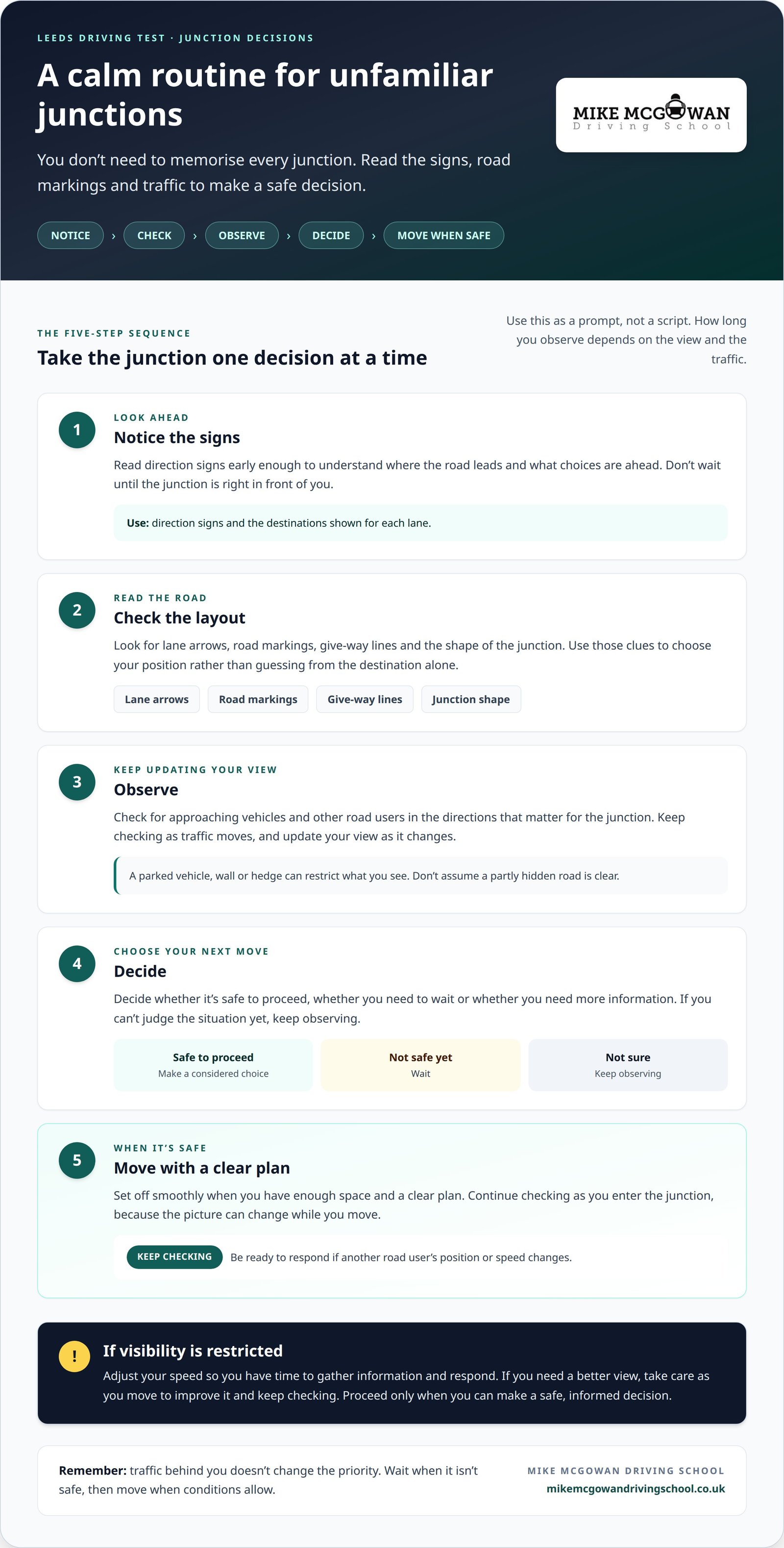
A short routine gives you a clear next step without asking you to predict the whole junction at once. Remember: notice the signs, check the layout, observe, decide, then move when it’s safe. The order stays steady, but how long you spend observing depends on what you can see and how traffic is moving.
Use this sequence as a prompt, not a script to follow mechanically. A clear junction with good visibility calls for different observations from one where buildings or parked vehicles block your view. The Highway Code’s guidance on road junctions is a useful reference for different junction situations.
- Notice the signs. Read direction signs early enough to understand where the road leads and what choices are ahead. Don’t wait until the junction is right in front of you.
- Check the layout. Look for lane arrows, road markings, give-way lines and the shape of the junction. Use those clues to choose your position rather than guessing from the destination alone.
- Observe. Check for approaching vehicles and other road users. Look in the directions that matter for the junction, and keep updating your view as traffic moves.
- Decide. Choose whether it’s safe to proceed, whether you need to wait or whether you need more information. If you can’t judge the situation yet, keep observing.
- Move when safe. Set off smoothly when you have enough space and a clear plan. Continue checking as you enter, because the picture can change while you move.
In practice, let the view and traffic guide your timing. Don’t treat each glance as a box to tick. Notice what you learn from observing, then use it to decide what to do next. A quiet road can become busier, or a vehicle you were waiting for can turn away. Base your decision on what’s happening now.
How should you approach a junction with restricted visibility?
Adjust your speed as you approach so you have time to gather information and respond. Look for traffic without assuming a partly hidden road is clear. If you need a better view, take care as you move to improve it and keep checking. Proceed only when you can make a safe, informed decision.
How do you choose a safe gap and move away smoothly?
Judge the speed and distance of approaching traffic based on what you can actually see. A vehicle that looks far away can still be approaching quickly. Once you begin moving, keep observing and be ready to respond if another road user’s position or speed changes.
If you’re practising for a Leeds test and want calm guidance applying this routine on local roads, you can book a driving lesson with Mike McGowan.
Route memorising versus junction awareness: what helps on test day?
Knowing parts of Leeds can help you feel more settled, but memorising a sequence of turns isn’t a reliable substitute for reading the road. Signs, lane markings and traffic tell you what to do at the junction in front of you. Practise the skills that help you respond if the layout or situation differs from what you expected.
Route knowledge still has value. Familiarity can help you recognise the kinds of layouts you’ll meet and feel less surprised by local roads. Use it as context, not as a set of instructions to follow regardless of what’s happening around you. Mike McGowan’s Leeds driving test route preparation can help you practise local roads, while your decisions at each junction still need to respond to the conditions.
Why is memorising every turn an unreliable plan?
A familiar junction can look different when traffic is heavier, a vehicle blocks your view or roadworks alter the layout. A direction can also arrive later than you expect. If you’re focused on reaching a remembered turn, you could miss a sign or feel pressured to change position at the wrong moment.
Use practice routes to build awareness instead. Notice how lane markings guide your position, how visibility affects your view and where you need to gather information. Apply those observations at the next junction, even if it’s unfamiliar. Route familiarity is helpful, but sound observation and a safe choice are more useful when the road doesn’t match your memory.
What should you do if you feel unsure at a junction?
Keep listening to the instruction, but don’t let it distract you from assessing the road. Check the signs and markings, consider your position and act only when you can do so safely. If you’re unsure whether a turn is appropriate, don’t make a sudden move to recover the route.
If you miss a direction, continue safely along the road rather than swerving, stopping unexpectedly or cutting across a lane. A route change isn’t a reason to rush. Base your next decision on the signs, traffic and space available, not on trying to get back to a preferred path at all costs.
One missed turn doesn’t automatically mean you’ve failed. What matters is how you respond and whether your driving remains safe. Good preparation means practising how to notice a change, stay composed and make the next decision using the information in front of you.
After a practice drive, think back to one junction that felt uncertain. Ask yourself what you noticed, what you acted on and what you’d look for next time. A short review helps turn route practice into awareness you can use elsewhere, rather than a list of turns to memorise.
How to practise tricky Leeds junctions without adding pressure
Build confidence in stages rather than starting with the busiest junctions you can find. Begin somewhere quieter, where you can focus on signs, road markings and visibility without feeling hurried. As those decisions become more familiar, practise similar junctions with more traffic or a less open view.
The aim isn’t to make every drive perfect. Choose one point to review afterwards, such as whether you spotted a direction sign early or gave yourself enough time to assess the view. One useful observation gives you something clear to work on next time, without turning the whole drive into a pass-or-fail judgement.
How can you practise a junction in manageable stages?
Start by identifying the clues before you reach the junction. Notice where the signs are, what the road markings indicate and whether anything limits your view. Then make the manoeuvre when it’s safe, paying attention to traffic and the space available.
Once you feel ready, practise the same kind of decision in a different setting. A similar turn with a queue, a clearer view or traffic approaching at a different pace helps you learn the principle, not just one layout. Calm feedback from an instructor can keep the focus on one practical adjustment at a time. If anxiety is making practice difficult, this guide to support for nervous learners in Leeds offers further reassurance.
How can you prepare for Leeds test-centre driving?
Practise a range of local road layouts as part of preparation for Leeds test centres, without relying on a particular route being repeated. Local practice can help you meet different signs, lane arrangements and traffic conditions, while the focus stays on decisions you can use elsewhere. Mike McGowan’s Leeds driving lessons can include practice on local routes.
A mock-test-style drive can help you get used to making decisions independently while following directions. Treat it as a chance to notice what you already handle well and what you’d like to practise again, not as a prediction of your result. If a junction feels difficult, your instructor can help you break down what you saw and what you could try next time.
Steady practice matters more than tackling every challenging layout in one drive. Build up gradually, pause to reflect on one learning point and return to it when you’re ready. If nerves affect your progress, mention that during your lesson so practice can focus on the situations you find hardest.
Get calm, local support for tricky junctions before your Leeds test
You don’t have to work through every junction worry on your own. Mike McGowan is a DVSA-approved instructor who offers calm, personalised test preparation in Leeds. You can focus practice on the decisions that feel least comfortable, whether that’s reading lane markings, judging a gap or staying settled when the road looks unfamiliar.
Local practice can help you get used to a range of Leeds road layouts, but it isn’t about promising an exact test route. The aim is to build habits that travel with you: noticing what’s around you, choosing a safe position and making a decision that fits the conditions. That gives you a sound basis for handling tricky junctions on your Leeds driving test without relying on memorised turns.
What can personalised junction practice help you work on?
Start by telling your instructor which situations make you feel least sure. You could focus a lesson on recognising signs earlier, dealing with a restricted view or deciding when to wait for a safe gap. Calm feedback helps make the next step clear, so practice feels like progress rather than a judgement on the whole drive.
As you grow more comfortable, practice can include different local layouts and traffic conditions. The point is to apply the same safe thinking in more than one place, not to rehearse a single junction until it feels familiar. Progress means becoming steadier in your decisions, not being promised a particular test result.
How can you take the next step?
If nerves are making it hard to practise, Mike McGowan’s free confidence-building programme is designed for anxious and nervous drivers. It offers another way to approach lessons at a calmer pace, while keeping the focus on the road skills you want to strengthen.
Automatic lessons use a Toyota Yaris, described as comfortable, with good visibility and easy handling. If you’re preparing for a Leeds test, you can discuss the junctions or situations you’d like to work on and use local practice to build transferable skills. You don’t need to arrive with a perfect plan; one clear concern is enough to start a useful conversation about your preparation.
A practical first step is to note one junction decision you’d like to feel more confident about. Bring that to a lesson and use it to shape your practice, one manageable step at a time.
Take your next junction one decision at a time
You don’t need to feel completely confident before you can make progress. Choose one part of junction driving that still takes extra thought, then use your next practice to understand it better. A small, clear focus can feel more manageable than trying to change everything at once.
Handling tricky junctions on your Leeds driving test gets easier to approach when you give yourself room to learn. If a particular road or decision worries you, make that the focus of your next lesson. Build experience gradually, without expecting every drive to go perfectly.
Before you set off, choose one thing you want to pay attention to. Afterwards, note what felt more manageable and what you’d like to practise again. That gives your next drive a useful starting point.
Take the next step at a steady pace. Each drive gives you another chance to learn.
Frequently Asked Questions
Will the examiner take me on a set route in Leeds?
Don’t rely on following one set route or expect to memorise every turn before your test. Prepare to respond to the road you’re on, including signs and lane markings you haven’t seen before. Practising in different parts of Leeds can help you get used to varied layouts, but the aim is to build confidence in your decisions, not to predict where you’ll be asked to drive.
What should I do if I miss a turn during my driving test?
Carry on safely rather than making a sudden move to get back on course. Check the road and signs around you, keep to a suitable position and follow the next direction when it’s safe. If you’re uncertain, don’t guess or cut across traffic. A missed turn by itself doesn’t mean the test is over; focus on driving safely from that point.
Can hesitation at a junction make me fail my driving test?
A pause doesn’t automatically mean you’ll fail. Waiting because you need more time to judge what’s happening is different from holding up traffic when it’s safe to proceed. Keep observing and make a decision once you have enough information. On your Leeds driving test, focus on being safe and appropriately decisive, rather than moving simply because you feel under pressure.
Are junctions in Leeds difficult for learner drivers?
Some junctions can feel demanding, but difficulty depends on the layout, visibility and traffic at the time. One learner might find a multi-lane approach confusing, whilst another is more concerned about seeing past parked vehicles. Try to identify the specific part that unsettles you. That gives you a clear focus for practice, rather than treating every Leeds junction as equally difficult.
Can I practise Leeds junctions with a parent or another accompanying driver?
Yes, if you meet the current learner-driver rules and the vehicle is suitable and properly insured for your practice. Before setting off, check the official GOV.UK guidance on who can supervise and what conditions apply. Agree a simple focus with your accompanying driver, such as spotting direction signs early, and choose a quieter practice setting if you’re still building confidence.
Should I use a sat nav to practise tricky junctions?
Yes, it can help you practise responding to spoken directions, but it shouldn’t become your only guide. Set the destination before you move and keep your attention on the road, signs and lane markings. If a direction comes too late for a safe manoeuvre, don’t force it. Continue safely and let the route change rather than making a rushed turn.
What if I cannot see clearly when approaching a junction?
Slow down appropriately and don’t treat a restricted view as proof that the road is clear. Look for a safe opportunity to improve your view while staying in a position that doesn’t put you or others at risk. Keep checking for traffic and proceed only when you can judge the situation. If you still can’t see enough to decide safely, wait and reassess.
Disclaimer
This article is intended as general guidance for learner drivers and does not replace official DVSA advice or a lesson with a qualified instructor. Rules, test requirements, and local test centre procedures can change, so always check GOV.UK or speak to your instructor for the most current information. Mike McGowan Driving School accepts no responsibility for outcomes based solely on the content of this article.


