Complex Roundabout Driving Lessons in Leeds
The best complex roundabout driving lessons in Leeds build your skills steadily. Look for an instructor who explains mirror checks, lane choice and awareness of other drivers, then gives you time to practise on busier junctions such as those near the M621 and the Armley Gyratory. You shouldn’t have to tackle the hardest roads before you feel ready.
If multi-lane roundabouts leave you unsure where to position the car, that’s a practical skill to work on, not a reason to feel embarrassed. Calm, patient instruction can help you understand each decision and practise at a manageable pace.
This guide explains what to look for in an instructor and how to progress from quieter roads to complex roundabouts and busy Leeds traffic. You’ll also learn how automatic or manual lessons shape your practice, so you can choose an approach that suits you.
Key Takeaways
- Choose a lesson plan that builds skills at a steady pace, so you can work on difficult situations without feeling rushed.
- Use each roundabout practice to focus on one decision at a time, such as lane choice, observation or timing your approach.
- At busy junctions, keep checking what other drivers, cyclists, pedestrians and buses are doing around you.
- Think about whether manual or automatic lessons suit the way you want to learn and drive.
- Beginner and refresher lessons can both help you practise challenging roads and build confidence at your own pace.
How do I find the best driving instructor in Leeds?
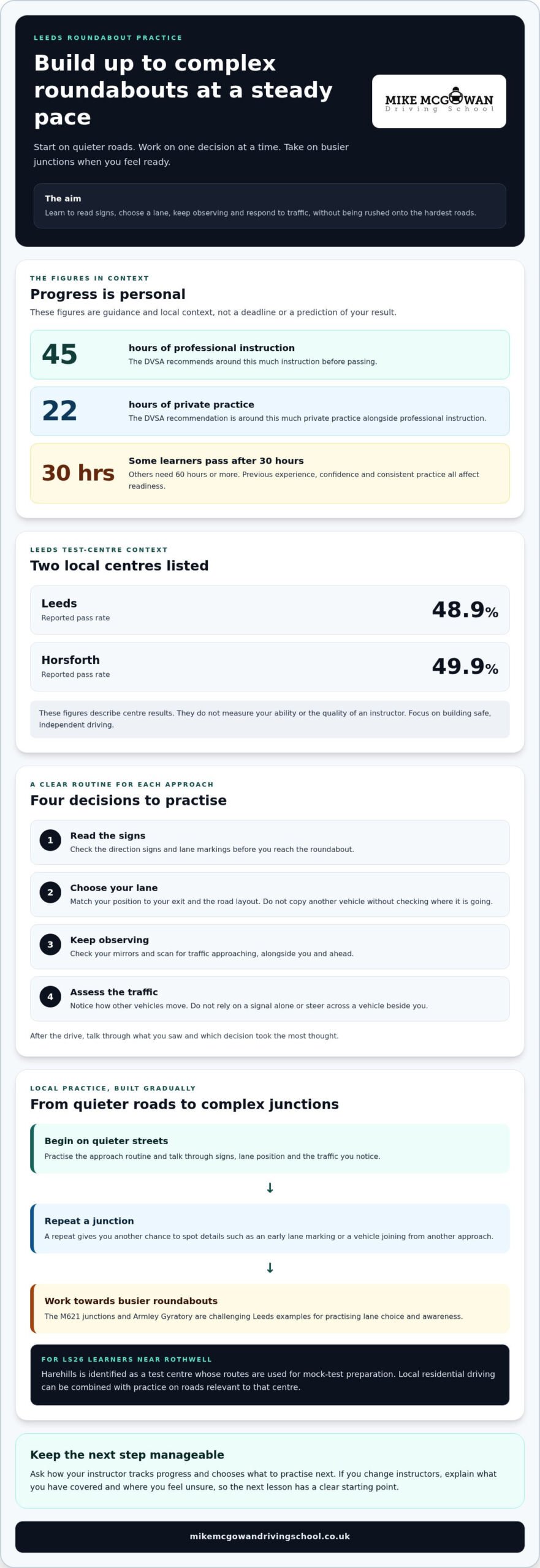
Look for an instructor who knows Leeds roads and can explain how practice will build towards your driving test. The most challenging roundabouts include those near the M621 junctions and the Armley Gyratory, where lane choice and observation need steady attention.
Local knowledge is most useful when it leads to clear, practical training. Ask how lessons progress from quieter streets to busier junctions and how you’ll review decisions afterwards. After approaching an unfamiliar roundabout, for example, you should be able to talk through the signs, your lane position and the traffic you noticed.
Leeds has 2 driving test centres listed for local learners: Leeds and Horsforth. Their reported pass rates are 48.9% at Leeds and 49.9% at Horsforth. These figures describe centre results, not your ability or the quality of an instructor. Choose practice that develops safe, independent driving rather than trying to predict a result from a percentage.
For LS26 learners practising around Rothwell, Harehills is identified as a test centre whose routes are used for mock test preparation. A useful lesson plan can combine local residential driving with practice on roads relevant to that centre. You can explore driving lessons in Leeds when comparing how local tuition fits your needs.
Mock tests can highlight decisions to practise before your real test. Arrange one a few weeks beforehand, then use the feedback to focus on specific issues, such as observation at junctions or choosing the correct lane. A mock test should give you useful direction, not add pressure.
Progress differs between learners. Some pass after 30 hours of lessons, while others need 60 or more. The DVSA recommends around 45 hours of professional instruction and 22 hours of private practice before passing. Treat these as guidance, not a personal deadline: confidence, previous experience and consistent practice all affect readiness.
When choosing an instructor, ask how they track your progress and decide what to practise next. A helpful plan might revisit a challenging roundabout before introducing a new route. If you’re changing instructors, explain what you’ve covered and where you feel uncertain. That gives the next lesson a useful starting point, whether you learn in a manual or automatic car.
Choose an instructor who knows the M621 junctions and Armley Gyratory and can provide clear practice with lane choice and observation on these complex roundabouts.
Complex and multi-lane roundabouts
Multi-lane roundabouts require early planning and continued observation as traffic moves. For complex roundabout driving lessons in Leeds, look for practice that helps you understand each decision, rather than simply repeating a route.
Mirror Checks and Lane Positioning
Before approaching, check your mirrors and read the direction signs and lane markings. Choose a lane that matches your exit, then maintain your position as you approach. Let the road layout guide you, rather than copying another vehicle without checking where it is going.
As you move around the roundabout, keep scanning for vehicles beside you and ahead. If a car is alongside as your exit approaches, for example, don’t steer across its path. Wait until you can leave safely, keeping your attention on the traffic rather than watching one vehicle for too long.
Practice on Roundabouts and Junctions
Break the approach into clear steps: read the signs, choose your lane, check around you and assess the traffic. A junction leading to a roundabout gives you a chance to practise this sequence before joining. Afterwards, talk through what you saw and which decision took the most thought.
Build your practice gradually, moving from a quieter approach to a busier multi-lane layout as your control improves. Repeat the same junction to notice details you missed the first time, such as an early lane marking or a vehicle joining from another approach. Repetition can build confidence without rushing.
Lessons on Complex Roundabouts
Which Leeds driving instructors offer lessons on complex roundabouts? Choose a local instructor who includes practical route work and explains lane choice, observation and timing during the drive. A useful lesson builds on what you can already do, then gives you room to try each decision with less guidance.
A good complex roundabout driving lesson in Leeds should also leave time to review a specific moment. Discuss, for instance, whether you spotted the correct sign early enough or noticed a vehicle beside you. Clear feedback gives you a practical focus for the next drive, rather than leaving you to guess what needs work.
Roundabouts Used for Driving Lessons
Which complex roundabouts in Leeds are commonly used for driving lessons? Roundabouts near the M621 junctions and the Armley Gyratory are identified as challenging examples. Their layouts give learners a chance to practise lane choice, awareness and responding to traffic while approaching an exit.
Before driving a new route, talk through its signs and your intended exit. During practice, focus on your position and the traffic around you, then review your decisions afterwards. The aim is to build a routine you can use independently, including on unfamiliar roundabouts beyond your lesson route.
Awareness of other drivers at roundabouts
Traffic at a roundabout can change quickly, so observe what nearby drivers are doing rather than relying on a signal alone. A car’s position, speed and movement can help you judge whether it is continuing around or preparing to leave. Keep scanning as you approach, enter and move towards your exit.
Start with a steady scan. Check your mirrors, look towards the roundabout and notice vehicles approaching from your right, then return your attention to the road ahead. If a vehicle slows near an exit, for example, don’t assume it will take it until its movement gives you a clearer picture.
A driver’s signal is one clue, not the whole story. Check whether the car’s position and speed support what the signal suggests. If a vehicle indicates left but continues around the roundabout, hold back and reassess instead of relying on its signal alone. This gives you time to respond without rushing your decision.
Watch vehicles beside you as well as those ahead. A car in a neighbouring lane may move towards an exit, while a larger vehicle can block your view of what is happening beyond it. Leave a safe space and avoid sudden changes in direction. If your view is blocked, wait until you can see enough to make a considered choice.
Hazard perception means noticing a developing situation early enough to respond smoothly. At a Leeds roundabout, that could mean spotting a queue building near an exit, a vehicle braking sharply or a driver joining while you are already moving around. Recognising these changes helps you adjust your speed and position calmly.
Practise a simple observation routine on each journey: check your mirrors before changing speed or position, look ahead for traffic movement, then scan again before acting. After passing an exit, keep watching for vehicles joining or leaving nearby. This routine helps you gather information without staring at one car for too long.
During lessons, ask to review one specific moment after each roundabout. Discuss whether you noticed a car approaching quickly, saw a signal clearly or left enough space for another driver. Identifying the detail makes feedback practical and helps you distinguish a missed observation from the feeling that the whole journey went badly.
Routes near Leeds test centres can include different traffic conditions, but the same observation habits apply on familiar and unfamiliar roads. If another driver behaves unexpectedly, ease off, create space and reassess the traffic around you. You don’t need to predict every action; focus on spotting changes early and choosing a calm response.
Busy roads, cyclists, pedestrians and buses in Leeds
Busy Leeds roads require you to notice more than the vehicle directly ahead. Near Stourton Park and Ride, junctions can be busy with buses and commuters. Watch how traffic moves through the junction and leave time to respond when a bus slows or pulls away.
At a junction near Stourton Park and Ride, scan ahead and check your mirrors. Look for buses changing position, cyclists travelling alongside traffic and people waiting to cross. If your view is blocked, ease your approach and wait until you can see enough to make a clear decision.
Cyclists can be harder to spot when traffic moves slowly or vehicles are parked near the road. Check your mirrors before changing position and look carefully before moving past a stationary vehicle. A cyclist could be travelling between a parked car and your vehicle, so check the space before steering towards it.
Pay close attention to pedestrian crossings as you approach busy roads. Look for people waiting at the kerb, crossing in front of a bus or moving between parked vehicles. If someone steps towards a crossing, slow down and reassess the traffic around you. This gives you time to respond without making a sudden move.
Parked cars can narrow Leeds residential streets and limit your view of oncoming traffic. As you approach them, check what is ahead and consider whether there is enough room to pass safely. If another vehicle approaches, wait in a suitable place rather than squeezing through a narrow gap.
Students walking near busy streets are another reason to scan beyond the car in front. Near a bus stop, for example, people may gather beside the kerb or move towards a bus. Keep your speed controlled, leave space and check for pedestrians before continuing past the stop.
Hazard perception means noticing changes early, not trying to predict every move. On a Leeds road, you might spot a bus indicating, a cyclist moving out from beside parked cars or a pedestrian nearing a crossing. Identify the hazard, ease your speed and decide how much space you need.
Build your practice in stages rather than making every drive intensive. Start with one focus, such as scanning for cyclists, then add bus stops or parked vehicles as your attention improves. Reviewing when you first noticed each hazard helps you understand your perception and make the next journey feel more manageable.
Driving lesson types and instructor approaches
The right lesson approach depends on what you need to practise and how you learn. At a complex junction, useful tuition connects vehicle control with decisions such as reading signs and choosing an exit. A clear focus for each drive helps you understand what you’re practising and what to revisit.
Manual lessons include gear changes alongside steering, observation and positioning. In stop-start traffic, those tasks can compete for your attention. An instructor can help you get comfortable with the controls on a quieter road before adding more demanding junctions to the route.
Automatic lessons remove gear changes from the driving task. In Rothwell, learners can start on quieter residential streets before progressing to busier multi-lane roundabouts. This leaves more attention for positioning and spotting hazards in stop-start traffic. If you pass your test in an automatic car, you’re restricted to automatic cars unless you take another test.
Think about the car you want to drive after passing. If you need to drive a manual, learning in one gives you practice with its controls. If you plan to drive an automatic, automatic tuition lets you focus on steering, observation and decisions without managing gears. Choose the option that fits your plans, not someone else’s preference.
A helpful instructor adapts each lesson to your progress. If a roundabout feels too demanding, start by reading its signs and understanding the approach. If you already manage that, practise a different challenge, such as staying aware of traffic as you approach your exit. Specific feedback makes the next step clear.
If you’re changing instructors, explain what you’ve practised and which situations still feel uncertain. You could describe a junction where you struggle to choose a lane early. This gives your next instructor a useful starting point and helps you continue learning without treating earlier practice as wasted.
Think about your routine, too. If weekends fit around work or study, consider how consistently you can make time for practice. After each lesson, note one skill to revisit, such as reading signs earlier or maintaining a steady position. Clear goals give you and your instructor a practical way to review progress.
Compare manual and automatic tuition by matching the car to your plans and the skills you want to practise. A useful lesson leaves you understanding what you worked on and which decision to focus on next.
Mike McGowan Driving School: Beginner Driving Lessons
Mike McGowan Driving School offers beginner driving lessons with calm, personalised coaching to help learners build confidence on Leeds roads. Lessons develop core driving skills before you practise more demanding local routes.
Choose manual or automatic driving lessons to suit the car you plan to drive. Refresher lessons are also available if you have driving experience but want to feel more comfortable behind the wheel. Lessons can focus on the skills you want to strengthen.
Before your next lesson, note one situation you want to practise, such as approaching a busy junction or choosing a lane. A clear goal gives you a useful starting point and helps you reflect on your progress afterwards.
Take your next step towards confident driving
Complex roundabout driving lessons in Leeds give you a focused way to practise decisions that feel uncertain. Before your next drive, choose one clear aim, such as noticing signs earlier or staying calm when traffic changes around you. A specific focus helps you recognise your progress.
If you feel nervous during practice, pause and describe what is causing it. Is it choosing an exit, keeping track of nearby traffic or worrying about making a mistake? Naming the concern gives you something practical to discuss and work on, rather than treating the whole drive as a setback.
You don’t need every decision to feel easy straight away. Give yourself time to practise, reflect on what happened and return to the parts that need more attention. Each drive can help you build steadier judgement for the next one.
Frequently Asked Questions
How much do driving lessons cost in Leeds?
Lesson costs in Leeds depend on the instructor, lesson length and whether you choose manual or automatic tuition. To budget, compare the total time you expect to need, not just the rate for a single lesson. Ask what each lesson includes, then plan an amount you can manage. Mike McGowan Driving School offers one-to-one tuition with coaching tailored to your pace.
How much do driving lessons focusing on roundabouts cost in Leeds?
A roundabout-focused lesson depends on its length and whether you learn in a manual or automatic car. The practice might focus on a particular junction or repeat an approach. Before arranging lessons, decide which roundabout skill you want to improve. That helps you use lesson time purposefully and understand what you’re working towards.
Can learners practise complex roundabouts before passing the UK driving test?
Yes. You can practise complex roundabouts during driving lessons before your test. Your instructor can guide you through a route, explain the signs and help you review your decisions afterwards. For example, practise recognising your exit before approaching, then discuss what you noticed after leaving the roundabout. Practice should suit your current control and confidence.
What UK Highway Code rules apply when approaching and navigating a multi-lane roundabout?
Follow the road signs and lane markings at each roundabout, as layouts differ. The Highway Code provides guidance on approaching, positioning, signalling and watching for other road users. Read signs early, stay aware of traffic around you and avoid sudden lane changes. If signs or markings direct traffic differently from what you expected, follow the directions shown on the road.
How should learners choose the correct lane at a complex roundabout?
Use the signs and road markings before the roundabout to identify the lane for your intended exit. If you’re unsure which lane serves a destination, for example, slow enough to read the direction signs rather than making a late move. Maintain your position once you’ve chosen. If you miss an exit, continue safely and let your instructor help you plan another route.
What steps should a learner follow to navigate a complex roundabout safely?
Use a steady routine, guided by the signs and markings at that roundabout:
- Read the direction signs and choose your intended exit.
- Check mirrors and position in the appropriate lane.
- Observe traffic and approach at a controlled speed.
- Keep checking around you as you move through, then leave when your exit appears.
Afterwards, review one decision that felt difficult.
Do Leeds instructors offer refresher lessons or mock tests for roundabout driving?
Mike McGowan Driving School offers Refresher Lessons and Test Preparation, including mock tests and practice on local test routes. A refresher lesson can help someone returning to driving rebuild confidence at a particular junction. Test preparation helps you practise making decisions independently, rather than relying on frequent prompts. Use the lesson to focus on the situations you find hardest.
How can learners prepare for complex roundabouts in Leeds and what common mistakes should they avoid?
Before a lesson, review the route’s direction signs and note the exit you’ll practise. During the drive, focus on one task at a time, such as reading signs before choosing a lane. Common mistakes include leaving lane decisions too late, relying on another driver’s signal alone and changing position suddenly. Afterwards, talk through one moment you’d handle differently next time.
Disclaimer
This article is intended as general guidance for learner drivers and does not replace official DVSA advice or a lesson with a qualified instructor. Rules, test requirements, and local test centre procedures can change, so always check GOV.UK or speak to your instructor for the most current information. Mike McGowan Driving School accepts no responsibility for outcomes based solely on the content of this article.