Driving lessons in Cross Gates, Leeds: prices and online booking
You can book and pay for driving lessons online when the school’s booking system offers both options. For driving lessons in Cross Gates, Leeds, the payment steps, lesson costs and cancellation terms depend on the school’s own arrangements, so it’s worth understanding them before you choose a slot.
It’s reasonable to want the costs and practical details clear before you commit, especially if you’re fitting lessons around work, college or family plans. This guide explains how online booking and payment work, what affects lesson costs, and how to plan for your theory and hazard perception tests.
You’ll also find practical advice on managing lesson times and cancellations, so you can make a plan that feels manageable. If you’re nervous about starting, returning after a break or preparing for another test, a steady pace and clear expectations can help you feel more settled behind the wheel.
Key Takeaways
- See what to look for when booking and paying for lessons online, including the details to review before choosing a time.
- Understand what can affect lesson costs and how to compare manual and automatic tuition without focusing on price alone.
- Get practical ways to prepare for the theory and hazard perception tests alongside your driving lessons.
- Plan lessons around your commitments and understand what to consider if you need to rearrange or cancel.
- Find out how local tuition can help you build confidence on the roads around Cross Gates.
How much do driving lessons cost in Leeds?
Lesson costs depend on the instructor and the arrangement you choose, so compare like for like rather than looking at one figure alone. Check the price for the lesson length, whether tuition is manual or automatic, and when payment is due. A clear quote helps you and anyone paying for lessons plan the budget.
Lessons include personalised coaching, with tuition tailored to your pace. You’ll work on the skills needed to drive safely, including vehicle knowledge, the Highway Code, manoeuvres, road safety and test preparation. Ask questions as you learn, and let your instructor know which skills you want to practise.
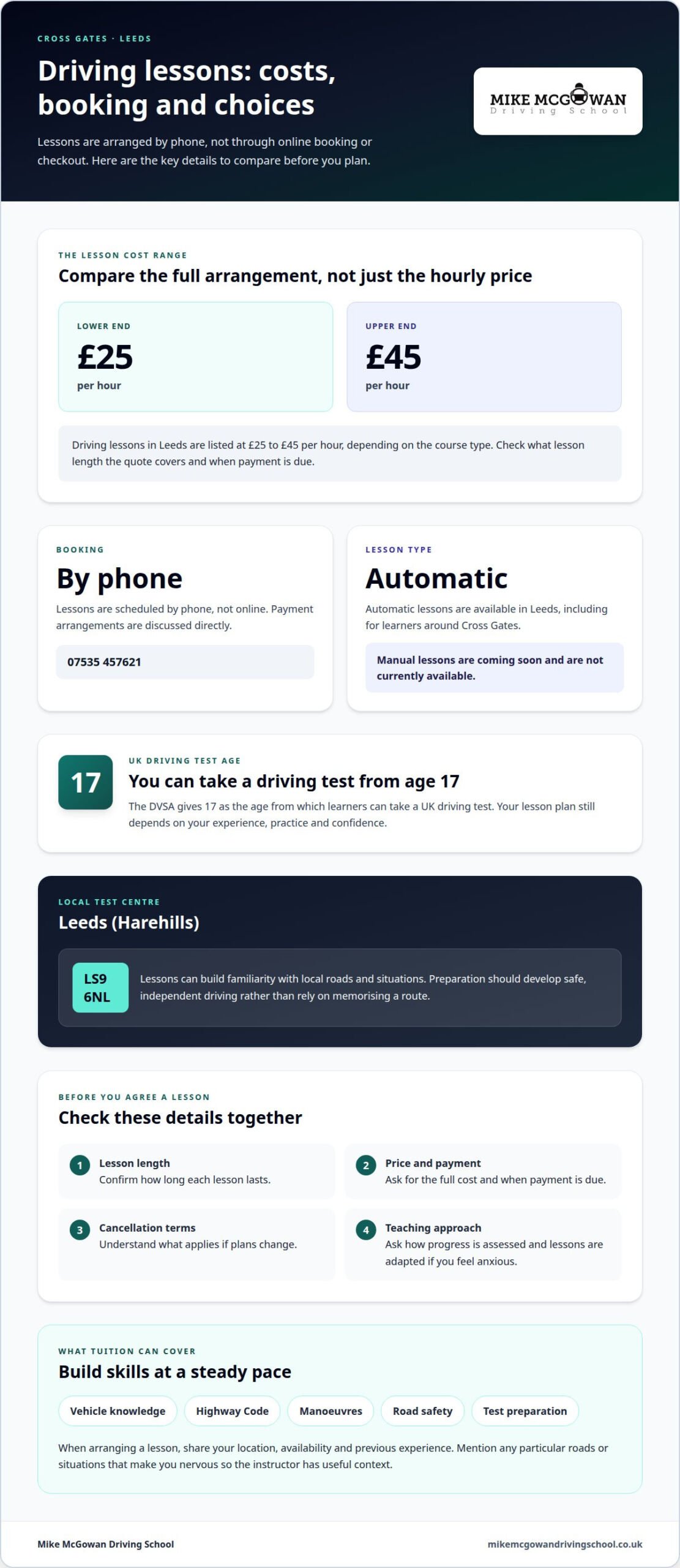
Local knowledge matters too. The nearest listed test centre for Cross Gates is Leeds (Harehills), LS9 6NL. Lessons can build familiarity with the kinds of roads and situations around the area, while keeping practice centred on the skills you need. Test preparation should develop safe, independent driving, not rely on memorising a route.
Local practice helps you prepare for the roads you’ll encounter around Leeds. Discuss junctions, roundabouts, parking and quieter roads, and mention any situation that makes you nervous. A calm, step-by-step approach gives you time to practise each skill and build confidence.
When you call, share your location in Cross Gates, preferred lesson type, availability and previous experience. If you’re a beginner, say so. If you’ve had lessons before or are returning after a break, explain what you’ve already covered. That gives the instructor useful context for planning your lessons.
Instructor training and qualifications are sensible topics to discuss before committing. Ask about their teaching approach, how they assess progress and how they adapt lessons when a learner feels anxious. A calm explanation of the process can help you understand what to expect. If you prefer a female instructor, state that preference at the enquiry stage.
Learners can take a UK driving test from age 17, according to the Driver and Vehicle Standards Agency (DVSA). The right lesson plan still depends on your experience, practice and confidence, rather than age alone. A learner who has driven before will have different priorities from someone starting with the basics.
For local information, see the page about driving lessons in Leeds. Before choosing a booking, compare the lesson length, price, payment arrangements and cancellation terms together. That gives you a clearer view of the likely commitment and helps you choose a schedule that fits your routine.
Driving lessons in Leeds cost £25 per hour to £45 per hour, depending on the course type. Use that range as a starting point, then check which course type and lesson length a quote covers. A lower hourly price may not be the best fit if the arrangement differs from what you need, so compare the same details across instructors.
Before deciding, ask for the full cost and payment arrangements in clear terms. Check whether the quoted price applies to the lessons you plan to book, and make sure you understand any cancellation terms. Comparing these details alongside the instructor’s teaching approach can help you choose an arrangement that suits both your budget and learning priorities.
Can I book and pay for driving lessons online?
Lessons are scheduled by phone, not through online booking or checkout. Call 07535457621 to arrange a lesson and discuss payment arrangements directly. This gives you a chance to explain what you need before settling on a time, whether you’re starting from scratch or returning to driving after a break.
Automatic driving lessons are available in Leeds, including for learners around Cross Gates. Manual lessons are coming soon and aren’t currently available. To decide whether automatic tuition suits you, consider the car you plan to drive and whether you want to learn clutch control and gear changes.
In an automatic car, you don’t need to coordinate a clutch and gears, leaving more attention for steering, observation and decisions on the road. Manual driving involves those extra controls as well as general road skills. Consider your goals and discuss your preference when you call.
Before phoning, make a short note of the details you want to cover:
- Your location in or near Cross Gates and a suitable meeting point.
- Whether you’re a beginner or have driven before.
- Your preferred lesson type, noting that automatic lessons are currently available.
- Times that fit around work, college or family commitments.
- Any questions about payment arrangements or lesson scheduling.
If a parent or family member is paying, it may help to have them join the call or agree the payment details beforehand. That way, everyone knows who is arranging the lesson and how payment will be handled. Lessons are scheduled by phone, so call rather than relying on an online message or selecting a time.
When you speak, explain your previous experience in practical terms. For example, mention whether you’ve practised moving off, turning or reversing. If a situation such as busy traffic or a junction makes you nervous, say so. This gives the instructor useful context for a suitable start.
Keep a note of the agreed lesson time and any payment details discussed during the call. If you need to change the arrangement later, use the contact method agreed with the instructor. A quick written reminder in your calendar can help you and anyone supporting your learning stay organised.
Theory and hazard perception test preparation
Reviews describe learners’ experiences, while pass rates are recorded for test centres, not individual instructors. Leeds (Harehills) is listed with a 42.0% pass rate, so use reviews to look for clear feedback, patient explanations and support with specific nerves.
Make theory preparation active rather than simply rereading notes. Practise road signs, junction priorities and hazard examples, then revisit questions you got wrong. For hazard perception, focus on developing risks, such as a car emerging from a side road or a pedestrian approaching a crossing.
As a clip unfolds, describe what you notice: a parked vehicle, a narrowing gap or someone near the kerb. This helps you practise scanning ahead instead of reacting at the last moment. Regular study can also help you spot topics that need more attention.
Theory study and practical lessons develop different skills, but they can reinforce each other. After a lesson on a busy roundabout, for example, review signs and priority rules. If a hazard clip shows a vehicle hidden by parked cars, discuss similar situations during your next drive.
For Cross Gates, the nearest listed driving test centre is Leeds (Harehills), LS9 6NL. Its listed average waiting time is 154 days. Treat that as a planning detail, and keep building your skills while you prepare, rather than relying on a particular test date to create readiness.
Other Leeds-area locations give useful context when considering test arrangements. Horsforth is listed 5.2 miles away, with a 50.34% pass rate. Wakefield has a listed pass rate of 48.21%. These figures relate to their respective centres, not to an individual learner’s likely result.
The Leeds theory test centre has a listed pass rate of 48.3%. That centre figure doesn’t show which topics a particular learner finds difficult. Use practice results to identify patterns, such as missed road-sign questions or hazards that you spot late, then focus revision on those areas.
Reviews and test-centre statistics answer different questions. A review can describe how an instructor explains a manoeuvre or supports an anxious learner; a centre pass rate summarises test outcomes at that location. Look for specific examples in feedback, then use lessons to practise the skills you need to develop.
Other centre figures can add context, but they do not predict an individual result. The Bradford (Thornbury) driving test centre is listed with a pass rate of 51.40%. The Leeds driving test centre is listed as 0.1 miles away. Compare these details as information about locations, rather than as a measure of your own readiness or likely outcome.
Preparation needs vary between learners. The page describes 20 hours of practice alongside 45 hours of driving lessons as the average preparation for a driving test. The page says learners with RARA in Leeds mostly take around 20-25 hours of driving lessons to pass their driving test. These figures offer points of reference, not targets everyone must meet. There is no minimum number of driving lessons required by law to take a UK driving test, so use your progress and instructor feedback to decide what further practice will help. Keep working on areas that feel uncertain, and make sure you can apply your knowledge consistently in different situations.
Flexible lesson schedules and cancellations
Work, college and family commitments can make a fixed lesson time difficult to keep. If you’re taking driving lessons around Cross Gates, look at your week and identify times that are usually free, such as a regular day off or a gap after college. A realistic routine is easier to maintain than a slot that often clashes with other plans.
Before arranging lessons, note your available days, preferred start times and meeting point. If you’re travelling from work, allow time to reach the agreed place. Sharing these details at the start helps you plan a practical schedule. A family member helping with arrangements can add lesson times to the family calendar.
Some learners prefer the same time each week, while others need to work around changing shifts or classes. Keep your calendar current and discuss suitable dates when arranging lessons. If your timetable changes, tell the instructor which days no longer work and suggest alternatives.
If plans change, give at least 24 hours’ notice to cancel or rearrange a lesson in Cross Gates. Contact the instructor as soon as you know the original time no longer works. Include the lesson date and time, then suggest another suitable slot. Clear details make it easier to understand which appointment needs changing.
Keep the cancellation terms with your booking details. Before confirming, note the agreed process for giving notice and any payment arrangements discussed. Don’t assume a message has changed the appointment until you receive confirmation. If someone else pays, tell them about the change so their records stay up to date.
If you decide to switch instructors mid-course, you can explain your decision and arrange future lessons with a different instructor. To make the change easier, write down what you’ve covered, such as moving off, junctions or reversing, and what you still want to practise. Share those notes with your new instructor so lessons can build on your experience.
It’s understandable to feel uneasy about starting again with someone new. You don’t have to present your progress as a test. Explain what feels comfortable, where you lose confidence and what kind of guidance helps. For example, say if you prefer manoeuvres broken into smaller steps or more time to practise a busy junction.
A calendar entry can prevent avoidable confusion. Add the lesson time, meeting point and instructor’s contact details, then set a reminder that suits you. If a lesson changes, update the entry and tell anyone helping with transport or payment. Clear notes make your learning plans easier to manage.
Driving lessons in Cross Gates
Local lessons work best when practice connects to familiar journeys around Cross Gates. Tell the instructor where you feel comfortable beginning, then build towards busier roads as your control and awareness improve. Familiar surroundings can make it easier to focus on each new skill.
An introductory lesson listed for Cross Gates lasts 2 hours. That gives a learner time to settle in, talk through their experience and begin practising. If you’re new to driving, the first session can focus on simple controls and observation before moving into more demanding situations.
Make your first lesson useful by sharing a clear starting point. Tell the instructor whether you’ve driven before, which controls feel unfamiliar and what makes you nervous. If you’ve had lessons elsewhere, explain what you’ve covered, such as moving off, junctions or reversing. This helps shape lessons around your experience.
Practice can then build in stages. You might work on steering and stopping first, then progress to junction decisions, roundabouts and parking. The instructor can explain each task, demonstrate where useful and give you time to repeat it. If a manoeuvre feels difficult, break it into smaller steps rather than rushing through it.
Driving around Cross Gates means responding to changing conditions. A quieter stretch can help you practise basic control, while busier traffic gives you experience judging gaps and planning ahead. The aim is not to memorise a route, but to recognise what’s happening and make safe decisions as the road changes.
When arranging a lesson near home, work or college, share your preferred meeting point. You can also mention local situations you’d like to practise, such as a confusing junction or parking manoeuvres. These examples give the lesson a practical focus without expecting you to know every route.
If you feel tense, say so before setting off or when a task starts to feel overwhelming. Your instructor can pause, explain the next step and give you time to try again. After the lesson, note one skill that felt steadier and one question to revisit. That gives your next session a clear starting point.
For driving lessons in Cross Gates, Leeds, choose a plan that fits your experience and builds local confidence gradually. A useful session should leave you with a skill to practise, a clearer understanding of what comes next and space to ask questions without feeling rushed.
Mike McGowan Driving School
Mike McGowan Driving School offers calm, one-to-one lessons for learners in Leeds who want clear guidance and a steady pace. Whether you’re starting out or returning after a break, lessons can be shaped around your experience and confidence.
Beginner Driving Lessons help you build core skills from the start, while Refresher Lessons give you space to revisit areas that feel uncertain. Automatic Driving Lessons are available for learners who prefer an automatic car. If a junction or manoeuvre makes you nervous, mention it early so your instructor can take it into account.
If you’d like to talk through lesson options and your next step, contact Mike McGowan Driving School.
Take your next step at a pace that suits you
Choosing driving lessons in Cross Gates, Leeds, is a personal decision. Think about what would help you feel prepared for your first session: a clear plan, time to talk through nerves or a chance to explain what you’ve already learnt. You don’t need to have every detail worked out before getting in touch.
Mike McGowan Driving School offers Beginner Driving Lessons, Manual Driving Lessons and Automatic Driving Lessons. Share what you’re hoping to achieve and the type of tuition you prefer, then take the next step when you feel ready.
Steady progress starts with one manageable step. You can build from there.
Frequently Asked Questions
Do you teach in an automatic or a manual car?
Automatic lessons are currently available, while manual lessons are coming soon. Automatic tuition is one-to-one in a Toyota Yaris. If you’re unsure whether automatic tuition suits you, consider the car you plan to drive after passing and whether you want to learn gear changes and clutch control. You can discuss your preference when arranging lessons.
Which areas do you cover for driving lessons?
Lessons are available in Leeds, Morley, Tingley, Beeston and surrounding areas. Cross Gates is in Leeds, so share your location and preferred starting point when you call to arrange a lesson. This helps make the conversation practical, especially if you’re balancing lessons with college, work or family commitments. Test preparation can also be tailored to local Leeds routes.
How many driving lessons do learners need before the test in the UK?
One estimate puts professional tuition at around 44 hours before passing, but that is a guide rather than a fixed target for every learner. Your starting experience, private practice and progress with key skills all affect the amount of tuition you need. Focus on becoming a safe, consistent driver, including handling unfamiliar roads and making decisions independently, rather than chasing a set lesson count.
How to choose a DVSA-approved driving instructor in Leeds
Mike McGowan is a DVSA-approved instructor with a patient, calm approach. If you feel anxious, explain what would help you feel comfortable and how you prefer to learn.
Disclaimer
This article is intended as general guidance for learner drivers and does not replace official DVSA advice or a lesson with a qualified instructor. Rules, test requirements, and local test centre procedures can change, so always check GOV.UK or speak to your instructor for the most current information. Mike McGowan Driving School accepts no responsibility for outcomes based solely on the content of this article.