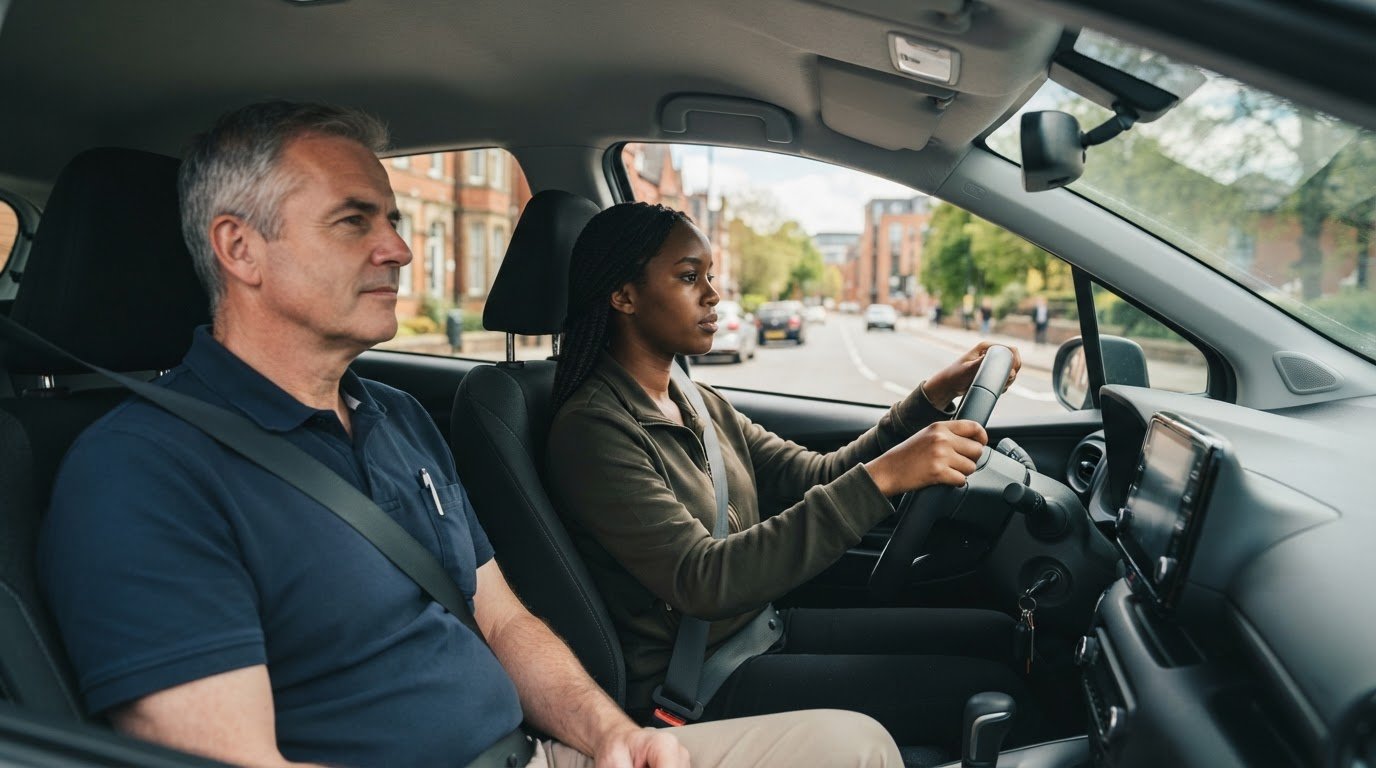
Learn to drive an automatic car in Leeds: lesson costs
The simplest car to learn in isn’t always the cheapest option. If you want to learn to drive an automatic car in Leeds, the total cost depends on the lesson rate and whether you book individual sessions or a block. Manual lessons tend to cost less, while an automatic removes the need to use a clutch and change gears.
Comparing costs carefully makes sense, especially if you or a family member is paying for lessons. But price is only part of the decision. Feeling settled behind the wheel and making steady progress matter too.
This guide explains how hourly rates and block bookings compare, what to look for in learner reviews, and how automatic tests and licences differ from manual ones. It also covers what learning in an automatic involves, so you can weigh the costs and choose the option that suits you.
Key Takeaways
- Compare the hourly rate with block-booking terms to understand how lesson choices affect your overall budget.
- Look for learner feedback that describes clear explanations, patient teaching and support with specific areas of practice.
- An automatic test follows the same structure and standard as a manual test, but an automatic licence covers automatic cars only.
- Learning in an automatic removes clutch control and manual gear changes, which can help you focus on other parts of driving.
- Consider the type of car you want to drive after passing before choosing between automatic and manual lessons.
How much do driving lessons cost in Leeds?
Your total cost depends on the lesson rate, booking format and practice you need. Compare the cost per hour, not just the size of a block booking.
There is no single waiting time for automatic lessons across Leeds. Start dates depend on instructor availability and the times you can attend.
This Leeds driving lesson video shows steering practice and corrections in action:
Automatic lessons across Leeds and nearby areas
Automatic driving lessons let you practise without operating a clutch or changing gears. In Leeds, consider where lessons begin and which local roads you want to practise on. Learners comparing options in Wakefield or Huddersfield should also factor in travel to lessons and the areas they need to drive in. The Leeds driving lesson area page gives local context.
Manual and automatic lesson choices
Manual lessons tend to cost less, while automatic lessons suit learners who find clutch control or gear changes difficult. You can switch lesson types, but you’ll need time to get used to the new car’s controls. Tell your instructor what you’ve already covered, such as junctions or manoeuvres, so lessons can build on those skills rather than start from scratch.
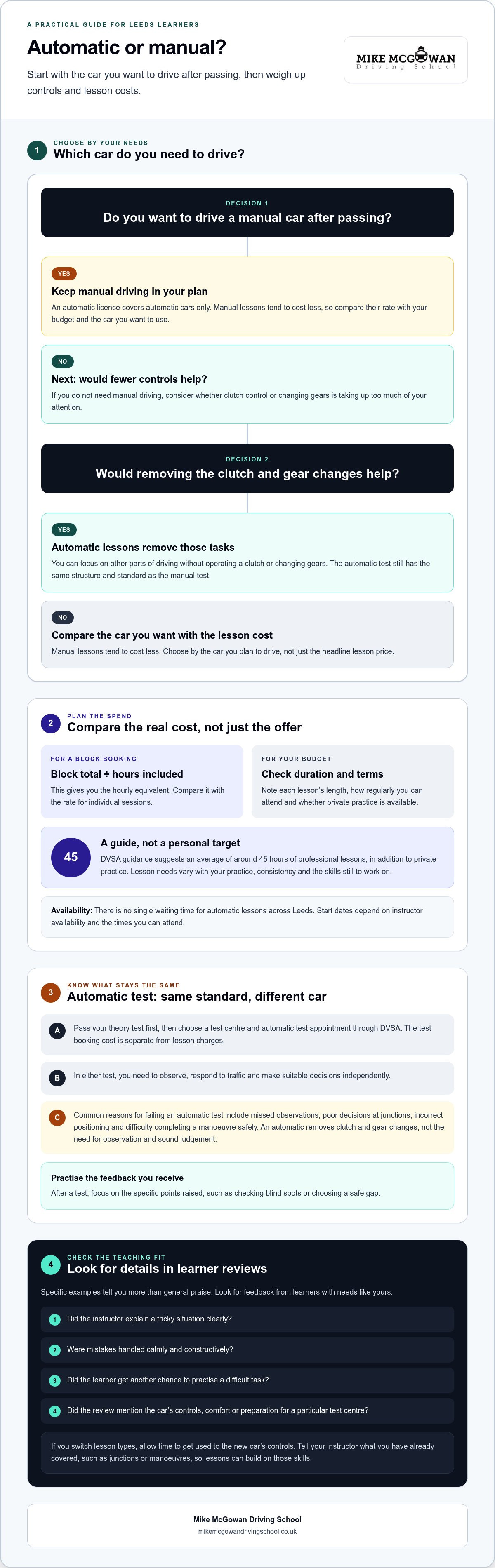
To compare costs, note each lesson’s duration and whether you’re paying per session or booking a block. Divide the block’s total cost by the hours it includes to find the hourly equivalent. Then consider how regularly you can attend and whether private practice is available. These details help learners and families plan spending without choosing on the headline offer alone.
Lesson numbers vary between learners. DVSA guidance suggests an average of around 45 hours of professional driving lessons, in addition to private practice. Treat that as a guide, not a personal target: progress depends on what you have practised, how consistently you drive and which skills still need attention.
Leeds-area practical test centres include Harehills, Horsforth and Thornbury. Learners commonly practise across local streets and junctions near their chosen centre, alongside varied road types. Leeds is also close to the M1, M62 and M621. An instructor can help you build experience on suitable roads as your control and confidence develop.
Common reasons for failing an automatic test include missed observations, poor decisions at junctions, incorrect positioning and difficulty completing a manoeuvre safely. An automatic removes clutch and gear changes, but observation and sound judgement still matter. After a test, focus your practice on the specific feedback you received, such as checking blind spots or choosing a safe gap.
Learner feedback and instructor recommendations
Learner reviews are most useful when they describe what happened during lessons. Look for examples of how an instructor explained a tricky situation, responded to a mistake or helped someone prepare for a particular test centre. “I felt more confident” offers some insight, but details about what changed make it easier to judge whether the teaching style could suit you.
Read feedback from learners with similar needs. A beginner might value clear explanations of the basic controls, while someone returning after a break could look for patient support as they rebuild familiar habits. If you’ve failed a test, focus on comments about constructive feedback and targeted practice, rather than treating another learner’s result as a prediction of your own.
Notice whether reviews mention how the instructor communicates between tasks. Useful feedback might explain why a road position needed adjusting, then give the learner another chance to try. That tells you more about how a lesson is taught than general praise without a specific example.
The training car can also affect how settled you feel. Reviews that mention a clean, comfortable vehicle or clear explanations of its controls can help you picture the lesson. Consider practical details too, such as whether the learner felt able to ask questions before moving into busier traffic.
Recommendations from friends can be valuable, but ask what made the lessons work for them. Was the instructor calm when they made mistakes? Did they practise the areas they found difficult? Their answers can help you distinguish a good personal fit from a recommendation based only on convenience.
One-to-one lessons give you space to raise a concern without feeling watched by other learners. You might say that roundabouts feel confusing or that you want to repeat a manoeuvre. A helpful instructor should listen, agree on a clear focus and explain how you’ll work on it during the session.
Use these points when weighing up reviews and recommendations:
- Look for a specific example of teaching or feedback.
- Compare comments from learners with needs like yours.
- Notice whether mistakes were explained calmly and constructively.
- Check whether feedback describes progress, not just a final result.
No review can tell you exactly how your own lessons will feel. It can, however, help you identify useful questions: do you prefer calm explanations, time to practise again or direct feedback after each task? Knowing what helps you learn makes it easier to recognise a teaching approach that respects your pace and prepares you for the next drive.
Automatic versus manual tests and licences
To book an automatic practical test in Leeds, pass your theory test first, then choose a test centre and automatic test appointment through DVSA. The test booking cost is separate from lesson charges, so include it as its own item in your test budget.
The automatic driving test has the same structure and standard as the manual test. The difference is the car used, not the level of safe driving expected. In either car, you need to show that you can observe, respond to traffic and make suitable decisions independently.
Your licence depends on the type of car you use for the test. Passing in an automatic gives you a licence for automatic cars only. Passing in a manual permits you to drive both manual and automatic cars in the UK. Think about where you expect to drive after passing, not just which car feels easier during lessons.
An automatic can suit someone who finds clutch control and gear changes difficult. Without those tasks, you can focus more on traffic, road position and planning ahead. Manual lessons also teach clutch control and gear changes. If you’re comfortable learning those skills and want the wider licence, manual keeps more vehicle choices open.
Your vehicle choice can matter for work and everyday travel. Many driving jobs in Leeds and across the UK, including delivery roles, prefer or require drivers who can use manual vehicles. If a job you’re considering specifies a manual car, an automatic-only licence could limit that option. Check what type of vehicle you expect to need before deciding which test to take.
Running costs are another consideration when choosing a car after passing. Manual cars generally have lower maintenance costs than automatics because their transmissions are less complex and contain fewer parts that can fail. They’re also often more fuel-efficient. These are general differences, so consider the specific car you’d drive and your regular journeys.
Affordability involves more than choosing a lesson type. Consider lesson spending, the test booking cost and the car you plan to use afterwards. Choosing an automatic for confidence or ease can still make sense, even if a manual licence offers broader access. The right fit depends on your driving needs and likely vehicle use.
If you’re unsure, write down the cars you expect to drive and any work requirements you know about. Then compare those needs with the licence each test provides. If you expect to drive only an automatic, the restricted licence may suit your plans. If you need access to manual cars, taking the test in a manual covers both types.
Pass your theory test, then use DVSA to choose a Leeds test centre and book an automatic practical test. The test booking fee is separate from lesson charges.
Hourly rates and block-booking discounts
For automatic driving lessons in Leeds, compare the hourly rate with the total cost of a block. A lower headline price is useful only if the booking suits your budget, schedule and learning needs. Check the lesson length, the number of sessions included and any terms that affect changes or cancellations.
Use the same calculation for each driving school: divide the block total by the hours it includes. Then compare that hourly equivalent with the cost of booking the same number of hours individually. This shows whether the block offers a saving, rather than relying on words such as “discount” or “special rate”.
Regular automatic lessons are available in five-hour and ten-hour blocks in Leeds. A larger block commits you to more lessons upfront, so weigh any per-hour saving against what you can comfortably pay at once. A smaller block may be easier to budget for and lets you review your progress before booking more sessions.
Some lesson listings show separate rates for students, NHS staff and Blue Light workers. Check who qualifies, whether the reduced rate applies to single lessons and blocks, and whether the terms differ. Don’t assume a concession applies automatically. Include eligibility and booking conditions in your comparison.
Lesson type also affects the comparison. Manual lessons tend to cost less than automatic lessons, but the lowest hourly rate isn’t automatically the best fit. If using a clutch and changing gears makes it harder to focus on traffic, weigh the overall learning experience as well as the price. The right choice depends on the car you want to drive and the skills you need to build.
Before booking, write down the figures and terms that matter to you:
- The cost per lesson and its duration.
- The block total and number of included hours.
- The hourly equivalent after dividing the total by the hours.
- Any student, NHS or Blue Light eligibility rules.
- How the booking terms handle changes to planned lessons.
A learner who can attend regularly and budget for several sessions might prefer a block. If you’re still deciding between automatic and manual lessons, you could compare individual sessions first, then review your choice once you understand the car’s controls. Parents paying for lessons can use the same calculation to compare options clearly.
Finally, compare like with like. A motorway session, refresher lesson and beginner session serve different purposes, so their prices aren’t directly comparable. Check that each quoted rate covers the same lesson type and duration before choosing a driving school or booking a block.
Benefits of learning in an automatic car
An automatic can make the early stages of driving feel more straightforward if coordinating several controls is distracting. That can leave more attention for noticing signs, following directions and judging what other road users are doing. For a beginner in Leeds, these are useful skills to develop from the first journeys.
An automatic can also help you settle into a steady routine. Instead of worrying about stalling at a busy junction, you can focus on stopping safely, looking carefully and choosing when to move. If a situation feels rushed, your instructor can help you work through it calmly and repeat the practice when needed.
Automatic lessons can suit learners who find manual controls difficult to manage, including some people with restricting difficulties and older learners. Consider which part of driving takes the most effort for you. That can help you decide whether an automatic would make lessons more manageable, rather than choosing based on someone else’s preference.
There’s still plenty to learn. You’ll need to develop awareness, good judgement and reliable routines in changing traffic. For example, practise approaching a junction by checking signs early, choosing your position and looking out for people crossing. A patient approach gives you time to understand each step before putting them together.
Consider these points before choosing your lesson type:
- Which parts of driving currently feel hardest to manage?
- Would fewer simultaneous tasks help you stay focused?
- What type of car do you expect to use once you’re driving independently?
An automatic is not a shortcut to learning safe driving habits. It changes how you manage the car, while progress still depends on practice and thoughtful decisions. If you’re unsure, write down what you want lessons to help with, such as feeling calmer in traffic or gaining confidence with directions. That gives you a clear starting point for deciding what suits you.
Mike McGowan Driving School: Beginner Driving Lessons
Mike McGowan Driving School offers beginner lessons for learners starting from scratch, including one-to-one automatic and manual tuition. Calm, personalised coaching can help you work through specific worries, such as clutch control, busy junctions or parking, at a steady pace.
Choose automatic lessons if you want to focus on road awareness without changing gears. Manual lessons suit learners who want to qualify in a manual car. If you’ve driven before or passed a test, refresher lessons can help you rebuild confidence and practise the skills you need.
You can discuss which lesson type fits your experience and goals. For more information or to get in touch, visit Mike McGowan Driving School online.
Choose a first step that feels manageable
If you’re planning to learn to drive an automatic car in Leeds, start by deciding what you want from your first lesson. You might focus on getting comfortable with the controls, building confidence in traffic or fitting lessons around your routine. A clear starting point makes it easier to explain what would help you feel prepared.
You don’t need to settle every decision before you begin. Think about the kind of car you expect to drive and any part of learning that feels uncertain. A conversation can help turn those thoughts into a practical next step, without making the process feel bigger than it needs to be.
Take it one decision at a time. With a plan that suits your needs, you can begin learning at a steady pace and build towards driving independently.
Frequently Asked Questions
Is it easier to learn in an automatic?
An automatic can feel easier if managing the car’s controls is your main difficulty. Your progress still depends on learning to read the road, spot hazards and make decisions independently. During a first lesson, notice which parts take most of your attention. This gives you a practical way to judge whether an automatic suits you, rather than relying only on a friend’s experience.
Are there automatic teaching specialists?
Mike McGowan Driving School provides automatic tuition with a DVSA-approved instructor. Effective teaching should match your starting point and give you clear feedback to use on your next drive. After practising a turn, for example, you should understand what went well and what to adjust next time. That guidance can make each lesson feel purposeful.
Can I practise between lessons?
Yes, provided you have a suitable car, learner insurance, L plates and a qualified supervising driver. Agree one clear practice goal before setting off, such as staying centred on a familiar road or making smooth stops. Keep the route within your current ability and finish by discussing what felt comfortable and what needs more work at your next lesson.
How many lessons do I need to pass?
There’s no fixed number of lessons that suits every learner. Focus on whether you can handle skills reliably, including when the route or traffic changes. After a lesson, note any task that still needs reminders, such as checking before moving off. Use those notes to plan what to practise next, rather than treating a set number of lessons as a target for passing.
Is my location covered in an automatic car?
Automatic lessons are available in Leeds. If you live elsewhere in West Yorkshire, consider whether travelling into Leeds fits your routine. Before arranging a lesson, identify a convenient place in Leeds to begin and think about how you’ll get there. This helps you plan regular attendance without assuming lessons start in every nearby town.
Is the test the same?
Yes, the automatic practical test has the same structure and standard as the manual test. To prepare, practise making decisions without waiting for your instructor to prompt you. You can also ask for a mock test-style drive, then use the feedback to choose what to work on next. This helps you get used to managing the drive independently.
What licence do I get?
Passing in an automatic gives you a licence for automatic cars only. Before choosing, think about the car you expect to use regularly, such as a family car or one needed for work. If you have a particular vehicle in mind, check whether it’s automatic or manual before settling on your test route. This simple step can help your choice fit your plans.
How do I learn to drive an automatic car in Leeds?
Start by choosing automatic tuition and telling your instructor what you’ve driven before, if anything. First, get familiar with the car’s controls while parked, then build up to driving on roads that match your experience. As you progress, ask for feedback on one or two skills to focus on next. This gives each lesson a clear purpose and direction.
Disclaimer
This article is intended as general guidance for learner drivers and does not replace official DVSA advice or a lesson with a qualified instructor. Rules, test requirements, and local test centre procedures can change, so always check GOV.UK or speak to your instructor for the most current information. Mike McGowan Driving School accepts no responsibility for outcomes based solely on the content of this article.
