Harehills driving test centre lessons and route practice
A familiar route matters less than feeling ready for the roads and decisions it brings. Harehills driving test centre lessons focus on practising local streets, junctions, roundabouts and manoeuvres, alongside the wider skills you need on test day. The Driver and Vehicle Standards Agency says you’ll drive for around 35 minutes.
Busy roads or the thought of making a mistake can feel daunting. Steady practice helps you get used to driving around Harehills without needing to memorise a route or get everything right straight away.
This guide explains what local route practice can involve, how lessons can build confidence at a manageable pace, and what to ask about weekly instructor availability. You’ll have a clearer idea of how to prepare, whether you’re just starting out or returning after a difficult test experience.
Key Takeaways
- Local route practice is about building confidence on different roads and junctions, not memorising a test route.
- Lessons can build from quieter streets to busier Harehills roads as your skills develop.
- If nerves are affecting your driving, identify the situations that feel hardest and work through them steadily in lessons.
- Ask about regular weekly lesson slots so you can plan a routine around instructor availability.
- When comparing lesson costs, consider how often you can practise and what fits your budget.
Harehills driving test route practice
Harehills driving test centre lessons should prepare you for local road situations, not one memorised route. Practise busy urban roads, quieter streets and the decisions you’ll need to make throughout the practical test.
Test route practice with an instructor
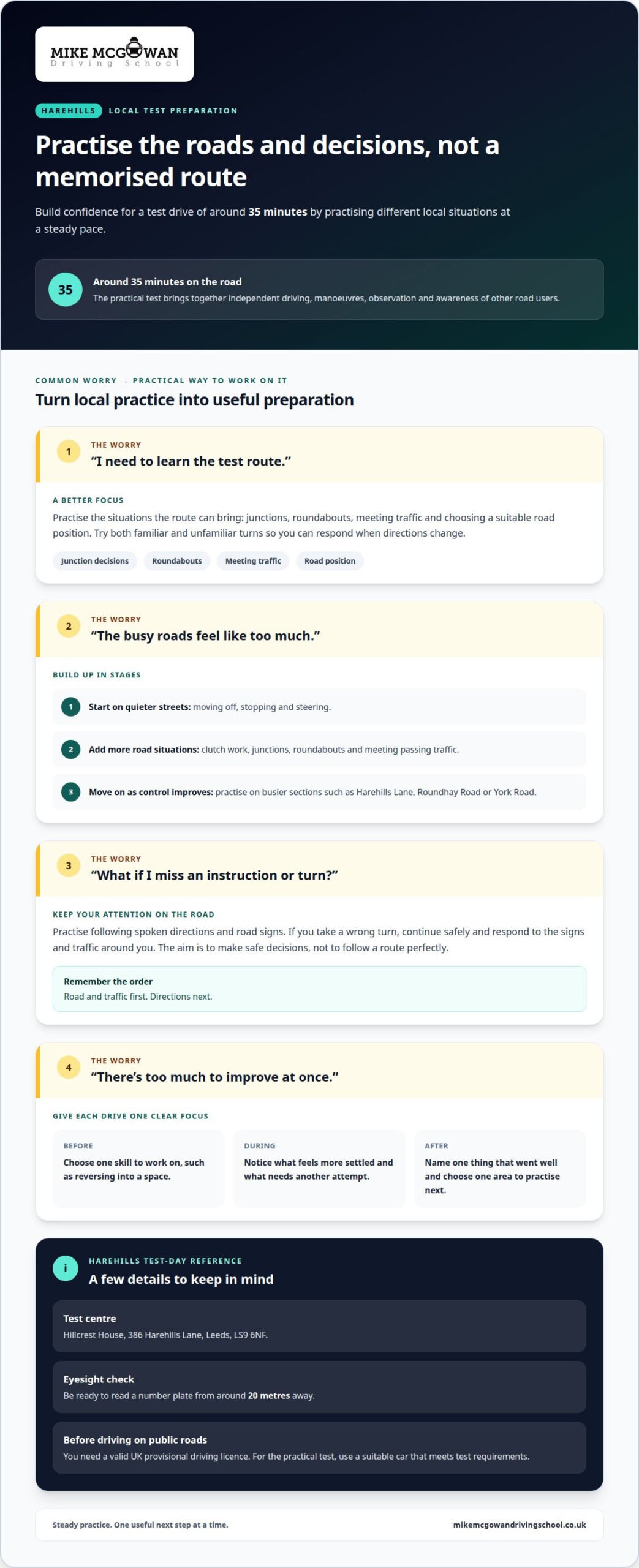
Lessons around Harehills can build safe, independent decision-making through practice with junctions, roundabouts, meeting traffic and choosing a suitable road position. Try unfamiliar turns as well as familiar ones, so you can respond calmly when directions change. The goal is to develop your driving skills, not memorise every street.
Test preparation brings together the skills assessed during a practical drive. You’ll drive for around 35 minutes, according to the Driver and Vehicle Standards Agency. Practice can include independent driving, manoeuvres, observation and awareness of other road users. Ask your instructor to explain what you did well after each practice drive, then choose one area to work on next.
During independent driving, follow directions while keeping your attention on the road. If you take a wrong turn, continue safely and respond to the signs and traffic around you. Practise following road signs as well as spoken directions, so missing an instruction doesn’t unsettle the rest of your drive.
Test centre location and pass rate
The Harehills test centre is the Leeds practical test location at Hillcrest House, 386 Harehills Lane, Leeds, LS9 6NF. The centre’s pass rate was 34.7% in 2020. That figure describes results from that year, not the outcome for an individual learner. Use local practice to build skills, rather than treating a past rate as a prediction.
What documents and vehicle requirements apply? You need a valid UK provisional driving licence before driving on public roads. Bring your licence and use a suitable car that meets practical test requirements.
How can I book or change a practical test at Harehills? Use the official government practical-test booking service to book or change your appointment. Follow the steps to select the test centre and manage your booking.
What common faults cause learners to fail? Errors in observation, junction decisions, roundabouts and manoeuvres can affect safe driving. During practice, ask your instructor to point out specific moments when your observation or positioning needs more attention.
What does the eyesight check involve? During the test, you must read a number plate from around 20 metres away, according to the Driver and Vehicle Standards Agency. Include this check in your test-day preparation.
For a practical session, review the route afterwards by naming one junction, one observation decision and one manoeuvre to practise again. The local driving lessons page gives you a way to explore lesson support while you plan your preparation.
Leeds (Harehills) routes average 36 minutes and 8.6 miles. The first Harehills route is an older, updated example; nearby busy urban roads and quieter streets can be difficult to navigate.
Driving lessons in Harehills
Local lessons can take you from basic vehicle control to driving confidently on busier Leeds roads. Your route and lesson pace can reflect your experience and the skills you want to practise.
Driving lessons near Harehills
A driving lesson near Harehills should focus on your current ability and the next steps in your learning. Beginners can start with moving off, stopping and steering on quieter residential streets. As your control improves, practise clutch work, junctions, roundabouts and meeting passing traffic. If you’re returning to driving, use lessons to rebuild confidence in skills that feel rusty.
You can progress gradually from quieter roads to busier sections of Harehills Lane, Roundhay Road or York Road. Your instructor can adapt each session to what you find difficult, whether that’s judging a gap at a junction or holding a steady road position when traffic approaches.
Give each lesson a clear focus. At the start, choose one skill to work on, such as reversing into a space or approaching a roundabout. During the drive, notice what feels more settled and what needs another attempt. At the end, agree on a next step, such as repeating the manoeuvre or practising it somewhere different.
Hourly driving lesson costs
The hourly rate covers a set period of driving instruction. To plan your spending, compare the stated lesson rate with the session length and how often you intend to practise. Your overall budget also depends on your experience and the skills you need to work on.
Before choosing a lesson routine, work out what fits your budget. Regular lessons can help you carry learning from one session into the next, while longer gaps may mean you need time to revisit skills at the start. Keep a brief note of what you covered and your next practice goal. This makes progress easier to discuss and helps each lesson stay purposeful.
Planning a useful lesson
Link each lesson goal to a real local driving situation. For example, practise observation and road position on a quieter street before using those skills at a busier junction. If you’re working on clutch control, repeat moving off and stopping until you feel more in control, then practise those actions in ordinary traffic.
Lessons can be shaped around your stage of learning. Beginners need time to build the basics; returning drivers can revisit familiar skills; and learners nearing test standard can focus on consistency. A calm, clear plan gives you something specific to work on without expecting every skill to improve at once.
If you’re ready to plan a lesson around your next learning goal, use the lesson appointment booking page.
Support for nervous learners
For nervous learners, breaking practice into manageable steps can make driving feel more approachable. Before setting off, identify the situation that worries you, such as turning right at a busy junction. Practise the skill in a calmer setting first, then gradually add more traffic or unfamiliar roads.
Getting to know the area around Harehills can make local practice feel more familiar. During lessons, notice landmarks, road signs and junction layouts. You don’t need to memorise a route. Instead, focus on what each situation requires, such as checking your mirrors before changing position.
A simple lesson goal gives you a clear focus. Choose one skill, such as maintaining a steady approach speed at a roundabout. After practising, discuss what felt manageable and what needs another attempt. Specific feedback helps set a useful starting point for your next session.
If busy roads feel overwhelming, build up gradually. Practise a skill on a quieter residential street, then try it on a busier road when you feel ready. For example, work on checking for cyclists and parked cars before meeting traffic on Harehills Lane. Focus on one decision at a time.
Manoeuvres can feel uncomfortable if you’re worried about getting them wrong. Break a reverse park into clear steps: choose a safe position, observe around the car, move slowly and pause if you need to reassess. Repeating the same steps in different spaces helps you practise the decisions, rather than relying on one familiar parking spot.
If you’ve failed a test before, use the experience to plan your practice. Note the situations that felt hardest, such as an observation check or a junction decision. Work on those with your instructor, while also practising other parts of the drive to keep your preparation balanced.
If you feel nervous during a lesson, tell your instructor what’s happening and describe the immediate challenge. For example, explain that you’re losing focus at a complicated junction. You can stop safely, discuss what to do next and continue when you feel ready. Clear words can turn a general worry into a practical task.
Try these steps before each session:
- Choose one skill to practise, such as meeting oncoming traffic.
- Agree where to begin, such as a quieter street near the practice area.
- After driving, note one success and one next step.
Keep your notes brief and specific. “Checked both ways before turning” is more useful than “drive better”. Over several lessons, examples like these can help you see what’s improving and where you need more practice.
Lessons in Leeds can help you get familiar with the area around Harehills test centre. Use local practice to build confidence in the surroundings, while focusing on safe observation and decision-making rather than trying to predict a test route. If a road or junction feels difficult, ask to practise the relevant skill calmly, then review what went well and what you’d like to work on next.
Weekly lessons and instructor availability
A weekly lesson provides a regular opportunity to build on your practice. If you’re arranging Harehills driving test centre lessons, consider whether a recurring time fits your routine and your instructor’s availability.
Weekly lesson availability
Weekly availability means finding a regular lesson time that works for both you and your instructor. Share your usual commitments, such as college, work or family plans, so you can discuss a realistic slot. Regular weekly lessons in Harehills can be arranged subject to local instructor availability.
Before settling on a time, consider how you’ll get to the lesson and whether your routine changes. For example, if you travel into Leeds for college, choose a slot that allows time for the journey. A parent helping with the cost can also plan around a predictable schedule.
Link each session to the one before it. After a lesson, note a skill to revisit, such as turning left at a junction or reversing into a space. At the next session, use that note to decide where to begin. This makes it easier to track what you’ve practised and what needs more attention.
If one fixed time doesn’t suit you, discuss other days or times of day. Explain regular commitments, such as work shifts or school pick-up. A realistic routine is easier to maintain than a preferred slot that regularly clashes with other plans.
Busy and quiet lesson times
Busy times usually mean more traffic, while quieter times tend to have less. There’s no single busiest or quietest time for every street in Harehills. Traffic varies between roads and throughout the day, so choose a lesson time based on the kind of practice you want.
To practise responding to other road users, discuss driving on busier roads with your instructor. If you’re learning a new manoeuvre, begin somewhere with space to concentrate. Plan the session around the skill you want to develop, rather than assuming a particular time will always bring the same traffic.
Quieter streets can give you room to focus on vehicle control, turning or parking, but they won’t provide the same experience as driving in heavier traffic. Include a range of road conditions in your practice to get used to judging gaps and adjusting your position around other vehicles.
Before arranging a lesson, identify the skill you want to practise. If you’re working on observation, tell your instructor and agree on a suitable route. If you’re revisiting a manoeuvre, explain which part feels difficult. A specific goal helps you use the lesson well, whatever the traffic is like.
To plan a regular routine, note your available days, fixed commitments and next practice goal. This gives you a clear starting point when discussing lesson times around Harehills.
How much do driving lessons near Harehills cost per hour?
An hourly lesson rate is the charge for one hour of driving instruction. For lessons around Harehills, use the stated rate and lesson length to plan your budget.
There isn’t one hourly rate that applies to every learner. To work out the cost of a lesson, consider the hourly rate and the time booked. If a session lasts longer than an hour, calculate the total from the quoted rate and duration before deciding whether it fits your budget.
For example, note the hourly rate, session length and total charge together when planning a regular routine. This gives you a clear view of each booking’s cost and avoids guessing or comparing sessions of different lengths as if they were the same.
Your total spending on driving lessons also depends on how often you book and how long you continue. Those choices are personal. If you’re fitting lessons around college, work or family commitments, plan a realistic routine and consider how it fits your budget.
Before booking, use this short comparison:
- Rate: note the stated charge for one hour.
- Duration: check how long the lesson lasts.
- Total: calculate the full charge for that session.
- Routine: decide how often lessons fit your budget and timetable.
Compare like with like. An hourly rate alone doesn’t show the total cost when lesson lengths differ. If you’re comparing one-hour sessions with longer bookings, calculate each total separately. You’ll then have a clearer picture before choosing a schedule.
Cost is only one part of choosing a lesson routine. Consider whether the session gives you enough time to practise a particular skill, such as approaching junctions or reversing. Set a clear goal, then note what you covered and what you want to practise next.
If you’re sharing the cost with a parent or another family member, agree on a budget together before setting a routine. Noting each lesson’s rate, duration and total makes spending easier to track. It also helps you plan ahead without feeling pressured to book more often than you can afford.
For a practical cost comparison, look at the stated hourly rate and the full charge for the session you plan to book. Then choose a lesson routine that fits your budget and allows you to practise steadily.
Mike McGowan Driving School: Beginner Driving Lessons
Mike McGowan Driving School offers beginner lessons for learners building from the basics towards confident, independent driving. Calm, personalised coaching helps you learn at a steady pace, whether you’re new to driving or feeling unsure after a difficult experience.
Choose manual or automatic lessons to suit the type of car you want to learn in. If you’ve driven before but want to rebuild your confidence, refresher lessons can focus on the skills and situations you’d like to revisit. Lessons around Harehills can include local road practice and support with the parts of driving you find most challenging.
If you’re ready to discuss a suitable next step, visit Mike McGowan Driving School’s website.
Take your next step towards test day
Good Harehills driving test centre lessons help you understand what to practise next, without expecting you to master every road at once. Choose one part of driving that still feels uncertain, such as meeting traffic or approaching a junction, and make it your next practice goal.
If family members are supporting your learning, talk through the plan together. A clear goal makes it easier to see what each lesson is working towards and discuss your progress. If you’ve had a test setback, use it to guide your practice, not to judge your ability. Confidence grows as you work on specific skills at a pace that suits you.
When you’re ready to arrange a lesson, share that goal with your instructor. It gives your conversation a useful starting point and helps you focus on the next step, rather than worrying about the whole journey.
Keep building your skills one at a time. You can learn at your own pace.
Frequently Asked Questions
Which driving instructors offer lessons near Harehills driving test centre?
Mike McGowan Driving School offers calm, one-to-one manual and automatic lessons in Leeds, including support for nervous learners. Arrange a lesson by calling or messaging Mike directly. If you’re choosing between manual and automatic tuition, consider the type of car you want to learn in and drive after passing. Share your experience and what feels difficult so your lessons can start at a useful level.
What roads, junctions and roundabouts near Harehills should learners practise?
Practise on Harehills Lane, Roundhay Road and York Road, as well as quieter nearby streets. Rather than learning a fixed route, focus on different situations: emerging from side roads, choosing a safe gap, reading signs and handling traffic at roundabouts. Ask your instructor to vary the approach and direction. This helps you respond to what’s happening around you instead of relying on one familiar sequence of turns.
Disclaimer
This article is intended as general guidance for learner drivers and does not replace official DVSA advice or a lesson with a qualified instructor. Rules, test requirements, and local test centre procedures can change, so always check GOV.UK or speak to your instructor for the most current information. Mike McGowan Driving School accepts no responsibility for outcomes based solely on the content of this article.