Horsforth driving test centre preparation and costs
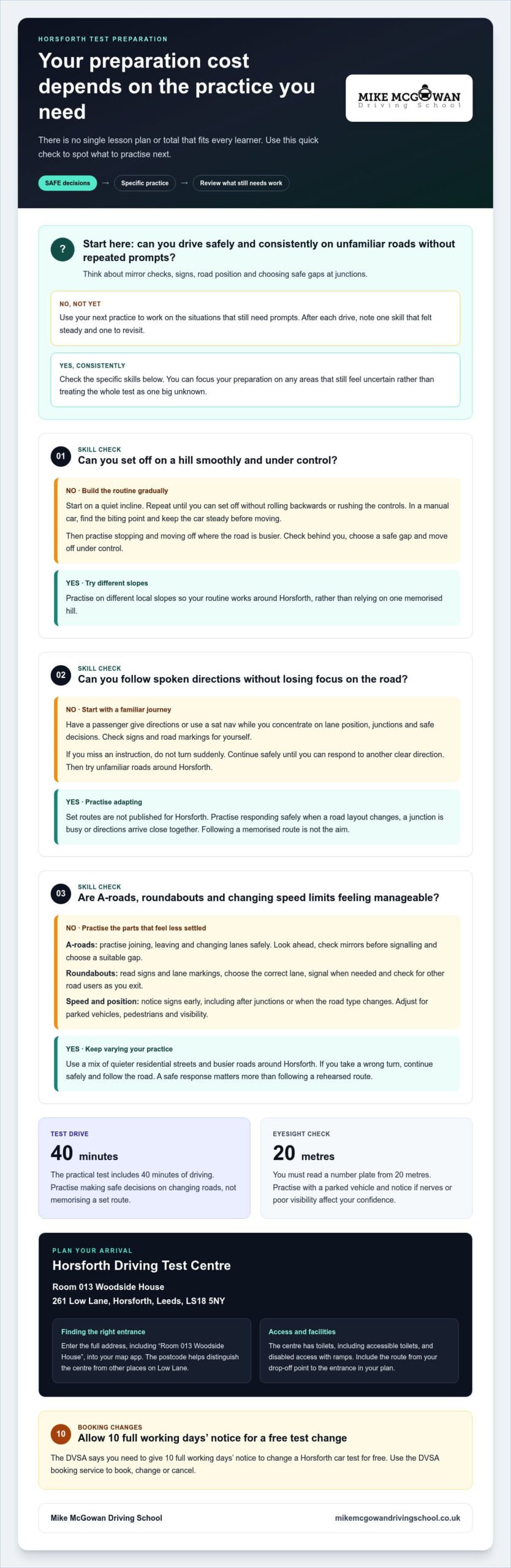
Your total spend on Horsforth driving test centre preparation depends on how much practice you need before you feel ready. Horsforth Driving Test Centre is at Room 013 Woodside House, 261 Low Lane, Horsforth, Leeds, LS18 5NY. There isn’t one lesson plan or total that fits every learner.
It’s reasonable to want a clear idea of costs before committing, especially if you’re nervous about the test. Knowing where you’ll go and what to practise can make preparation feel more manageable.
This guide covers what affects your preparation costs, where to find the centre and which skills to practise, including hill starts and local roads. You’ll also learn how test preparation can focus on the areas where you need more confidence, without assuming every learner needs the same amount of practice.
Key Takeaways
- Work out your preparation budget around the practice you need, rather than assuming every learner needs the same number of lessons.
- Practise the skills that help you feel settled on local roads, including hill starts, junctions and roundabouts.
- Build confidence with sat nav directions and reversing manoeuvres by practising them calmly before test day.
- Review the vehicle safety questions and eyesight check so they feel familiar when your test begins.
- Use lessons to focus on specific gaps in your driving, whether you’re learning from the start or returning after a break.
Driving test preparation and practical skills
Practical preparation for a Horsforth test should focus on skills you can use on unfamiliar roads. Practise making safe decisions without prompts, then review which situations still need attention.
To book, change or cancel a Horsforth car test, use the DVSA booking service. The Driver and Vehicle Standards Agency (DVSA) says you need to give 10 full working days’ notice for a free change.
Assessing practical test readiness
Readiness means driving safely and consistently, even when a road or instruction feels unfamiliar. On a practice drive, notice whether you check mirrors before changing speed or direction, respond to signs and choose safe gaps at junctions without repeated prompts.
Candidates must read a number plate from 20 metres during the eyesight check, according to the Driver and Vehicle Standards Agency (DVSA). Practise reading a parked vehicle’s plate from the required distance, and notice whether nerves or poor visibility affect your confidence.
After each drive, note one skill that felt steady and one to revisit. You might feel comfortable meeting traffic but need more practice positioning at a roundabout. This gives your next session a clear focus, rather than making the whole test feel like one big unknown.
Practising hill starts
Practise smooth hill starts on sloped local roads. Begin on a quiet incline and repeat the manoeuvre until you can set off without rolling backwards or rushing the controls. In a manual car, focus on finding the biting point and keeping the car steady before moving.
Then practise stopping and moving off where the road is busier. Check for vehicles behind you, choose a safe gap and move off under control. The aim is to develop a routine that works on different slopes around Horsforth, not to memorise one particular hill.
Building sat-nav confidence
Practise following spoken directions while keeping your attention on the road. Check signs and markings for yourself. If you miss an instruction, don’t turn suddenly. Continue safely until you can respond to another clear direction.
Start with a familiar journey, then try unfamiliar roads around Horsforth. A passenger can give directions or use a sat nav while you focus on lane position, junctions and safe decisions. The Horsforth driving lessons page offers local context for planning practice in the area.
Set routes aren’t published for Horsforth, and the practical test includes 40 minutes of driving. Practise adapting when a road layout changes, a junction becomes busy or directions arrive close together. Responding safely matters more than following a memorised route.
Horsforth test centre location
Horsforth Driving Test Centre is at Room 013 Woodside House, 261 Low Lane, Horsforth, Leeds, LS18 5NY. Knowing the exact address helps you plan your journey and find the right entrance without searching at test time.
For April 2025 to March 2026, Horsforth’s car test pass rate was 49.7%; Great Britain’s was 50.0%. These figures describe results across each area, not what any individual learner will achieve.
Finding the test centre
Enter the full address, including “Room 013 Woodside House”, into your map app. The postcode LS18 5NY helps distinguish the test centre from other places on Low Lane. If someone is driving you, agree a drop-off point before setting out, then follow the address details to the correct room.
Plan your journey from your starting point in Leeds or elsewhere in West Yorkshire. Allow time for the final walk to Woodside House, and aim to arrive settled rather than rushed. A practice visit can help you recognise the building and work out the approach before test day.
Checking centre facilities
Horsforth test centre has toilets, including accessible toilets, and disabled access with ramps. If you use a wheelchair or have mobility needs, knowing these facilities are available can help you plan your arrival at Room 013. Consider the route from your drop-off point to the entrance as part of that plan.
Allow time to find the correct room and use the facilities before your appointment. Keep your driving licence ready instead of searching through your bag at the entrance. If a parent or friend is accompanying you, agree where they’ll wait while you check in.
Horsforth conducts car tests, motorcycle module 2 tests, ADI part 2 tests and ADI part 3 tests. Check your booking details so you know which test you’re attending and where to go within Woodside House.
If you’re travelling from outside Horsforth, save the full address before setting off and plan your route from a familiar starting point. This leaves you free to focus on the centre entrance and your appointment when you arrive.
Is my test centre supported?
Horsforth preparation is about practising the road conditions you could encounter, not memorising one journey. Local roads, roundabouts and traffic flow all help you develop sound decision-making.
Practising local roads and roundabouts
Busy A-roads feature on Horsforth test routes, so practise joining, leaving and changing lanes safely. Look well ahead, check mirrors before signalling and choose a suitable gap rather than rushing because traffic is waiting behind you.
At a roundabout, approach at a speed that lets you assess signs, lane markings and traffic. Practise choosing the correct lane, signalling when needed and checking for other road users as you exit. If you take a wrong turn, continue safely and follow the road. A calm, safe response matters more than following a rehearsed route.
Speed limits can change between roads, so use signs and the road layout to judge the limit. Practise spotting signs early, especially after a junction or when entering a different type of road. Look for parked vehicles, pedestrians and changes in visibility, then adjust your speed and position to suit the conditions.
Rather than repeating only the easiest streets, vary your practice around Horsforth. Include quieter residential roads, busier routes and roundabouts. The DVSA does not publish set routes for Horsforth, so understanding road signs and responding to conditions is more useful than learning a route by heart.
Using local mock tests
A mock test with a local instructor gives you the chance to practise making decisions without step-by-step prompts. Treat it as a helpful check, not a verdict. Afterwards, review specific moments such as lane choice, mirror checks or hesitation at a busy junction.
For each major route, aim for 3-5 rehearsals at different times of day. This helps you experience how traffic and visibility can change, rather than expecting the same drive every time. Ask the instructor to include A-roads and roundabouts, then note where you felt rushed or unsure.
Test timing affects the traffic you encounter. Practising at different times helps you handle both quieter roads and heavier traffic, including queues near junctions. On a busier drive, leave more space, check mirrors before slowing and wait for a safe gap. On quieter roads, keep scanning for parked vehicles and people crossing.
Use a mock test to give your next practice session more focus. Choose one or two areas to work on, then repeat the drive with those points in mind. If roundabouts feel difficult, practise approaches and exits separately before combining them on a local drive. This steady review helps you judge progress by your actions, not just your nerves.
Sat nav directions and manoeuvres in the UK driving test
Practise following directions while staying aware of signs, traffic and road position. The independent driving section lasts about 20 minutes, and includes one reversing manoeuvre.
Prepare by practising sat nav directions, reversing and the vehicle safety questions. Keep your attention on safe driving, even if you miss an instruction or feel unsure.
Practise following sat nav directions as part of your test preparation. Practise with a sat nav on an unfamiliar journey, but don’t treat its voice as your only guide. Check road signs and markings yourself, and keep your eyes on the road. If you miss a turn, carry on safely rather than making a sudden manoeuvre.
During independent driving, focus on the next safe decision rather than remembering every direction. For example, if a sat nav tells you to turn left but the road markings show a different lane arrangement, follow the markings and choose a safe position. If an instruction comes late, continue along the road until you can respond safely. A missed turn is easier to manage than a rushed one.
For reversing, practise slowly in a quiet place before adding the pressure of other traffic. Check around the car before moving, keep your speed controlled and look in the direction you’re travelling. Use mirrors to support your observations, not replace looking around. If you lose sight of the space or another road user appears, stop and reassess before continuing.
The test includes one reversing manoeuvre. Practise parking and reversing in more than one setting, such as between parked cars or into a marked space. The exact set-up can vary, so learn to control the car and observe carefully rather than relying on a memorised sequence. Ask a supervising driver or instructor to watch for missed checks and unclear positioning.
Practise the vehicle safety questions alongside your driving. The practical car test includes one question before driving and one while driving. For the first, listen to the wording and explain the relevant check clearly. For the question on the move, keep control of the car and complete the requested action only when it’s safe.
Practise answering aloud before test day, then repeat the answers during a drive. For example, pair a spoken safety check with a quiet stretch of road so the action doesn’t distract you from steering or observation. A steady routine helps you handle directions, reversing and questions as separate tasks within one drive.
Show me, tell me vehicle safety questions
The practical car test includes one vehicle safety question before driving and one while driving. Knowing how to explain a check and carry out an action can make these moments feel more familiar.
Show me, tell me questions were added to the UK driving test in 2003. For the tell me question, you explain a vehicle safety check before setting off. For the show me question, you demonstrate an action whilst driving, when it’s safe.
Practise both types of question aloud. A clear explanation matters more than memorising a long speech. Use official practice materials, then make sure you understand the purpose of each check. If you’re unsure, revisit the question and practise explaining it in your own words.
For a tell me answer, listen to the whole question before responding. Identify what the examiner wants you to explain, then describe the steps in a sensible order. For example, if asked how you would check something, explain the check rather than guessing at a result. Keep your answer focused and leave out details you don’t understand.
For a show me question, practise locating and using the relevant control before your test. Learn where the controls are in the car you’ll drive, so you’re not searching while moving. Keep your attention on the road and demonstrate the action only when it’s safe. If traffic or a junction needs your attention, safe driving comes first.
A simple practice routine can help. Choose one tell me question and answer it aloud, then practise one show me action with a supervising driver. Repeat the routine on another drive so you can recall the answer without memorising every word. Ask someone listening to flag unclear explanations, not to put you under pressure.
If you’re learning in a different car from the one you’ll use for practice, take time to become familiar with its controls. Find the relevant switches before moving, then practise using them safely with support. A calm walk-through can help you remember where each control is when the question comes up.
Before your next drive, choose one question that feels difficult and practise answering it clearly. Then check that you can carry out the related action without losing focus on the road.
Mike McGowan Driving School: Beginner Driving Lessons
Mike McGowan Driving School offers Beginner Driving Lessons for learners starting from the basics. If you’re already learning, Automatic Driving Lessons or Manual Driving Lessons can match the car you want to drive. Refresher Lessons can help if you’ve had a break or want to rebuild confidence before returning to local roads.
Tell your instructor which parts feel least comfortable, such as busy roundabouts, hill starts or following sat nav directions. This gives you a clear place to begin and helps you make practical use of each lesson. You don’t need to have every test skill mastered before asking for support.
For details about learning in the area, visit mikemcgowandrivingschool.co.uk or contact Mike McGowan Driving School.
Make your next practice session count
Horsforth driving test centre preparation works best when you turn uncertainty into a clear practice plan. Before your next drive, write down the situations that still take extra thought, such as choosing a gap, following directions or recovering after a missed turn. Take the list with you and focus on one area at a time.
This also gives you a more useful way to review progress than asking whether you feel completely confident. Notice what you can now manage without prompts, then choose the next skill to strengthen. If you’re worried about failing again, use that concern to identify what needs practice, not to judge your ability.
A calm, focused session is a constructive next step. You can build readiness steadily, at a pace that works for you.
Each practice drive can help you feel better prepared for the next.
Frequently Asked Questions
How much does it cost?
The total depends on how much practice you need and which skills need attention. Lesson costs vary by provider, and extra practice can affect your overall budget. Before planning, list what you’ve already paid for and what remains, such as lessons or test-related costs. Mike McGowan Driving School offers beginner, automatic and manual lessons. Contact Mike directly for current costs before arranging tuition.
Where is Horsforth Driving Test Centre and how do I get there?
Horsforth Driving Test Centre is at Room 013 Woodside House, 261 Low Lane, Horsforth, Leeds, LS18 5NY. Put the full address and postcode into your map app, then check the route from your starting point in Leeds. If someone is dropping you off, agree where to meet beforehand. Allow time for traffic and finding the correct room, rather than arriving flustered.
What roads and routes are commonly used for driving tests from Horsforth test centre?
There isn’t a published set route to learn by heart. Busy A-roads feature on Horsforth test routes, alongside local roads and junctions. Practise reading signs, choosing lanes and adjusting your speed as the road changes. For example, if a route takes you from a residential street onto a busier road, focus on safe observations and joining traffic smoothly, not predicting the examiner’s next turn.
What manoeuvres can be tested at Horsforth Driving Test Centre?
You’ll complete one reversing manoeuvre during the practical car test. Practise reversing slowly, checking around the car and stopping if another road user enters the area. The space and surrounding traffic can differ, so focus on observation and control rather than memorising a fixed sequence. A useful practice drive includes reversing in a quiet place first, then in settings with parked vehicles nearby.
What should I bring and do on the day of a UK practical driving test?
Take your driving licence and booking details, and plan your journey to Woodside House in advance. Aim to arrive about 10 minutes early, leaving time to find the centre and settle. Before setting off, check that you have everything together and know who is taking you there. If nerves build, pause, breathe steadily and focus on the next practical step rather than the whole test.
What are the most common reasons for failing a driving test in Leeds and Horsforth?
There isn’t a reliable local ranking of individual reasons here. In practice, errors can happen when observation, positioning or decisions become inconsistent. For example, a learner might approach a junction too quickly, miss a mirror check before changing position or hesitate when choosing a safe gap. After a mock test, ask for clear examples of any repeated issue. Then practise that skill in context on your next drive.
What local road conditions and hazards should learners practise around Horsforth?
Practise busy A-roads, roundabouts, sloped roads and residential streets around Horsforth. Each presents a different task: joining moving traffic, choosing a lane, moving off smoothly uphill or passing parked cars safely. Rain, poor visibility and changing traffic levels also affect what you can see and how much space you need. On every drive, scan ahead, check signs and adjust your speed to the conditions.
Disclaimer
This article is intended as general guidance for learner drivers and does not replace official DVSA advice or a lesson with a qualified instructor. Rules, test requirements, and local test centre procedures can change, so always check GOV.UK or speak to your instructor for the most current information. Mike McGowan Driving School accepts no responsibility for outcomes based solely on the content of this article.